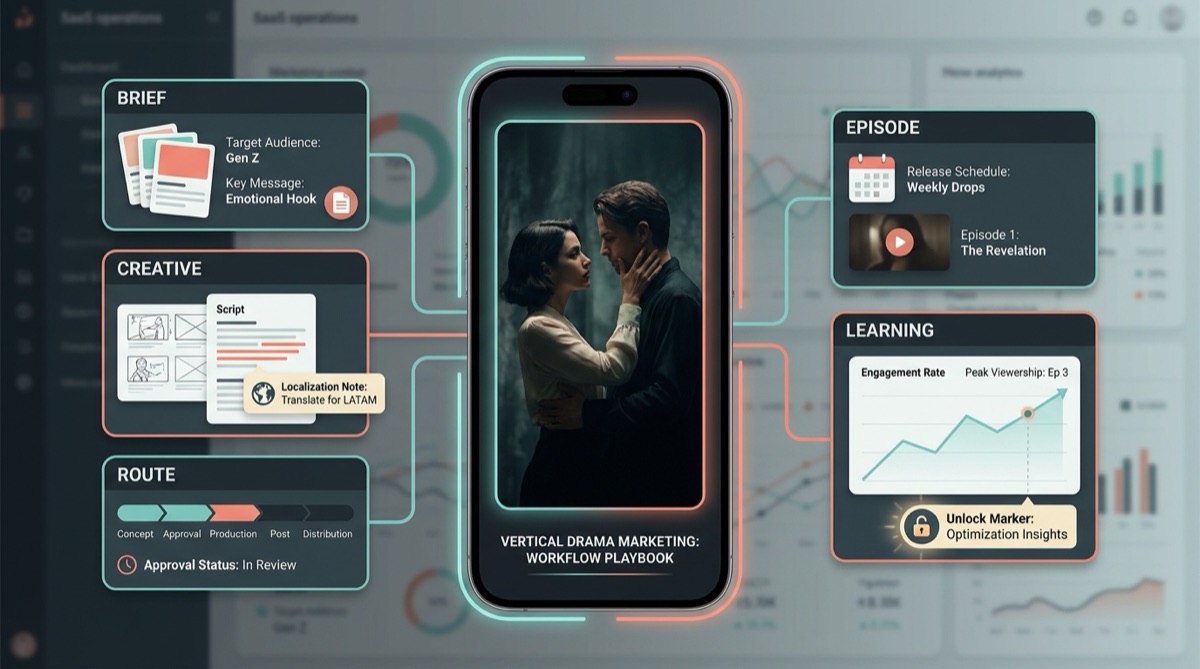
Vertical drama marketing often breaks in the spaces between teams.
The producer believes the campaign is selling a revenge promise. The creative strategist cuts three versions around humiliation and power reversal. The media buyer uploads the assets under a naming convention that only partly matches the brief. The localization owner changes the title so it feels native. The product route opens on a softer romance synopsis. The analyst sees a performance dip, but cannot tell whether the weak signal came from the hook, the route, the subtitle pass, the episode opening, or the unlock moment.
That is not a creativity problem. It is a handoff problem.
This vertical drama marketing: workflow playbook gives short drama operators a handoff spine: a simple control system that keeps the story promise traceable from the first campaign brief to the final learning record. It is built for growth leads, producers, creative strategists, localization managers, analysts, product owners, and monetization owners who need one shared operating record instead of five disconnected workstreams.
Use this guide with the campaign operations kit, the daily creative testing loop, the launch-day workflow, the measurement and attribution playbook, and the weekly learning library. Those articles explain how to launch, test, measure, scale, and archive learning. This article focuses on the connective layer that makes those workflows reliable.
In other words, this vertical drama marketing: workflow playbook is not another dashboard. It is the operating spine that prevents a campaign from changing identity as it moves from story to ad to app experience.
Vertical Drama Marketing: Workflow Playbook for the Handoff Spine
The handoff spine has one job:
Keep the same emotional promise, audience context, route, episode package, offer state, and decision question visible at every handoff.
A vertical drama team can move quickly only when every owner knows what must stay fixed and what is allowed to change. Without that discipline, a campaign test becomes impossible to interpret. A click winner may be attached to the wrong title page. A localized version may look weak because the first episode still carries source-language subtitles. A paid unlock may underperform because the ad promised one cliffhanger and the paywall arrived after another.
This vertical drama marketing: workflow playbook uses six gates.
| Gate | Handoff | Core question | Required output |
|---|---|---|---|
| 1. Promise lock | Strategy to production | What exact emotional contract are we selling? | Promise card |
| 2. Creative transfer | Production to media | Which asset expresses that promise and which variables changed? | Creative handoff sheet |
| 3. Route transfer | Media to product | Where should the viewer land and what context must survive? | Destination manifest |
| 4. Episode transfer | Product to content | Does the opening episode fulfill the same promise? | Episode package check |
| 5. Offer transfer | Content to monetization | Does the unlock point fit the viewer expectation? | Offer-state note |
| 6. Learning transfer | Analytics to next brief | What should change next without losing lineage? | Decision and learning card |
The goal is not to slow the team down. The goal is to remove the rework caused by ambiguous handoffs.
Gate 1: Lock the Promise Before Production
The first handoff happens before a single asset is made. The campaign lead and producer need to agree on the story promise in plain language.
A story promise is not a genre label. "Billionaire romance," "revenge," or "werewolf" is too broad. A useful promise tells the team what emotional contract the viewer is being asked to accept.
| Broad idea | Locked campaign promise |
|---|---|
| CEO romance | A humiliated assistant reveals she controls the company that fired her |
| Revenge drama | A betrayed wife returns with proof that destroys the family lie |
| Secret identity | The woman everyone dismissed is the hidden heir with legal power |
| Second chance | The man who abandoned her must win trust after the truth is exposed |
| Forbidden love | A protector breaks rank when loyalty and desire collide |
The promise card should include:
- Promise sentence: the emotional contract in one line.
- Viewer wound: humiliation, betrayal, abandonment, danger, longing, debt, or exclusion.
- Reversal: what changes the power balance.
- Proof moment: the visual, line, document, or action that makes the promise believable.
- Protected constants: market, title, episode package, destination, offer, or audience elements that should not change during the test.
- Allowed variables: hook format, opening cut, caption, thumbnail, voice-over, or localization choice.
- Decision question: what the campaign must teach the team.
This is the first rule of the vertical drama marketing: workflow playbook: never hand off a campaign as a vague content type. Hand off a promise, a proof moment, and a decision.
Copyable Promise Card
Campaign ID:
Series:
Market and language:
Primary audience:
Promise sentence:
Viewer wound:
Power reversal:
Proof moment:
Protected constants:
Allowed variables:
Primary decision:
Stop condition:
Owner:
For an AI-native vertical drama brand such as Nuvelle, this discipline matters because production can branch quickly. A fast pipeline is useful only when each branch preserves enough identity to be evaluated later.
Gate 2: Transfer Creative Without Losing Lineage
The second handoff moves from production to media. This is where teams often lose the parent-child relationship between creative versions.
The media buyer should not receive a folder called "final ads." They should receive a creative handoff sheet that explains which promise each asset carries, what changed, and what must be compared.
| Field | Why it matters |
|---|---|
| Parent promise ID | Keeps all variants tied to the same emotional contract |
| Creative lineage ID | Shows which assets belong to the same test family |
| Version ID | Identifies the exact upload-ready file |
| Changed variable | Explains what the test is actually comparing |
| Protected constants | Prevents accidental comparison of unrelated packages |
| Caption and CTA | Confirms the message matches the destination |
| Safe-zone status | Avoids mobile overlay or subtitle problems |
| Disclosure status | Confirms ad, sponsor, or creator relationships are handled where relevant |
TikTok's Creative Center can help teams observe platform-native creative patterns and creative tooling, but the platform should not become the only memory layer. A vertical drama campaign needs internal lineage because the important unit is not just an ad file. It is the relationship between promise, episode, route, localization, and offer.
FTC guidance for influencer and endorsement disclosures is also a useful guardrail when a campaign uses creator-style testimonials, paid endorsements, or sponsored creator content. The operational point is simple: disclosure expectations should be checked before the asset leaves creative, not after media upload.
Creative Handoff Sheet
| Creative ID | Parent promise | Format | Changed variable | CTA | Route | Status |
|---|---|---|---|---|---|---|
VD-MX-014-A | Public humiliation to ownership reveal | Direct scene | Opening moment | Watch episode 1 | Series detail page | Approved |
VD-MX-014-B | Public humiliation to ownership reveal | Reaction-led | First face reaction | Watch episode 1 | Series detail page | Approved |
VD-MX-014-C | Public humiliation to ownership reveal | Text-led recap | Caption framing | Watch episode 1 | Series detail page | Hold for subtitle review |
Do not compare version A to version C if C is also using a different destination, title page, or offer. That turns a creative test into a package test.
This vertical drama marketing: workflow playbook treats lineage as a production asset. Every future scale decision depends on knowing which elements moved and which elements stayed fixed.
Gate 3: Transfer the Route With Context Intact
The third handoff moves from media to product or growth ops. The viewer has clicked. The question is whether the campaign context survives the route.
Google Analytics provides a Campaign URL Builder that is useful for consistent campaign parameters, and Google Analytics recommends sending defined events with prescribed parameters when those events fit the behavior being measured. For vertical drama marketing, generic tagging is only the first layer. The route also needs story-specific context.
At minimum, the destination manifest should preserve:
campaign_id
series_id
market_id
language
promise_id
creative_lineage_id
creative_version_id
destination_id
episode_package_id
offer_id
cohort_window
The destination manifest should answer five questions:
- Does the ad click open the expected title or route?
- Does the title, poster, synopsis, and first CTA continue the same promise?
- Does the route work for app-installed, app-not-installed, signed-out, slow-network, and unsupported-device states?
- Does the route preserve the campaign and creative context for measurement?
- Does the route show the correct language and offer state for the market?
Destination Manifest
| Route element | Pass condition | Failure response |
|---|---|---|
| Public URL or deep link | Opens the expected title or episode route | Hold or cap spend |
| Fallback route | Preserves title context if app route fails | Repair before scale |
| Title metadata | Matches campaign promise, market, and language | Rewrite or localize |
| Episode package | Starts the expected episode version | Attach correct package |
| Offer state | Free, coin, subscription, trial, or unlock state matches ad expectation | Fix offer copy or route |
| Measurement context | Required IDs appear in analytics and campaign registry | Mark tracking confidence low |
This is where the vertical drama marketing: workflow playbook protects the team from false creative conclusions. If a betrayal hook appears weak because the click lands on a generic app page, the creative did not fail cleanly. The route broke the test.
Gate 4: Transfer the Episode Package, Not Just the Title
The fourth handoff moves from product route to content experience. A viewer does not judge the campaign by the title page alone. She judges whether the first episode fulfills the promise fast enough to keep watching.
For vertical drama, the episode package should be treated as the release unit attached to the campaign. That package includes the title, poster, synopsis, opening episode, subtitle or dub state, cliffhanger boundary, and unlock point.
Use this episode transfer check.
| Package field | Question |
|---|---|
| Opening scene | Does the promised conflict appear early enough? |
| Character framing | Does the viewer understand who has power and who is wounded? |
| Proof moment | Does the episode validate the ad promise instead of replacing it? |
| Subtitle or dub | Is the language readable, timed, and emotionally native? |
| Cliffhanger boundary | Does the episode end where the next action feels earned? |
| Continuation path | Is the next episode easy to start? |
| Package version | Is this the same version approved in the campaign record? |
The episode packaging package P&L is useful when cost and ROI decisions depend on the release unit. For this handoff workflow, the practical rule is narrower: do not let a campaign sell one episode package while the product experience serves another.
Episode Package Handoff Note
Episode package ID:
Opening episode:
Promised beat present by:
Subtitle/dub version:
Cliffhanger boundary:
Unlock boundary:
Known risks:
QA owner:
Approved for campaign IDs:
This vertical drama marketing: workflow playbook asks the content owner to sign off on promise continuity, not just asset availability. A file can be technically ready and still fail the campaign if it does not carry the same emotional contract.
Gate 5: Transfer the Offer State Before the Unlock Moment
The fifth handoff moves from content experience to monetization. The question is not only whether the paywall works. The question is whether the commercial ask arrives at a moment that fits the story promise and viewer expectation.
For a vertical drama campaign, offer state can change the meaning of the test. A hook that performs well when three episodes are free may behave differently when the unlock arrives after episode one. A localized campaign may need different offer copy even when the product price or coin logic stays the same. A campaign that promises "watch the full episode" should not send the viewer into a confusing unlock path before the promised scene is fulfilled.
Record these fields before launch:
| Offer field | What to document |
|---|---|
| Offer ID | Stable identifier for the unlock, coin, subscription, trial, or hybrid treatment |
| Free boundary | What the viewer can watch before the first ask |
| Unlock boundary | Which episode, scene, or cliffhanger triggers the ask |
| Value statement | Why continuing now is worth the action |
| Market language | Localized offer copy and currency/points language where applicable |
| Trust elements | Payment clarity, cancellation copy, support route, and legal copy |
| Measurement event | Paywall view, checkout start, purchase, subscription, or paid unlock |
Google Analytics includes recommended events such as purchase and checkout-related events for commerce measurement. A short drama team may still need custom properties to preserve series, promise, episode package, and offer context. The important rule is consistency: the offer event should carry enough context for the analyst to connect paid behavior back to the campaign promise.
Offer-State Review
Before a campaign goes live, ask:
- Does the ad create the correct expectation about free viewing or unlock behavior?
- Does the title page use language that matches the offer state?
- Does the first unlock appear after enough promise fulfillment?
- Does the event taxonomy distinguish unlock view, checkout start, and paid action?
- Does the market version explain the offer clearly without burying required disclosure or support details?
This vertical drama marketing: workflow playbook prevents monetization from being judged in isolation. If the viewer never received the promised emotional payoff, the offer may look weak even when the paywall design is fine.
Gate 6: Transfer Learning Back Into the Next Brief
The final handoff moves from analytics to the next production brief. This is where many teams lose the value of testing.
A campaign result should not end as "winner," "loser," or "needs more data." It should become a next action tied to the original promise, creative lineage, route, episode package, and offer state.
Use five result labels:
| Result label | Use when | Next action |
|---|---|---|
| Produce branch | Promise and handoff chain are coherent | Build adjacent creative versions |
| Repair route | Click or destination context broke | Fix path before more creative |
| Repair package | Episode opening failed to fulfill promise | Recut or repackage episode start |
| Repair localization | Language, subtitle, title, or offer copy weakened continuity | Localize the full package, not just captions |
| Retire promise | Promise failed under clean conditions | Archive with reason and avoid repeat testing |
The weekly learning library is the permanent record. The handoff spine supplies the clean inputs that make that library useful.
Decision Card
Campaign ID:
Promise ID:
Creative lineage:
Route:
Episode package:
Offer state:
First meaningful break:
Tracking confidence:
Decision label:
Next brief:
Protected constants for next test:
Allowed variable for next test:
Owner:
Review date:
This final card is what turns the vertical drama marketing: workflow playbook into a repeatable system. The next creative request should inherit the correct lineage instead of starting from memory.
The 48-Hour Handoff Workflow
For teams that need a simple operating rhythm, run the handoff spine over 48 hours.
| Time | Owner | Action | Output |
|---|---|---|---|
| Day 1, 9:00 | Campaign lead | Lock promise, market, decision, stop condition | Promise card |
| Day 1, 11:00 | Producer and creative strategist | Build approved variants and note changed variables | Creative handoff sheet |
| Day 1, 2:00 | Product or growth ops | Confirm route, fallback, IDs, title page, and offer state | Destination manifest |
| Day 1, 4:00 | Content and localization | Check episode package, subtitles/dub, cliffhanger, market fit | Episode handoff note |
| Day 2, 9:00 | Analyst | Run measurement smoke test and route QA | Tracking confidence note |
| Day 2, 12:00 | Media owner | Open controlled delivery with cap and stop conditions | Live campaign record |
| Day 2, 5:00 | Campaign lead | Classify first break and next action | Decision card |
This workflow pairs naturally with the 9-to-5 launch-day workflow. The difference is timing. Launch day governs execution in the room. The handoff spine governs the evidence that must be ready before and after that launch.
Common Handoff Failure Modes
Use this table when a campaign result is hard to interpret.
| Symptom | Likely handoff failure | What to inspect first |
|---|---|---|
| Strong clicks, weak destination views | Route or fallback problem | Deep link, load, geo access, app-installed state |
| Strong destination views, weak episode starts | Promise discontinuity | Title, poster, synopsis, first CTA |
| Strong starts, weak progress | Episode package problem | Opening pace, promised beat, subtitles, sound-off comprehension |
| Strong progress, weak continuation | Cliffhanger or next-episode problem | Episode boundary and next card |
| Strong paywall reach, weak paid action | Offer-state problem | Offer clarity, value timing, payment trust |
| Conflicting dashboard reads | Identity or event problem | Campaign IDs, creative lineage, event properties |
| Localized version underperforms source | Partial localization | Title, captions, route, subtitles, offer language |
The discipline is to diagnose the earliest meaningful break. Do not rewrite creative when the route is broken. Do not relocalize captions when the title page is still in the wrong language. Do not change the offer when the episode opening never fulfilled the ad promise.
Handoff Spine Checklist
Before a campaign is considered ready, every owner should be able to answer yes.
- The campaign has one locked promise sentence.
- Every creative version has a parent promise ID and changed-variable note.
- The destination route preserves campaign, creative, market, episode, and offer context.
- The title page continues the same emotional promise as the ad.
- The episode package contains the promised beat early enough to feel honest.
- Subtitle, dub, title, synopsis, and offer copy match the target market.
- The unlock or paid action arrives after enough value has been delivered.
- Analytics can connect promise, creative, route, episode package, and offer state.
- The decision card can produce one next brief within 24 hours.
- The learning library receives the final result, proof, and next action.
This is the compact version of the vertical drama marketing: workflow playbook. If any item fails, the campaign can still run as an experiment, but the team should label the evidence as compromised.
Where This Fits in the Nuvelle Operating System
Nuvelle's approved positioning is an AI-native vertical short drama brand built around fast story production, mobile-first episodes, and high-emotion genres such as romance, revenge, betrayal, hidden identity, and power reversal. That makes handoff quality especially important. Speed creates more tests, but only traceable tests compound.
The broader Nuvelle SEO library already covers the campaign system from several angles:
- Use the stages 1-3 workflow to define story packaging and early funnel logic.
- Use the operations workflow to manage stages 4-7 across scaling, localization, retention, and portfolio review.
- Use the measurement playbook when event taxonomy or attribution is the weak point.
- Use the daily creative testing loop when the team needs same-day creative decisions.
- Use the weekly decision cadence when the issue is meeting rhythm and decision quality.
- Use the weekly learning library when the issue is preserving campaign learning.
This handoff-spine article sits between those guides. It explains how to keep the same campaign identity alive while work passes between functions.
Final Takeaway
A vertical drama team does not need a heavier process for every campaign. It needs a clearer spine.
The best use of this vertical drama marketing: workflow playbook is to protect the story promise as it moves through production, media, product, content, localization, monetization, analytics, and the next brief. When each handoff preserves the same promise, route, episode package, offer state, and decision question, the team can move fast without losing the meaning of the test.
That is how vertical drama marketing becomes cumulative. Each campaign creates more than assets and spend. It creates reusable evidence for the next story, the next market, and the next production decision.