Vertical drama marketing does not usually break because a team lacks ideas. It breaks because ideas enter the system faster than the team can name, test, interpret, and reuse them.
One producer wants a betrayal hook. A media buyer wants three shorter cuts. A localization manager sees a Spanish-language opportunity. A monetization owner wants to know whether the same campaign can support a paid unlock. By Friday, the team may have more assets, more spend, and less clarity.
This vertical drama marketing: workflow playbook is for the daily creative testing loop. It gives short drama operators a repeatable way to turn story ideas into controlled hook tests, route checks, learning records, and next-day production decisions.
Use it alongside the stages 1-3 vertical drama marketing workflow, the stages 4-7 operations workflow, the campaign operations kit, the measurement and attribution playbook, the launch-day workflow, and the first-winner scale workflow. Those guides cover the full campaign system, launch room, evidence chain, and scale sprint. This guide covers the operating loop that happens every working day: what gets tested, what gets rejected, what gets made, and what the team learns before the next batch.
Vertical Drama Marketing: Workflow Playbook for the Daily Creative Testing Loop
The daily loop should answer one question:
Which story promise deserves tomorrow's production capacity because today's evidence made the next test clearer?
That question is more useful than asking which ad had the highest click rate. A clickable hook may create weak episode starts. A slower hook may produce better continuation because it sets the story contract honestly. A localized variant may look promising until the destination fails the language handoff.
For operators, the daily vertical drama marketing: workflow playbook should be treated as a production control system, not a creative inspiration document.
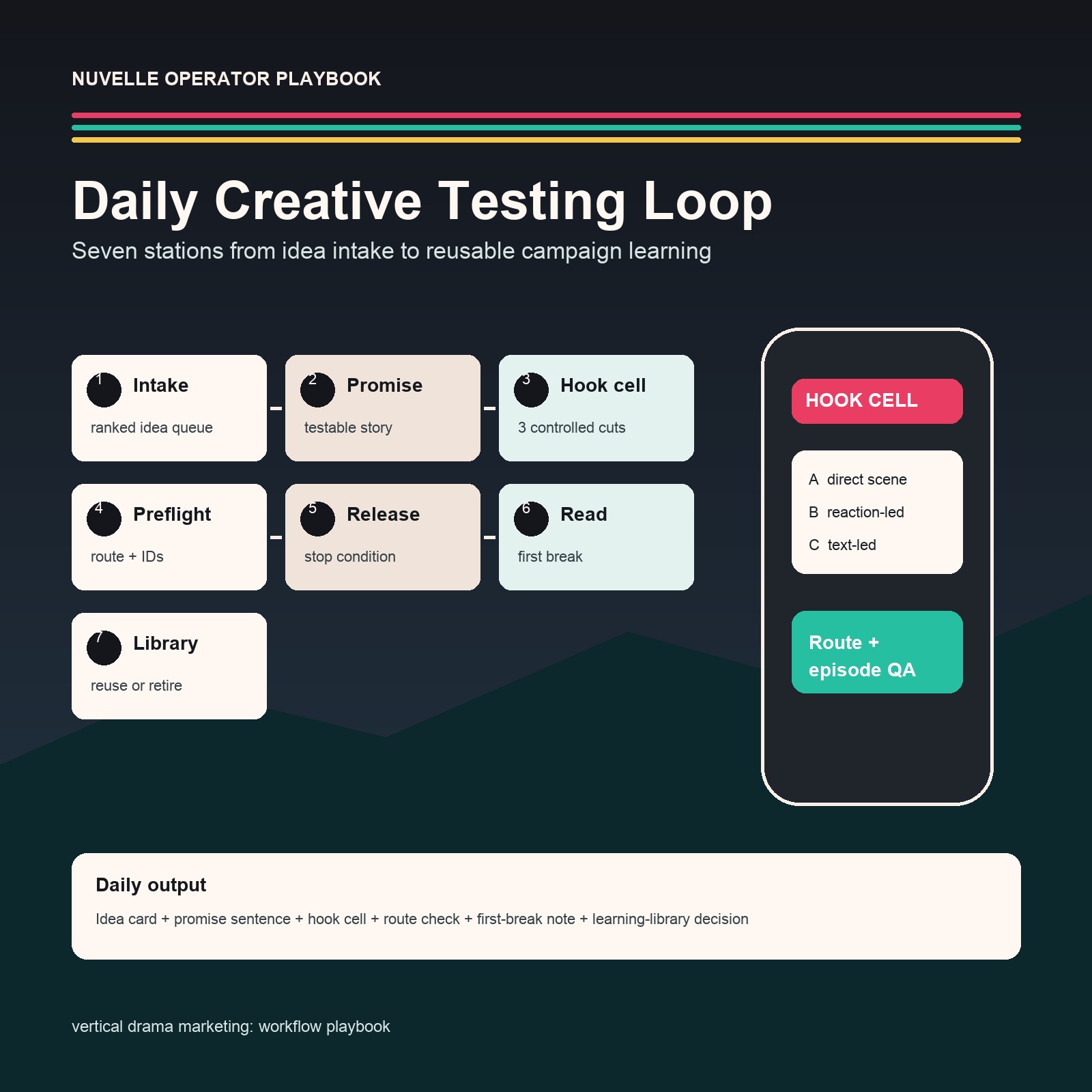
This vertical drama marketing: workflow playbook uses seven daily stations.
| Station | Owner | Daily output |
|---|---|---|
| 1. Intake | Campaign lead | Ranked idea queue |
| 2. Promise framing | Producer and creative strategist | Testable story promise |
| 3. Hook cell | Creative team | Three controlled creative variants |
| 4. Preflight | Growth ops and localization | Approved route, IDs, and language fit |
| 5. Controlled release | Media owner | Limited delivery with stop conditions |
| 6. Same-day read | Analyst and campaign lead | First-break note |
| 7. Learning library | Campaign lead | Reuse, revise, retire, or escalate decision |
The value of the vertical drama marketing: workflow playbook is the closed loop. Ideas do not simply become more videos. They become named tests, and tests become reusable evidence.
Station 1: Run Creative Intake Like a Queue, Not a Brainstorm
Most short drama teams can generate hooks quickly. The hard part is deciding which hooks deserve production time.
Create one daily intake queue with four lanes.
| Lane | What belongs here | Example |
|---|---|---|
| New promise | A fresh emotional contract for a title or market | "Rejected wife reveals she owns the company" |
| Execution branch | A new way to show an already proven promise | Dialogue opening versus narrator recap |
| Funnel repair | A test designed to fix a diagnosed break | New title page after strong clicks but weak starts |
| Market adaptation | A localized or audience-specific version | Spanish title, captions, and synopsis for the same revenge setup |
Every idea needs a short card before it can enter production.
Idea name:
Series:
Market and language:
Hook family:
Story promise:
Viewer proof moment:
Destination:
Episode package:
Offer state:
Why now:
Decision needed:
Stop condition:
Do not accept "make five more versions" as an intake card. The queue should capture the reason for the test. If the reason is unclear, the idea stays in parking until someone can state the promise, destination, and decision.
This is the first discipline in the vertical drama marketing: workflow playbook: production capacity should follow a ranked queue, not the loudest request.
Station 2: Turn the Idea Into a Testable Story Promise
A vertical drama ad sells an emotional contract. The viewer should know why she is watching within seconds: revenge, rescue, exposure, forbidden desire, second chance, hidden power, family betrayal, or another recognizable promise.
Before making assets, rewrite the idea as a promise sentence.
| Weak idea | Testable promise |
|---|---|
| "CEO romance hook" | "A public humiliation turns into a power reversal when the assistant reveals she controls the company." |
| "More werewolf versions" | "The rejected mate refuses the bond and forces the alpha to prove loyalty." |
| "Spanish version" | "A betrayal-and-revenge promise will be tested with native title, caption, synopsis, and route language." |
| "Try faster edits" | "The same secret-marriage reveal will be tested through a direct confrontation opening instead of a narrator recap." |
A testable promise has four parts:
- Character position: who has power at the start.
- Emotional wound: humiliation, betrayal, abandonment, danger, debt, or longing.
- Reversal or choice: what changes the stakes.
- Viewer reason: why the next episode feels necessary.
The promise sentence becomes the control record. It should appear in the creative brief, campaign ID, destination map, and learning library.
Station 3: Build a Hook Cell, Not a Random Batch
A hook cell is a small set of creative variants built around one controlled promise. It prevents the team from comparing unrelated ideas and pretending the result is clean.
Build three variants per cell.
| Variant | What changes | What stays fixed |
|---|---|---|
| A. Direct scene | Opens on the conflict or reveal | Promise, title, destination, episode package, offer |
| B. Reaction-led | Opens on the rival, hero, or heroine reacting | Promise, title, destination, episode package, offer |
| C. Text-led or narrator-led | Opens with caption, confession, or recap framing | Promise, title, destination, episode package, offer |
Keep the first cell small. If the team changes the promise, market, route, episode opening, and offer at the same time, the test is no longer a hook cell. It is a new campaign package.
Use a short creative spec:
| Field | Rule |
|---|---|
| Opening moment | One recognizable story beat in the first seconds |
| Proof | A visual, line, document, face reaction, threat, or reversal |
| Caption | Readable without sound and consistent with the promise |
| CTA | Matched to the destination and offer state |
| Cut length | Defined before production |
| Safe zones | Mobile captions, face visibility, and app-store overlays checked |
| Lineage | Parent promise ID and version IDs assigned before upload |
TikTok's Creative Center can be useful for observing platform-native formats, pacing, and opening conventions. Treat it as a reference library, not a substitute for your own promise system.
This is where the vertical drama marketing: workflow playbook protects creative speed from becoming creative noise.
In this vertical drama marketing: workflow playbook, the hook cell is the smallest useful production unit. It is large enough to compare execution and small enough to preserve learning.
Station 4: Preflight the Full Promise Path
The daily loop should not release a creative variant until the full viewer path is checked.
Use a promise-path preflight.
| Path element | Pass condition | Failure response |
|---|---|---|
| Creative | Promise, caption, thumbnail, CTA, and version ID match the brief | Quarantine the asset |
| Link | Campaign parameters and deep link route are correct | Hold release or cap spend |
| Destination | Title, poster, synopsis, and first CTA continue the same promise | Fix packaging before traffic |
| Episode start | The promised conflict appears early enough to feel fulfilled | Recut or choose a better package |
| Language | Ad, page, subtitle or dub, offer copy, and fallback route match the target market | Route to localization repair |
| Offer | Free, coin, subscription, or unlock state matches the ad expectation | Fix offer copy before release |
| Measurement | Required IDs appear in analytics or the campaign registry | Hold or mark tracking confidence low |
Google Analytics documentation on campaign URL parameters and recommended events can help teams standardize tracking. The operational rule is simpler: the team must be able to trace promise, creative, route, episode package, and offer through the first meaningful action.
The preflight should take minutes, not hours. If it takes hours, the system is missing a launch manifest or controlled naming convention.
Station 5: Release With a Daily Stop Condition
Controlled release is not just a budget setting. It is a decision boundary.
Each hook cell needs one primary signal and at least two guardrails.
| Signal type | Example question |
|---|---|
| Primary signal | Which variant creates the strongest qualified episode starts per destination view? |
| Guardrail 1 | Does episode-one progress remain acceptable? |
| Guardrail 2 | Does continuation or unlock exposure collapse for any variant? |
| Data-quality guardrail | Are campaign IDs, route checks, and event properties intact? |
Avoid naming a winner from the top of the funnel alone. The point is not to find the most clickable betrayal line. The point is to find the story promise and execution that make viewers continue.
Use three daily stop conditions:
- Route stop: a creative sends users to the wrong page, app route, title, or language.
- Promise stop: the ad promise is not fulfilled by the destination or episode opening.
- Evidence stop: IDs, events, or cohort boundaries are too broken to interpret.
A test can be paused without being declared bad. Pausing protects the learning loop from polluted evidence.
Station 6: Write a Same-Day First-Break Note
The same-day read should be short. It is not a full performance report. It is a decision note that tells tomorrow's production team what to do.
Use this format.
Date:
Hook cell:
Promise:
Market:
Variants:
Primary signal:
First meaningful break:
Tracking confidence:
Decision:
Next production request:
Owner:
Review date:
The first meaningful break should be diagnosed in order.
| Break location | What to inspect first |
|---|---|
| Impressions or delivery | Platform review, audience size, placement, budget cap |
| Click to destination | Link, page load, device fallback, geo availability |
| Destination to episode start | Title, poster, synopsis, CTA, sign-in friction |
| Episode start to progress | Opening pace, subtitle load, comprehension, promised scene timing |
| Progress to continuation | Cliffhanger, next-episode card, autoplay, episode boundary |
| Unlock exposure to paid action | Offer clarity, currency, trust, payment friction, perceived value |
This keeps the vertical drama marketing: workflow playbook from turning into a creative-only process. Sometimes the next best test is a route repair, a title-page rewrite, or a subtitle QA pass, not another hook.
Station 7: Build the Learning Library Every Day
A learning library is only useful if it captures decisions while the evidence is fresh.
Each daily test should end with one of five dispositions.
| Disposition | Meaning | Next action |
|---|---|---|
| Reuse | The promise and execution are strong enough to inform another cell | Build an adjacent execution branch |
| Revise | A fixable first break is visible | Change one controlled variable |
| Repair | Funnel, route, localization, or measurement broke the test | Fix the system before more creative |
| Retire | The promise repeatedly fails under fair conditions | Archive the idea and reason |
| Escalate | Evidence justifies a larger launch, localization, or scale workflow | Move to weekly decision or first-winner scale review |
The record should include creative thumbnails or file IDs, but the most important field is the plain-language learning:
The public humiliation opening earned attention, but episode starts weakened when the title page led with soft romance. Next test should align title, poster, and first episode with the revenge promise before creating more edits.
That sentence is more valuable than a folder of unnamed winners.
The weekly decision cadence can then summarize the daily records into fund, learn, maintain, or retire decisions. The first-winner scale workflow should only begin when the library shows a promise that survives preflight, release, and first-break review.
The Daily Creative Testing Checklist
Use this checklist before the next batch goes live.
| Check | Pass condition |
|---|---|
| Queue | Every production request has a ranked idea card |
| Promise | Each hook cell has one written story promise |
| Variables | The team knows what changes and what stays fixed |
| Lineage | Parent promise ID and version IDs are assigned |
| Destination | Title, poster, synopsis, route, and episode package match the promise |
| Language | Localized ads do not point to half-localized experiences |
| Offer | Commercial state matches the creative expectation |
| Measurement | Campaign parameters, events, and cohort windows are readable |
| Stop condition | Route, promise, and evidence stops are agreed before release |
| Learning | Same-day first-break note is written before new production starts |
If more than two checks fail, the team does not need more ads. It needs operating cleanup.
A 5-Day Operating Rhythm
A daily loop becomes stronger when the week has a rhythm.
| Day | Focus | Output |
|---|---|---|
| Monday | Queue and promise selection | Ranked test board for the week |
| Tuesday | Hook cell production | Controlled variants with lineage IDs |
| Wednesday | Preflight and controlled release | Route-checked tests with stop conditions |
| Thursday | First-break review and repair | Next production request or system fix |
| Friday | Learning library and weekly handoff | Reuse, revise, repair, retire, or escalate decisions |
The rhythm can compress for fast teams or stretch for larger organizations. Keep the order intact. Intake without learning creates clutter. Learning without a next production request creates reports that nobody uses.
Common Daily Loop Mistakes
Letting every idea become a new asset
Creative volume is useful only when the team can interpret it. Require an intake card and a promise sentence before production.
Testing promises against mismatched destinations
A strong revenge ad can fail if the destination presents the story as soft romance. The viewer judges the full path, not the ad file.
Treating localization as caption translation
Localized creative should include title, synopsis, route, subtitles or dub, offer language, and mobile QA. Use the short drama localization adaptation brief when a promise needs cultural adaptation rather than literal translation.
Changing the offer during a hook test
If the hook, route, and offer all change, the result is difficult to interpret. Change the offer only when the first break points to monetization.
Skipping disclosure review for creator-style ads
Creator reactions, paid endorsements, and influencer-like formats need clear disclosure controls. The FTC's social media disclosure guidance is a useful reference, and teams should check platform policies and local rules before release.
Copyable Daily Test Board
Use this board for every active hook cell.
| Field | Entry |
|---|---|
| Test ID | |
| Date opened | |
| Series | |
| Market and language | |
| Hook family | |
| Story promise | |
| Variant A | |
| Variant B | |
| Variant C | |
| Protected constants | |
| Primary signal | |
| Guardrails | |
| Route check owner | |
| Measurement owner | |
| Stop condition | |
| Same-day decision | |
| Next production request | |
| Learning library note |
This template is deliberately plain. A daily creative testing loop should be fast enough for operators to use and structured enough for analysts to trust.
Turn Daily Creative Work Into Compounding Learning
The best vertical drama teams do not simply make more hooks. They make each hook easier to understand.
This vertical drama marketing: workflow playbook turns the daily creative loop into seven stations: intake, promise framing, hook cell production, preflight, controlled release, same-day first-break read, and learning library update. When the loop works, tomorrow's creative request is not a guess. It is the next controlled move from today's evidence.
Nuvelle is the home of AI shorts, with premium vertical dramas built for fast, emotional mobile viewing and daily story discovery. Explore the Nuvelle blog for more practical guides to short drama marketing, localization, trailer testing, and episode packaging.