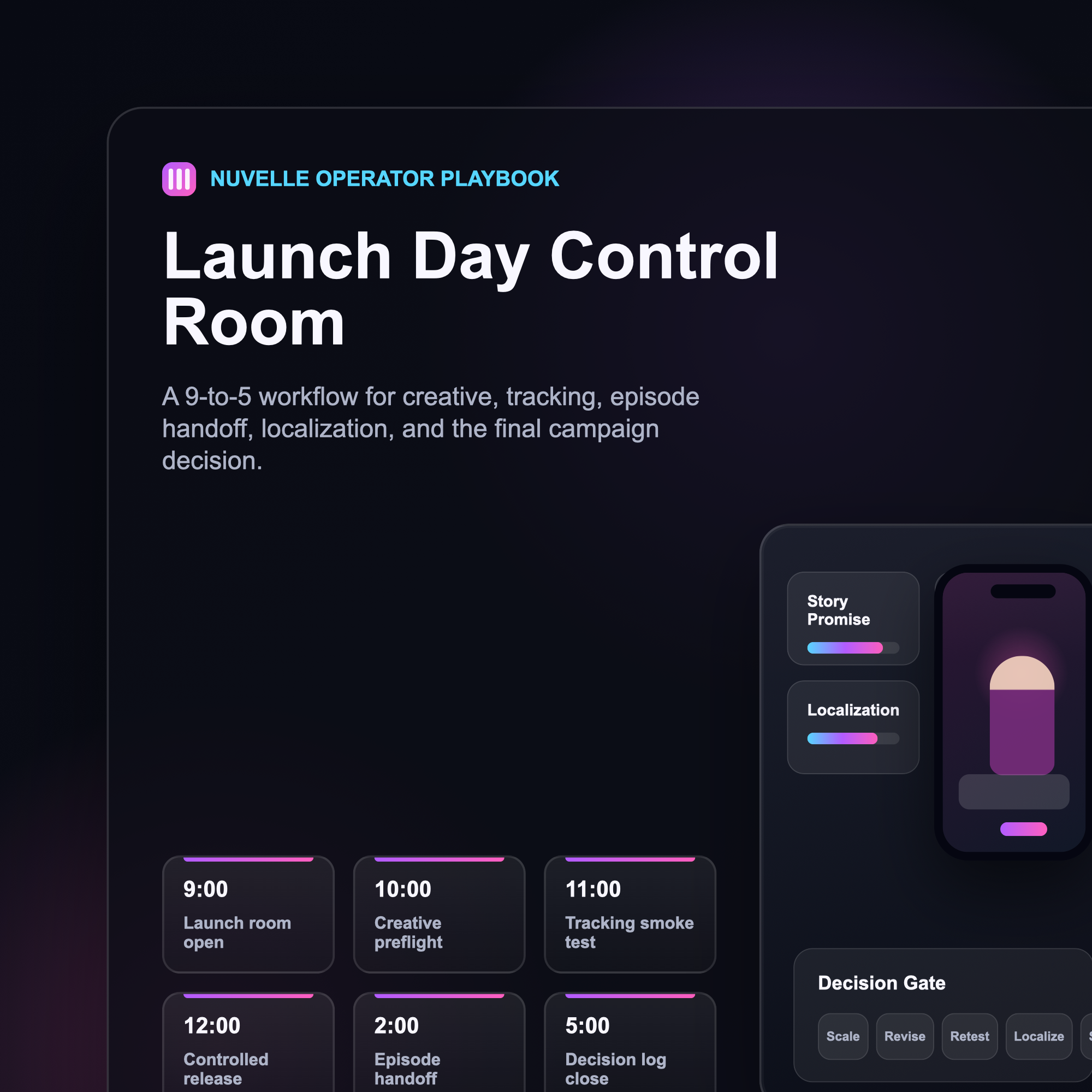
Vertical drama campaigns often fail on launch day for a simple reason: too many teams are working at once without a shared clock.
Creative is checking hooks. Paid media is watching delivery. Product is checking the handoff into episode one. Localization is checking captions and offer language. Finance is asking whether the early signal deserves more spend. Everyone is busy, but the campaign still drifts because nobody owns the sequence.
This vertical drama marketing: workflow playbook gives short drama teams a 9-to-5 launch-day operating system. It is built for producers, growth leads, creative strategists, analysts, localization managers, and monetization owners who need one practical day plan for taking a new vertical series, market test, or major creative package live.
Use it after the stages 1-3 vertical drama marketing workflow, the stages 4-7 operations workflow, and the campaign operations kit. Those pieces define the broader system. This guide turns launch day into a controlled shift with timed gates, owners, evidence, and stop conditions.
Vertical Drama Marketing: Workflow Playbook for a 9-to-5 Launch Day
A launch day is not the day to discover that a story promise, creative ID, episode package, deep link, subtitle file, or paywall treatment is ambiguous. The launch day should answer a narrower question:
Can this campaign move from controlled release to controlled learning without breaking the promise-to-episode-to-unlock chain?
The schedule below assumes a campaign starts at 9:00 a.m. in the team’s operating timezone and reaches its first daily decision by 5:00 p.m. Adjust the exact times for platform review, market timezone, or media delivery windows, but keep the order intact.
| Time | Gate | Core question | Decision output |
|---|---|---|---|
| 9:00 | Launch room open | Are owners, assets, IDs, and stop conditions aligned? | Go, hold, or fix before spend |
| 10:00 | Creative and destination preflight | Does every promoted promise land in the right experience? | Approve or quarantine assets |
| 11:00 | Tracking smoke test | Can the team trace a test viewer through the journey? | Tracking pass or spend cap |
| 12:00 | Controlled release | Is delivery clean enough for signal collection? | Open limited spend |
| 1:00 | First signal read | Is attention qualified, or merely clickable? | Preserve, pause, or adjust hooks |
| 2:00 | Episode handoff check | Does the ad promise continue into episode one? | Fix destination, package, or opening |
| 3:00 | Monetization and retention check | Is the first break content, product, or offer related? | Assign one controlled intervention |
| 4:00 | Market and localization review | Does the package still feel native in the target market? | Continue, relabel, relocalize, or hold |
| 5:00 | Decision log close | What happens tomorrow morning? | Scale, revise, retest, localize, or stop |
The value of the vertical drama marketing: workflow playbook is not the meeting schedule itself. The value is that each hour has a specific decision and a specific evidence standard. That prevents the launch room from becoming a running commentary on dashboard changes.
Before 9:00: Build the Launch Packet
The launch packet should be complete before the day begins. If the team is still naming assets, arguing over the story promise, or finding the right episode export at 9:15, the launch has already lost control.
The packet needs seven sections.
| Section | Required fields | Owner |
|---|---|---|
| Campaign brief | Business question, market, audience hypothesis, primary promise, review window | Campaign lead |
| Series card | Title, genre, protagonist frame, episode package, cliffhanger boundary, unlock point | Producer |
| Creative manifest | Parent concept, hook type, version ID, caption, thumbnail, CTA, placement | Creative strategy |
| Destination map | Landing page, app route, deep link, fallback route, store route, offer state | Product or growth ops |
| Measurement map | UTM fields, platform IDs, event names, required properties, dashboard owner | Analytics |
| Localization card | Language, market context, title, synopsis, subtitles, dub or voice-over status, offer copy | Localization |
| Risk register | Tracking risks, review risks, payment risks, content issues, stop conditions | Campaign lead |
Google’s Campaign URL Builder and analytics documentation are useful references for controlled campaign parameters, but a vertical drama team should go beyond generic UTM tagging. A useful launch packet connects utm_campaign, utm_content, platform creative ID, promise ID, series ID, episode package ID, and offer ID.
The rule is straightforward: if the team cannot identify the same viewer journey across ad, destination, episode, and unlock event, the campaign is not ready for a meaningful launch.
Copyable Launch Packet Fields
Use this compact structure when the team needs a fast operating template:
Launch ID:
Series ID:
Market:
Language:
Audience hypothesis:
Story promise:
Hook family:
Creative lineage IDs:
Approved versions:
Destination ID:
Episode package ID:
Offer ID:
Primary decision:
Primary signal:
Guardrail signals:
Spend cap:
Stop condition:
5 p.m. decision owner:
In Nuvelle’s category, this discipline matters because vertical drama marketing is built around emotional promises. A “humiliated assistant becomes the owner” hook, a “secret wife rejected by the CEO” hook, and a “werewolf mate betrayal” hook may all look like short video ads in a media dashboard. Operationally, they are different promises and should not be mixed into one vague creative bucket.
9:00: Open the Launch Room
The first gate in the vertical drama marketing: workflow playbook is ownership alignment.
The campaign lead opens the launch room with a five-minute readout:
- What is launching.
- Which audience and market it is meant to test.
- Which story promise is being evaluated.
- Which creative versions are approved.
- Which spend cap and stop condition apply.
- Who can make the 5 p.m. decision.
Do not use this meeting to rewrite the campaign. If a stakeholder wants a different promise, offer, episode opening, or market, that should become a new test. Launch day is for executing the approved test cleanly.
9:00 Gate Checklist
| Check | Pass condition | Failure response |
|---|---|---|
| Owner coverage | Creative, media, analytics, product, localization, and monetization owners are assigned | Hold launch until owner is assigned |
| Stop condition | Everyone knows what pauses spend or quarantines an asset | Add condition before launch |
| Creative scope | Only approved versions are eligible | Remove unapproved files from upload queue |
| Market scope | Country, language, offer, and timezone are explicit | Hold localization or routing |
| Decision authority | One person owns the final call | Escalate before spend opens |
This prevents the most expensive kind of launch-day confusion: a campaign that is technically live but strategically ownerless.
10:00: Run Creative and Destination Preflight
At 10:00, the team checks whether every creative sends the viewer to a matching experience.
This is where many vertical drama campaigns quietly leak performance. The ad promises a revenge reveal, but the destination opens on a romance setup. The creative uses a billionaire rescue angle, but the series detail page leads with family betrayal. The caption says “watch the full episode,” but the deep link lands on a generic app page. The viewer may click, but the story contract weakens before episode one begins.
Use the promise-to-destination table below.
| Creative field | Destination field | Question |
|---|---|---|
| Hook promise | Title and synopsis | Does the first text continue the same emotional contract? |
| Opening image | Thumbnail or poster | Does the visual world feel like the same story? |
| Proof moment | Episode-one opening | Does the promised scene or conflict appear quickly? |
| CTA | Route behavior | Does the click land where the CTA implied it would land? |
| Language | Page and subtitle language | Is the experience fully localized, not half-translated? |
| Offer tease | Unlock or subscription state | Does the commercial ask fit the viewer’s expectation? |
The campaign operations kit covers the launch manifest in more detail. On launch day, the goal is narrower: approve, quarantine, or fix every asset before paid delivery creates messy data.
Quarantine Rules
Quarantine an asset if any of these conditions are true:
- The creative ID does not match the manifest.
- The CTA lands on the wrong route.
- The ad promise does not appear in the destination or episode package.
- Subtitles, captions, or title metadata are in the wrong language.
- The promoted episode package is not the package attached to the destination.
- The ad references a free, coin, subscription, or unlock path that the destination does not show.
Quarantine is not failure. It is how a team protects the test from contaminated evidence.
11:00: Run the Tracking Smoke Test
The 11:00 gate confirms whether the team can observe the journey it is about to buy.
Run at least three test journeys:
- A clean first-time viewer from ad click to destination view.
- A viewer from destination view to episode start and episode progress.
- A viewer from episode continuation to unlock or offer view, even if no purchase is completed.
The exact stack can vary. Google Analytics publishes recommended event guidance for common behaviors, while teams can still define custom events when required behavior is not covered. For a vertical drama marketing workflow, the important part is not tool ideology; it is consistent event naming and enough properties to diagnose the first break.
| Event | Minimum properties |
|---|---|
destination_view |
series ID, market, language, promise ID, creative version ID, destination ID |
episode_start |
series ID, episode number, package ID, acquisition IDs |
episode_progress |
episode number, progress milestone, package ID |
next_episode_start |
from episode, to episode, package ID |
unlock_view |
offer ID, episode boundary, currency or offer state |
paid_action |
transaction or confirmation ID, offer ID, value where available |
If the smoke test fails, do not open full spend. Either cap delivery to the lowest practical amount while the analytics owner fixes the chain, or hold launch until the chain is reliable.
This is the most important measurement rule in the vertical drama marketing: workflow playbook: never scale into a blind funnel.
12:00: Open Controlled Release
At noon, the campaign can move from preflight to controlled release.
Controlled release means the team is buying enough delivery to create early learning without allowing platform automation or stakeholder excitement to outrun evidence. The spend cap should be set before launch day. It should be low enough that a broken route, bad localization pass, or misleading promise cannot create material waste.
The media owner should confirm:
- Campaigns, ad groups, and creative versions match the launch packet.
- Placements and markets match the test scope.
- Budget and bid settings reflect controlled release, not scale.
- Learning-period expectations are understood by stakeholders.
- No unapproved creative is active.
Use platform-native review and creative tools as inputs, not as the source of truth. TikTok Creative Center can help teams observe creative conventions and platform patterns, but the internal manifest should remain the control record for what actually launched.
Controlled Release Decision
At 12:00, there are only three valid decisions.
| Decision | Use when | Next action |
|---|---|---|
| Open | Creative, route, tracking, and owner coverage passed | Start limited delivery |
| Open capped | Minor measurement issue exists but core route is safe | Start with strict cap and fix by 1:00 |
| Hold | Route, localization, offer, or tracking breaks the test | Stop before paid delivery |
Avoid the fourth unofficial decision: “launch and watch closely.” If the team already knows the test is compromised, watching it closely does not make the evidence cleaner.
1:00: Read the First Attention Signal
The 1:00 read is not a final performance judgment. It is a quality check on whether the campaign is attracting the kind of attention the test was designed to attract.
For a short drama campaign, early attention should be read in layers:
| Layer | What to inspect | Question |
|---|---|---|
| Delivery | Impressions, spend pace, rejected ads, audience concentration | Is the platform actually delivering the test? |
| Attention | Hook hold, click behavior, qualified destination visits | Is the promise earning useful curiosity? |
| Continuity | Landing engagement, title select, episode start | Does the click continue into the story? |
| Contamination | Wrong market, wrong route, unexpected placement, tracking gap | Is the signal usable? |
Do not crown a winner by click-through rate alone. A highly clickable humiliation hook may attract broad curiosity and still fail if viewers do not continue into episode one. A less flashy identity-reveal hook may produce fewer clicks but stronger episode starts and better continuation.
This vertical drama marketing: workflow playbook treats early media data as a triage signal, not a verdict.
1:00 Triage Actions
- Preserve: Keep the asset live if attention and continuity are both acceptable.
- Pause: Stop an asset if it attracts clicks that do not continue into the destination or episode path.
- Cap: Limit spend if delivery is too narrow or tracking confidence is incomplete.
- Rename: Fix campaign or creative naming if identifiers are inconsistent, but record the change.
- Quarantine: Remove any asset that proves mismatched after live verification.
Every action should be logged with timestamp, owner, reason, and expected effect.
2:00: Check the Episode Handoff
By 2:00, the launch room should look beyond the ad and inspect the first content handoff.
Vertical drama marketing depends on a compressed promise cycle. The viewer sees a high-emotion setup, clicks for resolution, and expects the first episode or preview to continue that feeling immediately. If the campaign loses the viewer between destination and episode one, the fix may be product routing, title packaging, opening pace, subtitle readability, or promise mismatch.
Use a first-break diagnosis.
| First weak point | Likely issue | Immediate investigation |
|---|---|---|
| Click to destination | Route speed, deep link, store fallback, market availability | Test route on target devices |
| Destination to episode start | Title, synopsis, poster, sign-in friction, CTA clarity | Compare page copy to ad promise |
| Episode start to progress | Opening pace, scene continuity, subtitle readability, sound | Watch the first 30 seconds on phone |
| Episode completion to next episode | Cliffhanger, autoplay, next-episode framing | Inspect packaging and transition |
| Offer view to action | Price context, payment trust, unlock value, offer timing | Review commercial path and copy |
The episode packaging workflow is useful when this handoff reveals a deeper package problem. On launch day, do not rebuild the series. Identify the first break and assign one controlled intervention.
Phone-First QA
Do not approve the episode handoff from a desktop dashboard only. Watch the path on a phone in the target aspect ratio:
- Is the protagonist recognizable immediately?
- Does the subtitle line fit without covering the key action?
- Is the conflict understandable with sound off?
- Does the promised payoff begin early enough?
- Does the next-episode transition feel like the obvious next action?
Vertical drama is a mobile format. A launch-day workflow that does not include phone QA is incomplete.
3:00: Check Monetization and Retention Signals
The 3:00 gate asks whether early behavior points to a content problem, a product problem, or a commercial problem.
Do not collapse all weak revenue into “bad creative.” A campaign can acquire qualified viewers and still fail because the offer appears too early, the unlock value is unclear, the payment path feels unfamiliar in the market, or the free-to-paid boundary interrupts the wrong cliffhanger.
Use this decision table.
| Pattern | Interpretation | Best next move |
|---|---|---|
| Weak clicks and weak starts | The promise or targeting may be wrong | Revise hook or audience before content changes |
| Strong clicks and weak starts | Destination mismatch or route friction | Fix page, deep link, title, or app path |
| Strong starts and weak progress | Opening episode problem | Review first 30 seconds and subtitle readability |
| Strong progress and weak continuation | Cliffhanger or package transition problem | Adjust episode boundary or next-episode framing |
| Strong continuation and weak unlock | Offer, price context, or payment trust problem | Test offer copy, timing, or unlock explanation |
This keeps the vertical drama marketing: workflow playbook operational. The team should leave the 3:00 gate with one diagnosis, not five theories.
The One-Intervention Rule
Only one material intervention should be made before the 5:00 decision unless a route or payment path is broken.
Examples of acceptable interventions:
- Pause one contaminated creative version.
- Fix a wrong deep link.
- Replace a mislabeled subtitle file.
- Cap delivery on a market with incomplete tracking.
- Adjust an offer explanation if the wrong copy is live.
Examples of changes that should usually wait:
- Recut every hook.
- Change audience, creative, destination, and offer simultaneously.
- Swap the promoted episode package without updating IDs.
- Open a new market before the first market is diagnosed.
Too many launch-day changes destroy the learning record.
4:00: Review Market and Localization Fit
At 4:00, the localization owner and campaign lead inspect whether the package still feels native in the target market.
This matters even for English-first teams. A vertical drama ad can be technically translated and emotionally flat. Romance, betrayal, family obligation, wealth, workplace hierarchy, jealousy, and revenge all carry local assumptions. The short drama localization beginner guide explains the broader system; launch day needs a faster market-readiness check.
| Layer | Launch-day question |
|---|---|
| Title | Does it communicate the right genre and promise in the target language? |
| Synopsis | Does it preserve the emotional stakes, not merely the plot? |
| Subtitles | Are they readable on a phone at real playback speed? |
| Voice or audio | Does the tone support the genre promise? |
| Offer | Does the unlock or subscription language match local payment expectations? |
| Metadata | Are language, market, category, and store fields consistent? |
If localization is not ready, do not pretend the test measured market demand. It measured an incomplete version of the market experience.
4:00 Localization Decisions
| Decision | Use when |
|---|---|
| Continue | The package is coherent and early behavior is usable |
| Relabel | Metadata or naming is inconsistent but the experience is safe |
| Relocalize | Translation is correct but emotional stakes are weak |
| Hold | Subtitle, route, offer, or title mismatch invalidates the market test |
For Nuvelle-style AI-crafted vertical dramas, localization can become a compounding advantage only if the team treats it as audience-story fit, not as a file conversion task.
5:00: Close the Decision Log
The final gate in the vertical drama marketing: workflow playbook is not a status update. It is a decision record.
By 5:00, the campaign lead should close the launch day with five fields:
- What went live: approved assets, routes, markets, episode packages, and offers.
- What changed: every pause, cap, fix, relabel, or quarantine.
- What the evidence says: early attention, handoff, episode, continuation, unlock, and market-readiness notes.
- What the team will do next: scale, revise, retest, localize, hold, or stop.
- What will be reviewed tomorrow: owner, dashboard, cohort window, and stop condition.
The weekly decision cadence turns this launch-day record into a portfolio decision. The measurement and attribution playbook explains how to preserve the evidence chain. Launch day is the bridge between the plan and those later reviews.
Copyable 5:00 Decision Log
| Field | Entry |
|---|---|
| Launch ID | |
| Source market and language | |
| Series and episode package | |
| Story promise tested | |
| Creative versions live | |
| Assets paused or quarantined | |
| Route or tracking fixes | |
| First weak point | |
| Current diagnosis | |
| Decision | Scale, revise, retest, localize, hold, or stop |
| Owner | |
| Next review time | |
| Stop condition |
Do not close the day with “monitoring.” Monitoring is an activity, not a decision. A strong vertical drama marketing: workflow playbook produces a next action that a teammate can execute without rereading the entire Slack thread.
The Launch-Day RACI
A compact RACI prevents launch-day overlap.
| Workstream | Responsible | Accountable | Consulted | Informed |
|---|---|---|---|---|
| Story promise and episode package | Producer | Campaign lead | Creative, localization | Finance |
| Creative version control | Creative strategy | Campaign lead | Paid media | Analytics |
| Paid delivery and spend caps | Paid media | Growth lead | Analytics | Campaign lead |
| Tracking and dashboards | Analytics | Growth lead | Product | Campaign lead |
| Destination and app route | Product or growth ops | Product lead | Analytics, creative | Paid media |
| Localization readiness | Localization | Market lead | Creative, product | Campaign lead |
| Offer and unlock path | Monetization | Growth lead | Product, finance | Campaign lead |
| 5 p.m. decision | Campaign lead | Growth lead | All owners | Stakeholders |
The person accountable for the final decision should not be the person chasing every tactical fix. Launch day needs one conductor and several owners, not one person trying to do everything.
Common Launch-Day Failure Modes
The same avoidable problems appear across vertical drama marketing operations.
| Failure mode | Symptom | Prevention |
|---|---|---|
| Promise drift | Ad, title, and episode opening imply different stories | Promise-to-destination preflight |
| Naming chaos | Analysts cannot join creative, route, and episode data | Stable identity map |
| Blind spend | Paid delivery opens before tracking passes | 11:00 smoke test gate |
| False creative winner | Clickable hook drives weak episode starts | First-break diagnosis |
| Localization theater | Translated copy is linguistically correct but emotionally weak | 4:00 market fit review |
| Overcorrection | Team changes creative, audience, route, and offer at once | One-intervention rule |
| No decision | Day ends with “keep monitoring” | 5:00 decision log |
These are not abstract best practices. They are the operational issues that make a campaign appear more mysterious than it is.
A One-Day Playbook for Repeatable Learning
The complete vertical drama marketing: workflow playbook should help the team do three things repeatedly:
- Preserve the story promise from ad to episode.
- Protect the evidence chain from naming, routing, tracking, and localization contamination.
- Convert the day’s signal into a clean next action.
That is also where Nuvelle’s AI-native vertical drama model changes the operating standard. When a platform can develop and test story worlds quickly, the bottleneck shifts from production capacity to decision quality. More hooks, more genres, and more localized cuts only compound if the team knows which promise worked, where the viewer continued, and what should happen next.
A 9-to-5 launch day will not answer every strategic question. It should not try to. Its job is to move a campaign from approved idea to controlled learning without losing the thread.
Use this vertical drama marketing: workflow playbook whenever a new series, market, creative package, or monetization path goes live. Start the day with one launch packet. End it with one decision log. Everything in between should make that decision easier to trust.
FAQ
What is a vertical drama marketing workflow playbook?
A vertical drama marketing workflow playbook is an operating guide for moving a short drama campaign from story promise to creative, destination, episode behavior, monetization, localization, and decision-making. This version focuses on the 9-to-5 launch-day workflow.
Who should own launch day for a vertical drama campaign?
One campaign lead should own the final decision, while creative, media, analytics, product, localization, and monetization owners handle their specific gates. Shared ownership without a final decision owner usually creates drift.
Should a team scale a vertical drama ad after one hour of good clicks?
Usually no. Early clicks should be treated as a triage signal. The team should also inspect qualified destination visits, episode starts, episode progress, continuation, and offer behavior before scaling.
What is the most important launch-day metric?
There is no single universal metric. The most important signal is the first meaningful break in the viewer journey. For one campaign, that may be click-to-episode-start. For another, it may be episode completion, continuation, or unlock behavior.
How does localization fit into vertical drama marketing?
Localization should be treated as audience-story fit, not just translation. Title, synopsis, subtitles, offer language, and emotional stakes all need to feel native in the target market before the team treats results as valid market evidence.