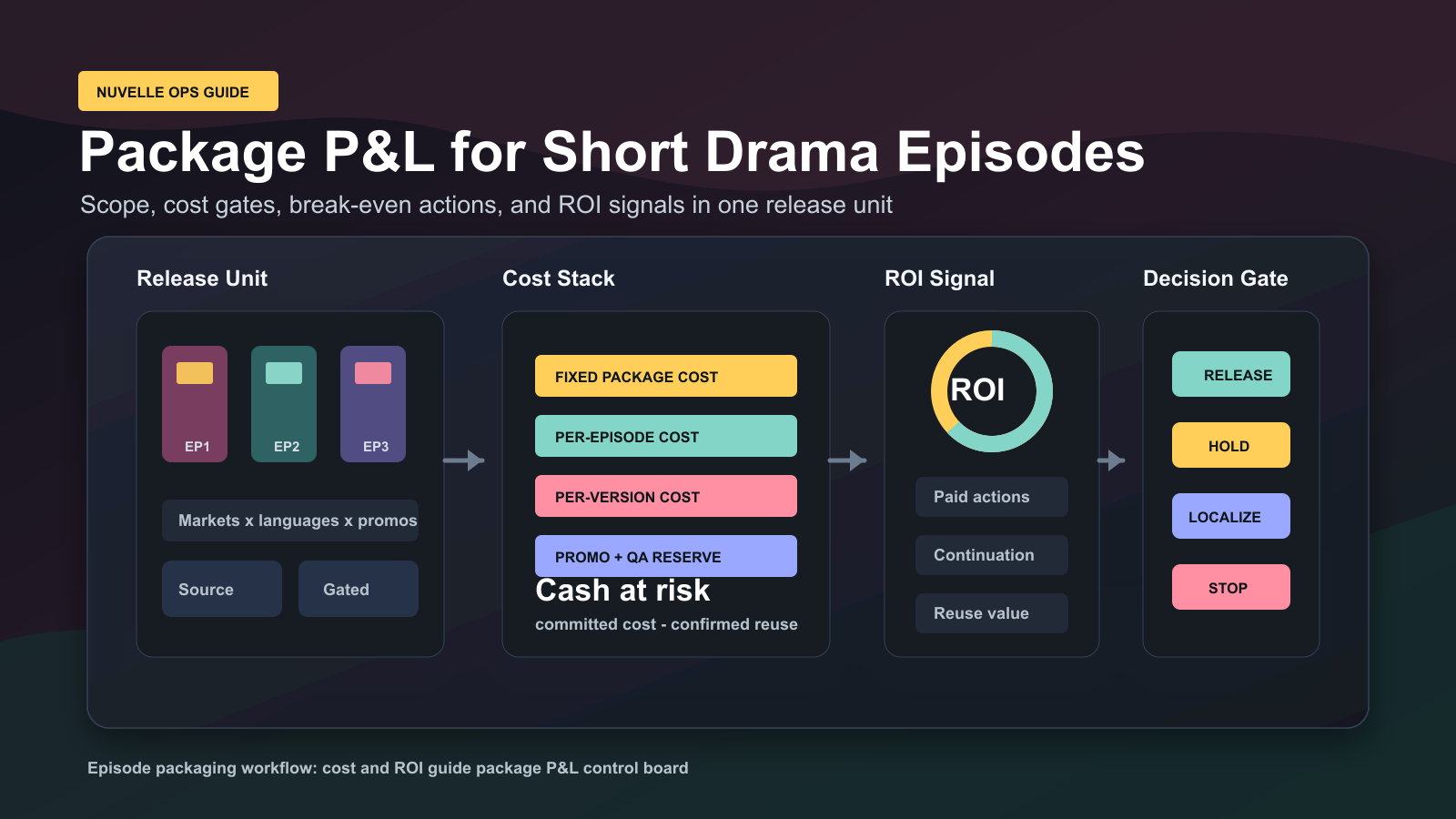
An episode packaging workflow: cost and ROI guide should give a short drama team one clear answer before money moves: what does this package need to earn, prove, or reuse to deserve release?
That is different from asking whether the team can finish the next episodes. Finishing is a production question. Packaging ROI is a commercial question. The package includes every asset needed to turn episodes into measurable viewer behavior: finished masters, captions, subtitles, metadata, thumbnails, paid cutdowns, app delivery, QA, tracking, localization notes, and the archive that helps the next package move faster.
For Nuvelle-style AI-native vertical drama, this matters because speed is valuable only when the release unit is still premium, mobile-first, and measurable. A team can create more content faster and still lose control of the economics if version count, rework, localization, and paid creative are approved without a package P&L.
Use this guide with the broader episode packaging workflow cost and ROI guide, the episode packaging ROI calculator template, the package approval decision guide, and the weekly cost-control guide. This article focuses on the package P&L: how to build the cost stack, calculate break-even paid actions, and decide whether to release, localize, resize, or stop the next package.
The Package P&L in an Episode Packaging Workflow: Cost and ROI Guide
The package P&L is a small operating statement for one release unit. It does not need to replace finance reporting. It needs to make the package decision visible before production momentum turns optional work into committed cost.
Use this structure:
| P&L field | What it means | Why it matters |
|---|---|---|
| Package ID | The named release unit being approved | Keeps cost, assets, and signal tied to the same decision |
| Package scope | Episodes, languages, markets, platforms, and promo variants | Prevents hidden version multiplication |
| Required cost | Work that must happen before the source package can launch | Defines the minimum viable release unit |
| Optional cost | Work that improves reach but can wait behind a signal | Protects cash before proof exists |
| Risk reserve | Rework, QA, delivery, rights, localization, and correction allowance | Stops surprise fixes from hiding the true cost |
| Reusable value | Assets likely to reduce future cycle time or cost | Credits real operating leverage without exaggerating it |
| Contribution action | Paid unlock, subscription start, retained viewer, or other monetized action | Connects packaging work to return |
| Break-even actions | Paid actions required to recover package cost | Turns ROI into a concrete target |
| Decision gate | Release, hold, localize, resize, or stop | Makes the next action explicit |
The goal of an episode packaging workflow: cost and ROI guide is not to prove that every package is profitable. Some packages are tests. Some are learning investments. Some are localization pilots. The goal is to know which kind of package is being approved and how much exposure the team is accepting before the next signal arrives.
Start With the Release Unit, Not the Episode Count
Episode count is not scope. A "three-episode package" may be small or expensive depending on versions, markets, languages, paid assets, and QA depth.
Define the release unit like this:
Package = episodes x markets x languages x platforms x promo variants x QA passes
Then write the scope in one sentence:
Approve episodes 1 and 2 for source-language app release, one metadata set, one thumbnail family, two paid cutdowns, and tracking QA. Hold Spanish subtitles, local thumbnails, and extra paid cutdowns until episode-one completion and episode-two continuation are readable.
That sentence does more than describe work. It tells producers, growth, localization, and finance what is funded now and what is intentionally waiting. This is the first control point in an episode packaging workflow: cost and ROI guide.
Use this quick version matrix before cost approval:
| Scope driver | Approved now | Held behind signal | Signal required |
|---|---|---|---|
| Episodes | ___ | ___ | Completion or continuation |
| Source-language exports | ___ | ___ | QA pass |
| Subtitle languages | ___ | ___ | Source story signal |
| Dub languages | ___ | ___ | Local market evidence |
| Metadata sets | ___ | ___ | Launch readiness |
| Thumbnail families | ___ | ___ | Hook or start-rate signal |
| Paid trailer cutdowns | ___ | ___ | Tracking smoke test |
| Platform crops | ___ | ___ | Channel launch need |
| QA passes | ___ | ___ | Risk level |
If the matrix cannot be filled in, the team is not ready to approve the package P&L.
Build the Cost Stack
A useful package P&L separates costs by behavior, not department. Department budgets can stay intact, but approval needs to show which costs are fixed, variable, gateable, risky, or reusable.
| Cost type | Examples | Package treatment |
|---|---|---|
| Fixed package cost | Brief, folder system, naming rules, metadata structure, export preset, shared QA plan | Spread across the approved release unit |
| Per-episode cost | Master finish, captions, continuity check, app export, episode metadata | Multiplies by episode count |
| Per-version cost | Subtitle pass, local title, localized metadata, alternate crop, platform spec, thumbnail adaptation | Multiplies by markets, languages, and platforms |
| Promo cost | Paid cutdowns, hook variants, stills, copy variants, upload checks | Release only when tracking can read the result |
| Risk cost | Rework, vendor redo, rights review, final-render fixes, platform rejection | Reserve before launch |
| Reusable investment | glossary, caption template, artwork system, title rules, validated hook format | Count only when next use is likely |
The basic formula:
Total package cost =
fixed package cost
+ per-episode cost
+ per-version cost
+ promo cost
+ risk reserve
- conservative reusable value
For AI-assisted production, do not erase review cost from the model. Nuvelle's positioning depends on premium AI-crafted vertical dramas, daily freshness, and film-grade presentation. That means character consistency, continuity, final-render review, localized promise control, and rights/provenance checks should appear as visible cost lines when they apply.
Separate Committed Cost From Gateable Cost
Most ROI mistakes happen because a team approves the total idea instead of the next commitment.
Use two numbers:
Committed-before-signal cost = required cost + optional cost approved now + risk reserve already committed

Cash at risk = committed-before-signal cost - conservative reusable value
Then use the package P&L to ask:
What cost can wait until we know whether viewers continue, unlock, subscribe, return, or produce another monetized signal?
This is the operating heart of an episode packaging workflow: cost and ROI guide. It protects speed because the team can still move the source package while holding optional scope. It also protects finance because localization, extra paid cutdowns, alternate thumbnails, and larger episode batches do not sneak into the committed column before the first useful read.
| Cost decision | Approve now when | Hold when |
|---|---|---|
| Source master and captions | The package cannot launch without them | The story or creative direction is still unresolved |
| First thumbnail family | The app release needs a clear promise | Multiple thumbnail concepts are being requested without a test plan |
| Paid cutdowns | Tracking, destination, and episode handoff are ready | The team cannot attribute starts or continuation |
| First localization pass | Source signal is strong enough to justify market testing | The source package has weak completion or unclear paid action |
| Additional languages | First localized package has readable signal | The first local version is still in QA or signal is weak |
| More episodes | Continuation and quality controls are stable | Bigger package size is justified only by lower unit cost |
Choose the Contribution Action
ROI needs a monetized or monetization-proxy action. For a short drama app, the package P&L can use one primary contribution action and a few supporting signals.
Good primary actions include:
- paid episode unlocks
- coin purchases
- subscription starts
- ad-supported completions when attention is directly monetized
- retained viewers inside a defined measurement window when retention reliably predicts value
Supporting signals include starts, episode-one completion, episode-two continuation, return viewing, and paid creative click-through. These signals are useful, but they should not replace the contribution action unless the team has a proven conversion path.
Use this model:
Contribution per paid action =
net revenue per paid action - variable serving or fulfillment cost per action

Break-even paid actions =
total package cost / contribution per paid action

Package ROI =
(attributable contribution - total package cost) / total package cost
If the team does not know contribution per paid action, use a conservative range instead of a single number. A practical episode packaging workflow: cost and ROI guide should show base case and downside case, because the first package rarely behaves exactly like the forecast.
| Input | Downside case | Base case | Upside case |
|---|---|---|---|
| Total package cost | $___ | $___ | $___ |
| Contribution per paid action | $___ | $___ | $___ |
| Break-even paid actions | ___ | ___ | ___ |
| Expected paid actions | ___ | ___ | ___ |
| ROI | ___% | ___% | ___% |
| Decision | Hold / resize | Release / test | Expand / localize |
The table is intentionally simple. It gives the team a commercial target that can be compared with actual results after launch.
Add a Learning-Adjusted ROI Line
Some packages should be approved even when direct payback is uncertain. That is acceptable only when the learning is specific and reusable.
Use this formula as a management view:
Learning-adjusted value =
attributable contribution + confirmed reusable value + decision value

Learning-adjusted ROI =
(learning-adjusted value - cash at risk) / cash at risk
Decision value means the package will change a future spend decision. Examples:
| Learning question | Real decision value |
|---|---|
| Does the second episode earn continuation after the opening cliffhanger? | Decides whether the next package should be one, two, or four episodes |
| Does the Spanish title and thumbnail promise attract the right viewer? | Decides whether to fund more localization |
| Does a paid cutdown create qualified starts, not just cheap clicks? | Decides whether to expand creative production |
| Does the caption and metadata template reduce QA time next week? | Decides whether to standardize the workflow |
| Does a certain unlock point produce paid actions? | Decides whether to package more episodes around that moment |
Do not count vague learning. "We learned the audience likes drama" is not decision value. "We learned that the revenge promise gets starts but loses continuation before the paid unlock" is decision value because it changes the next package.
Use Package Size as a Risk Lever
The lowest cost per episode is not always the best ROI. Bigger packages usually need stronger proof because they commit more scope before the next signal.
| Situation | Better package size | P&L logic |
|---|---|---|
| New story world, new market, or unproven hook | One episode | Protects cash while testing the premise |
| The main question is episode-two continuation | Two episodes | Gives the team a real handoff test |
| The opening works but paid action is uncertain | Two or three episodes | Gives growth more material without locking the full batch |
| Source package is strong but local market is unproven | Source package plus one gated localization pass | Keeps language cost behind proof |
| Story, QA, localization, and paid action are stable | Three or four episodes | Shared setup can create real efficiency |
This is why an episode packaging workflow: cost and ROI guide should not reward size by default. It should reward the smallest package that can answer the next business question.
Run the Package P&L Workflow
Use this sequence for each package:
- Name the package question. Decide what this package must prove: story promise, continuation, paid action, localization fit, creative hook, or workflow reuse.
- Define the release unit. List episodes, markets, languages, platforms, promo variants, metadata sets, thumbnails, and QA passes.
- Split required and optional scope. Mark what launches now and what waits behind a signal.
- Build the cost stack. Separate fixed, per-episode, per-version, promo, risk, and reusable costs.
- Calculate cash at risk. Use committed-before-signal cost minus conservative reusable value.
- Choose the contribution action. Use paid unlocks, subscription starts, retained viewers, or another monetized action that the business can actually measure.
- Run downside, base, and upside cases. Calculate break-even actions and expected ROI for each case.
- Set the gate. Decide what result releases localization, more paid cutdowns, more episodes, or a stop.
- Archive the evidence. Save the final package, cost stack, QA notes, performance signal, and next decision.
For campaign-side tracking, connect this workflow with the vertical drama measurement and attribution playbook. Packaging ROI depends on clean event definitions, not only clean exports.
For localization scope, use the short drama localization adaptation brief before approving local titles, subtitles, thumbnails, and cultural adaptation as if they were small text tasks.
A Copyable Package P&L Template
Use this one-page template in the weekly approval meeting.
| Field | Entry |
|---|---|
| Package ID | ___ |
| Series / story world | ___ |
| Package question | ___ |
| Approved episodes | ___ |
| Approved markets | ___ |
| Approved languages | ___ |
| Approved promo variants | ___ |
| Held-back scope | ___ |
| Required cost | $___ |
| Optional cost approved now | $___ |
| Gateable cost held | $___ |
| Risk reserve | $___ |
| Conservative reusable value | $___ |
| Cash at risk | $___ |
| Contribution action | ___ |
| Contribution per action | $___ |
| Break-even paid actions | ___ |
| Downside ROI | ___% |
| Base-case ROI | ___% |
| Upside ROI | ___% |
| Release gate | ___ |
| Localization gate | ___ |
| Stop or resize rule | ___ |
| Next decision date | ___ |
| Decision owner | ___ |
Keep the template attached to the package ID. The next package should start from the previous package's actual cost, rework, signal, and decision. That is how an episode packaging workflow: cost and ROI guide becomes a compounding operating system instead of a one-time spreadsheet.
Example Decision Rules
Use clear rules before launch:
| Result | Package decision |
|---|---|
| Completion is weak and paid action is unreadable | Hold localization and diagnose the source package |
| Starts are strong but continuation is weak | Revise episode-one promise, thumbnail, or handoff before adding episodes |
| Continuation is strong but paid action is weak | Test unlock point, offer, or episode order before expanding package size |
| Paid action clears base-case break-even | Release next paid cutdown set or next episode package |
| Source package works and local-market test is strong | Approve the next localization package with a fresh P&L |
| Rework reserve is exhausted before launch | Freeze optional scope and repair the QA control |
| Reusable assets reduce next package work | Credit reuse in the next P&L, but only after the asset is actually used |
These rules make disagreement useful. Creative can argue for story quality. Growth can argue for more testing material. Finance can argue from cash at risk. Localization can argue from real version workload. Everyone is using the same decision record.
Common P&L Mistakes
Avoid these shortcuts:
- Treating "episodes" as the same thing as release scope.
- Calculating ROI from views without a contribution action.
- Letting optional localization and paid creative enter the committed-cost column too early.
- Counting reusable value for assets with no confirmed next use.
- Forgetting risk reserve for QA, platform rejection, final-render issues, and localization fixes.
- Choosing a larger package only because cost per episode looks lower.
- Saving final files but not saving cost, rework, and performance evidence.
- Claiming learning value when the package does not change the next decision.
Each mistake weakens the next estimate. A disciplined episode packaging workflow: cost and ROI guide makes the next estimate sharper because it preserves the full loop: scope, cost, signal, decision, and archive.
Final Takeaway
The best episode packaging workflow: cost and ROI guide is a package P&L, not a generic production budget. It defines the release unit, separates required and gateable scope, calculates cash at risk, names the contribution action, and sets the release gate before the team commits the next cost.
Use one episode when uncertainty is high. Use two episodes when continuation is the question. Use three or four episodes only when the story, QA, localization, tracking, and paid action path are stable enough to justify the exposure.
For Nuvelle and other AI-native vertical drama teams, the package P&L turns creative speed into operating discipline. It lets the team keep daily-release momentum while protecting premium finish, localization quality, and measurable return.