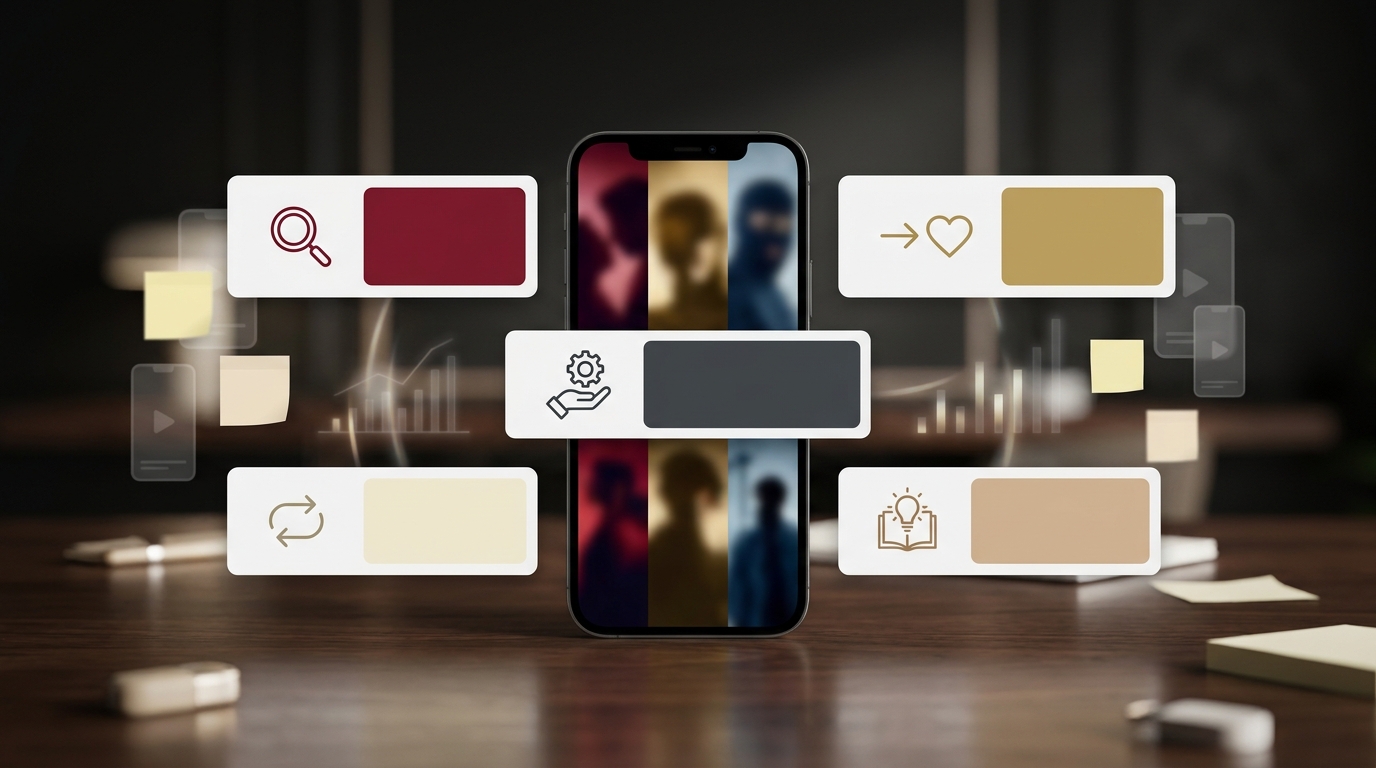
A reel short drama can do more than create a dramatic first tap. Used well, it can move a viewer through the whole path from "What is this story?" to "I want the next episode," then into a repeat viewing habit.
That is where many short-drama teams lose leverage. They treat every reel short drama asset like the same thing: a hook, a trailer, or an ad. In practice, each funnel stage needs a different job. An awareness hook should not be judged by the same signal as an unlock-boundary scene. A retention clip should not be written like a first-install ad. A localization test should not be measured only by views.
This guide maps practical reel short drama use cases by funnel stage so content, growth, and product teams can decide what to make, what to measure, and when to stop revising.
Nuvelle is an AI-native vertical drama platform for viewers, not a creator-tool marketplace. We use this framework because mobile-first drama works only when the story promise, first episodes, unlock path, and next-series experience all support the same viewer journey.
The Short Version: Match the Reel Short Drama to the Funnel Job
Use this funnel map before commissioning a trailer, editing a hook, buying traffic, or localizing a new short drama.
| Funnel stage | Viewer question | Best reel short drama use case | Primary asset | Main signal |
|---|---|---|---|---|
| Awareness | "Why should I care?" | Prove the story promise fast | Hook reel or premise scene | Thumb-stop, click, qualified episode start |
| Consideration | "Is this my kind of drama?" | Make the first watch feel safe and specific | First-three-episode path | Episode 1 start, Episode 2 tap, genre browse |
| Conversion | "Do I want the next part badly enough?" | Turn cliffhanger pressure into an unlock choice | Unlock-boundary scene | Boundary reach, unlock action, subscription or ad unlock |
| Retention | "What should I watch next?" | Build a repeat story habit | Next-series bridge or genre rail | Return view, favorite, next-series start |
| Learning | "What did this test teach us?" | Convert performance into the next creative rule | Decision card and event map | Keep, revise, scale, localize, or stop decision |
The same reel short drama title can support every stage, but not with the same cut. A betrayal reveal may be perfect for awareness. The public humiliation scene may work better for conversion. A softer couple moment may help retention if the viewer already understands the conflict.
What Counts as a Reel Short Drama Use Case?
A reel short drama use case is the business job assigned to a short-form vertical story asset.
It is not only the video format. It is the combination of:
- Story promise: the emotional deal, such as revenge, hidden identity, billionaire romance, rejected mate, or second chance.
- Episode job: what the scene must make the viewer understand or feel.
- Funnel stage: the moment in the viewer journey where the asset appears.
- Next action: tap, watch, unlock, favorite, download, return, or explore another series.
- Measurement: the signal that proves the asset did its job.
This matters because reel short drama performance is easy to misread. A hook can earn clicks and still fail if it sends viewers to the wrong first episode. A beautiful trailer can underperform if it summarizes too much and leaves no next question. A localized clip can look fluent but flatten the power reversal that made the original story work.
For format fundamentals, start with Nuvelle's guide to what vertical drama means and when it matters. For tool evaluation, keep the web drama tools evaluation framework open as a companion.
Stage 1: Awareness Use Cases
At the awareness stage, the viewer has no patience for setup. The reel short drama has to make one emotional promise immediately.
Good awareness use cases include:
| Use case | What to show | What to avoid |
|---|---|---|
| Hook reel | The insult, reveal, betrayal, threat, or impossible bargain | Slow context before the conflict |
| Genre sampler | Three quick proof moments from one lane, such as hidden identity or revenge | A generic montage with no clear story type |
| Character-power reveal | The underestimated protagonist showing hidden status, wealth, rank, or leverage | Explaining backstory instead of proving power |
| Ad-to-episode bridge | A short scene that lands naturally into Episode 1 | A trailer that promises a scene the viewer cannot find |
The awareness goal is not to explain the whole series. It is to create a specific question the first episode can answer.
For a reel short drama, weak awareness sounds like: "A woman faces love, ambition, and secrets."
Strong awareness sounds like: "Her husband thought she was a maid until she bought the mansion."
That difference matters because short-drama discovery usually happens in a fast scroll environment. The hook has to name the wound, power imbalance, or reversal before the viewer moves on.
Awareness Metrics to Watch
Track awareness with behavior that suggests real story curiosity, not only surface attention.
Useful signals:
- Hook hold or thumb-stop rate
- Click-through to the series page or app route
- Episode 1 start from the creative
- Cost per qualified episode start
- Comment language that repeats the story promise
Do not overvalue raw views. A reel short drama awareness asset can produce many low-intent views if the visual is shocking but the story promise is unclear.
Stage 2: Consideration Use Cases
At the consideration stage, the viewer is asking whether the story is worth a few more minutes.
This is where many teams make the funnel too vague. The viewer should not have to guess what kind of drama she is entering, whether early episodes are free, or how the next episode path works.
Good consideration use cases include:
| Use case | What it does | Best format |
|---|---|---|
| First-three-episode path | Proves the premise, raises stakes, and makes the next tap obvious | In-app episode sequence |
| Story detail page | Makes genre, premise, episode count, and watch path easy to inspect | App or web detail screen |
| Genre-lane comparison | Helps viewers choose between romance, revenge, werewolf, hidden identity, or second chance | Browse rail or blog guide |
| Trust and app route proof | Shows official app, store, support, language, and playback signals | Store page, landing page, or in-app screen |
The consideration stage is where a reel short drama stops being only an ad and starts becoming a viewing experience. If the first available episode does not satisfy the hook, the funnel breaks here.
Nuvelle's live site positions the product around AI short dramas across romance, revenge, werewolf, billionaire, and hidden identity worlds, made for fast mobile viewing. The current Apple listing for Nuvello Drama describes authorized short-form drama viewing, vertical playback, watch history, favorites, search, and language switching. Those are consideration-stage signals because they help a viewer understand the official path before investing more time.
For a viewer-side app checklist, use Nuvelle's mobile drama streaming evaluation framework.
Consideration Metrics to Watch
Useful signals:
- Series detail views
- Episode 1 starts
- Episode 1 completion
- Episode 2 taps
- Genre browse or search use
- Favorite, save, or watch-history continuation
- Drop-off between ad click and first episode start
The key question is simple: did the viewer who liked the reel short drama hook find the same promise in the product experience?
Stage 3: Conversion Use Cases
Conversion in short drama is usually about continuation. The viewer has watched enough to care, then reaches a decision point: unlock, subscribe, watch an ad, continue in the app, or leave.
A conversion-stage reel short drama asset should not feel like a generic sales page. It should protect the story tension that already exists.
Good conversion use cases include:
| Use case | What it should do | Failure signal |
|---|---|---|
| Unlock-boundary cliffhanger | Place the strongest next question at the boundary | Viewers reach the boundary but exit |
| Offer-state screen | Explain the available unlock path clearly | Confusion, back taps, support questions |
| Ad-supported unlock prompt | Give budget-sensitive viewers a path to continue | High boundary reach, low action start |
| Subscription bridge | Connect full-series access to binge intent | Subscription starts but weak continuation |
| Episode package test | Compare where the free sample should end | Good early completion, poor unlock rate |
This stage depends on promise continuity. If the awareness hook promised revenge but the conversion boundary lands on a quiet exposition scene, the viewer has no emotional reason to continue.
For operators, pair this stage with an episode packaging package P&L. The unlock boundary is not only a creative decision. It affects cost release, localization priority, and contribution measurement.
Conversion Metrics to Watch
Useful signals:
- Unlock-boundary reach
- Unlock action start
- Unlock action complete
- Subscription start, ad unlock, coin spend, or app continuation
- Episode completion after unlock
- Refund, cancel, or immediate exit patterns where applicable
Do not judge conversion only by the number of people who see the offer. A reel short drama conversion asset works when the viewer understands exactly why the next episode matters.
Stage 4: Retention Use Cases
Retention starts after the first story proves itself.
At this stage, the viewer is not asking, "What is short drama?" She is asking, "What should I watch next, and will this app keep giving me the feeling I came for?"
Good retention use cases include:
| Use case | What it does | Example signal |
|---|---|---|
| Next-series bridge | Moves a completed viewer into a similar emotional lane | Start of another series |
| Genre habit rail | Lets the viewer return to a favorite mood | Repeat genre browse |
| Daily drop module | Gives a reason to come back without searching | Return session after new content |
| Favorite and resume path | Reduces friction when watching in short sessions | Return to same series |
| Localization follow-up | Shows the viewer more titles in her preferred language | Localized version view |
Retention is where reel short drama becomes a catalog strategy. A single hit matters, but the durable value comes from understanding which emotional lanes create repeat behavior.
Nuvelle's product knowledge defines the platform around mobile-first vertical dramas, daily drops, genre-led discovery, and binge behavior. That makes retention use cases central: the viewer should be able to move from one power-reversal story to another without rebuilding trust from zero.
For campaign-side retention learning, use the vertical drama marketing measurement playbook and the weekly learning library workflow.
Retention Metrics to Watch
Useful signals:
- Return to series
- Next-series start
- Favorite or save
- Repeat genre browse
- Push or email return where used
- Completion of another first episode
- Weekly retained viewer cohort
The retention question is not whether one reel short drama worked once. It is whether the platform learned what the viewer wants next.
Stage 5: Learning Use Cases
The learning stage turns each test into reusable operating knowledge.
Without this stage, teams keep making new hooks without knowing why the last hook won or failed. A reel short drama program needs a decision habit, not only a production habit.
Good learning use cases include:
| Use case | What to record | Decision it supports |
|---|---|---|
| Creative decision card | Hook, promise, proof scene, audience, landing route, result | Keep, revise, scale, or stop |
| First-break diagnosis | Where viewers dropped from hook to episode to unlock | Fix creative, episode, route, or offer |
| Localization test card | Original promise, adapted line, subtitle/dub notes, local result | Localize deeper or revise |
| Episode package memo | First five episode jobs, boundary, cost, result | Change package size or release order |
| Genre lane rule | Which emotional promises repeated across winners | Build the next slate |
This is where the article's main scarcity appears: the best reel short drama workflow does not end at publication. It ends when the team can say, "This promise worked for this audience at this stage, and here is what we will do next."
A Practical Funnel-Stage Workflow
Use this seven-step workflow for a new reel short drama campaign or title launch.
1. Write the Story Promise Before the Hook
Use one sentence:
A [viewer-relevant protagonist] is trapped by [pressure], then discovers [power/reversal], forcing [next question].
Examples:
- A rejected bride is humiliated by a billionaire family, then returns with the contract that controls their company.
- A quiet nanny protects a child from danger, then discovers the single father is hiding the truth about her past.
- A rejected Luna is cast out as weak, then awakens the rank her pack tried to bury.
If the promise is not clear, do not make the reel short drama hook yet.
2. Assign the Funnel Stage
Before editing, label the asset:
- Awareness hook
- Consideration first-watch path
- Conversion unlock scene
- Retention next-series bridge
- Learning diagnostic asset
This prevents the team from asking one asset to do every job.
3. Build the First-Five-Episode Job Map
For most vertical drama launches, the first five episodes should have clear jobs.
| Episode | Job |
|---|---|
| 1 | Prove the wound, insult, danger, or impossible bargain |
| 2 | Show the power imbalance or emotional cost |
| 3 | Reveal the first hidden advantage or deeper threat |
| 4 | Force a public choice, mistake, or humiliation |
| 5 | End with a reversal that makes continuation feel urgent |
The exact map can change, but the discipline matters. If early episodes do not do distinct jobs, the funnel cannot diagnose the break.
4. Match Each Asset to One Next Action
Every reel short drama asset should have one expected next action.
| Asset | Next action |
|---|---|
| Hook reel | Open the series route |
| Series page | Start Episode 1 |
| Episode 1 | Tap Episode 2 |
| Boundary scene | Start unlock path |
| Completion screen | Start the next series |
| Learning card | Decide the next test |
If the next action is vague, the measurement will be vague too.
5. Protect Promise Continuity
Check that the same story promise appears across:
- Ad or social hook
- Landing route
- Title and poster
- First episode
- Unlock boundary
- Next-series recommendation
Promise breaks are expensive. They make teams blame the wrong thing. A weak conversion rate may be caused by the ad, the landing page, the first episode, the boundary, or the offer. The only way to know is to preserve the promise across the path.
6. Instrument the Minimum Event Map
Start with a compact event map:
| Event | Meaning |
|---|---|
creative_click | Viewer clicked from hook or promo creative |
series_view | Viewer opened the series route |
episode_start | Viewer started an episode |
episode_complete | Viewer completed an episode |
next_episode_tap | Viewer chose to continue |
unlock_boundary_view | Viewer reached the continuation boundary |
unlock_action_start | Viewer began the unlock path |
unlock_action_complete | Viewer completed the unlock path |
series_follow_or_favorite | Viewer saved the title |
next_series_start | Viewer began another series |
The names can change. The questions should not.
7. End With a Decision Card
After each test, write a short card:
| Field | Entry |
|---|---|
| Title or package | Series, episode range, language, market |
| Funnel stage | Awareness, consideration, conversion, retention, or learning |
| Story promise | The exact promise tested |
| Asset | Hook, episode path, boundary, bridge, or localization cut |
| Main metric | The one signal that mattered most |
| First break | Where viewers dropped or slowed |
| Decision | Keep, revise, scale, localize, or stop |
| Next test | One specific follow-up |
This makes reel short drama testing faster because the next team does not have to rediscover the lesson.
Where Nuvelle Fits
Nuvelle is built as a consumer destination for AI-crafted vertical dramas. The live Nuvelle site describes AI short dramas across romance, revenge, werewolf, billionaire, and hidden identity worlds. Project product knowledge defines the platform around 1-2 minute vertical episodes, daily drops, genre-led discovery, and mobile-first viewing.
That positioning makes Nuvelle a useful reference for funnel-stage thinking. It is not enough for a reel short drama to look dramatic in isolation. The viewer needs a clear genre promise, a smooth first-watch path, a reason to continue, and a way to find the next story world.
If you are comparing products or workflows, separate the jobs:
- Use Nuvelle as a viewing and discovery reference.
- Use an episode packaging workflow to control cost and release decisions.
- Use vertical drama marketing workflows to connect creative testing with episode data.
- Use localization guides when adapting the promise for another language or market.
The strongest short-drama systems are not only faster at making reels. They are better at assigning each reel short drama asset to a funnel job.
Final Checklist
Before publishing or scaling a reel short drama asset, answer these questions:
- What funnel stage is this asset for?
- What single story promise does it prove?
- What next action should the viewer take?
- Which episode or scene must satisfy the promise?
- Where is the free or continuation boundary?
- What event proves the asset worked?
- What will we revise if the first break appears?
- What will we reuse if the asset wins?
If the team cannot answer those questions, pause before making more variations. More clips will not fix an unclear funnel job.
FAQ
Is a reel short drama the same as a vertical drama?
They overlap, but they are not always identical. "Vertical drama" describes the portrait, mobile-first scripted format. "Reel short drama" often describes the short-drama clips or reel-like assets used for discovery, promotion, and mobile viewing. A good funnel plan treats the reel as one part of the vertical drama experience.
Which funnel stage matters most for a new short-drama title?
For a new title, awareness and consideration usually matter first because the team must prove the story promise and first-watch path. Conversion and retention become more important once the first episodes create enough continuation intent.
What is the biggest mistake in reel short drama marketing?
The biggest mistake is using the same dramatic scene for every stage. A shocking hook may earn attention, but conversion needs a clear next question, and retention needs a reason to start another story.
How many metrics should a team track?
Track enough to locate the first break. A practical starting set is creative click, series view, episode start, episode complete, next-episode tap, unlock-boundary view, unlock action, favorite, return, and next-series start.
How should teams use AI in reel short drama workflows?
Use AI to speed up ideation, versioning, localization support, and production throughput, but keep human judgment on story promise, cultural fit, emotional continuity, and funnel decisions. The goal is not more assets for their own sake. The goal is faster learning from each story promise.
Next Step
Use this reel short drama funnel map before the next title launch. Pick one story promise, assign one funnel stage, define the next action, and write the decision card before you scale production.