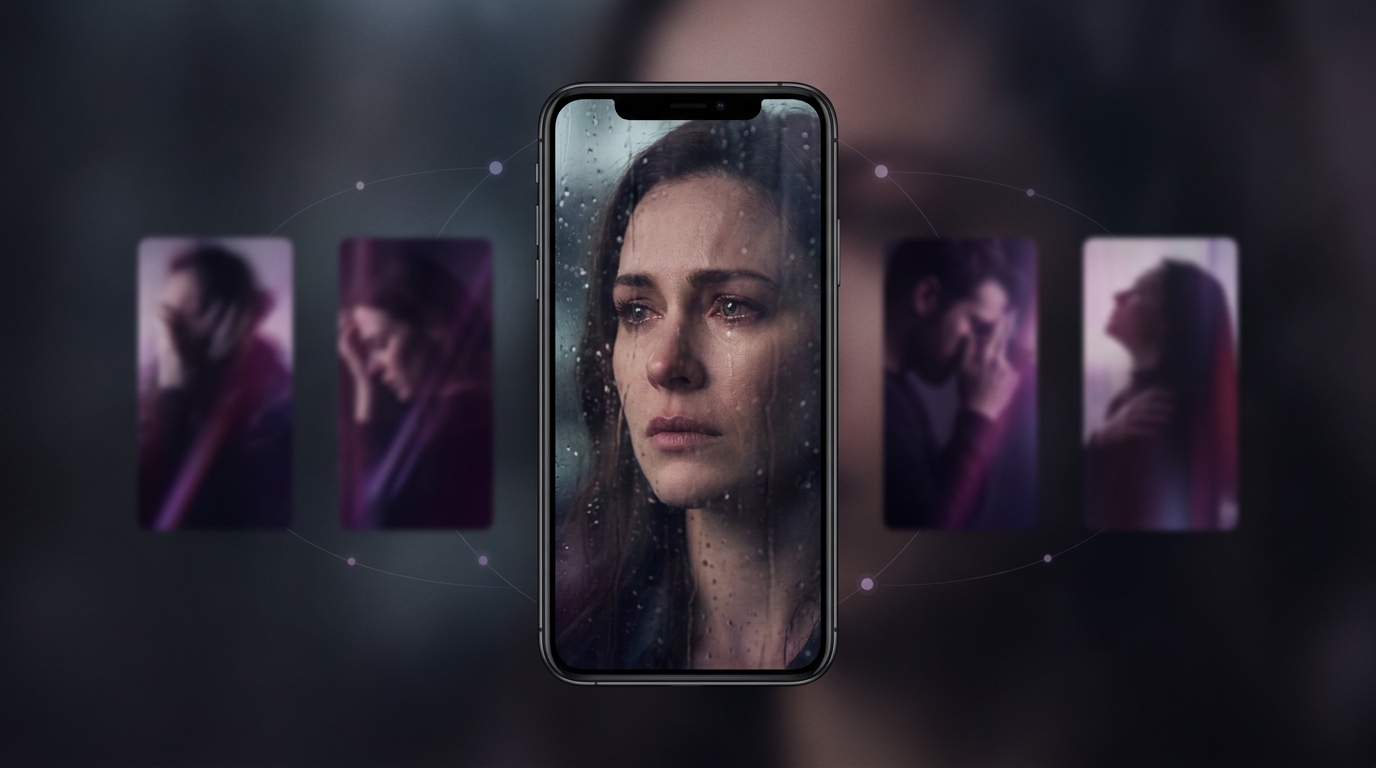
Vertical drama is a scripted story format built for the way people actually watch on phones: upright screen, short episodes, fast emotional turns, and cliffhangers that make the next tap feel obvious.
It is not just "TV cut into small pieces." A good vertical drama is designed from the start for portrait viewing, mobile pacing, serialized tension, and quick genre recognition. The frame is taller than it is wide. The scenes are compressed. The story hook arrives early. Each episode has a job.
That is why vertical drama matters for viewers, creators, and entertainment teams. It changes how stories are written, packaged, marketed, and monetized.
At Nuvelle, vertical drama means premium AI-crafted short dramas made for mobile-first viewing: one-minute episodes, daily drops, romance-forward genres, free starts in the app, and story worlds built for binge behavior. This guide explains what the format is, when it matters, and when a different format is probably better.
What is vertical drama?
Vertical drama is a short-form scripted series made primarily for portrait mobile screens. Most vertical drama episodes are around one to two minutes, and the story is usually broken into a sequence of compact episodes rather than a single long film or traditional TV episode.
The format usually has six traits:
| Trait | What it means |
|---|---|
| Portrait framing | Scenes are composed for a tall phone screen, not cropped from horizontal video. |
| Short episodes | Each episode resolves one small beat and opens the next question. |
| Serialized plot | The story depends on continuation, not standalone sketches. |
| High-emotion genres | Romance, revenge, hidden identity, werewolf fantasy, family betrayal, and second chance stories work especially well. |
| Immediate hook | The first few seconds need a clear conflict, reveal, or promise. |
| Mobile unlock path | Many apps let viewers watch early episodes free, then unlock later episodes with ads, coins, subscriptions, or app-only access. |
You may also see the format described as microdrama, mini drama, short drama, vertical series, mobile drama, or short-form serialized drama. These terms overlap, but "vertical drama" emphasizes the viewing frame and the mobile-first design.
The difference matters because portrait storytelling changes the craft. A dinner-table scene, a courtroom reveal, or a billionaire confrontation cannot be staged the same way it would be on a wide television screen. The writer, director, editor, and marketer all have to think in close-ups, reaction shots, bold reversals, and one clean emotional question per episode.
How vertical drama differs from short video
Vertical drama is related to short video, but it is not the same thing.
A short video may be a joke, reaction, tutorial, creator clip, product demo, or isolated scene. A vertical drama is a scripted serial. It asks the viewer to follow characters through a chain of consequences.
Here is the practical distinction:
| Format | Best use | Viewer question |
|---|---|---|
| Short social video | Fast discovery, humor, commentary, product hooks | "Was that worth my time?" |
| Vertical drama | Serialized emotional payoff | "What happens next?" |
| Traditional streaming episode | Deeper worldbuilding and longer arcs | "Do I want to spend 30-60 minutes here?" |
| Film | Complete story in one sitting | "Do I want the whole arc now?" |
Vertical drama matters when the next-question loop is the product. The viewer is not only watching a scene. She is tracking who lied, who has power, who will be exposed, who is secretly in love, and what the next episode will reveal.
That is why the format is so tied to romance and melodrama. A hidden heiress reveal, a rejected Luna comeback, a contract marriage twist, or a revenge reversal can be understood in seconds. The story world is familiar enough to enter quickly, but emotionally charged enough to keep watching.
When does vertical drama matter?
Vertical drama matters when mobile behavior, genre intensity, and serialized stakes all line up. If only one of those conditions is true, the format may underperform.
Use this quick scorecard before choosing vertical drama for a story, campaign, or platform strategy.
| Question | Strong vertical drama signal | Weak signal |
|---|---|---|
| Is the audience watching on phones first? | Most discovery and viewing happens on TikTok, Reels, Shorts, or a mobile app. | The audience expects desktop, TV, or long-form streaming. |
| Can the premise be understood in five seconds? | "She is the maid, but she owns the mansion." | The premise needs long exposition before it becomes interesting. |
| Does every episode create a next question? | Each beat ends with a reveal, threat, choice, or emotional reversal. | Episodes feel like loose scenes without momentum. |
| Does the genre reward high emotion? | Romance, revenge, hidden identity, werewolf, forbidden love, family betrayal. | The story depends mainly on atmosphere, subtlety, or slow procedural detail. |
| Can the frame hold close-up emotion? | Faces, status objects, text messages, doors, rings, contracts, and confrontations carry the plot. | The story depends on wide action geography or large ensemble blocking. |
| Is there a clear free-to-binge path? | Early episodes can be sampled quickly, then the viewer has a clear reason to continue. | The viewer has no obvious first episode or no clear continuation path. |
If you answer "yes" to four or more strong signals, vertical drama probably matters for the project. If you answer "yes" to two or fewer, consider a different format or reshape the premise before production.
When vertical drama matters for viewers
For viewers, vertical drama matters when the goal is emotional momentum without a long time commitment.
That usually means:
- You want a story you can start in a break, commute, or before bed.
- You prefer clear genre promises over slow setup.
- You like cliffhangers, secret identities, revenge turns, and second chances.
- You want a complete season that can be watched in short sessions.
- You want to sample the first episodes before deciding whether to unlock more.
Nuvelle's own homepage reflects that viewer behavior: the site positions the app around AI-crafted vertical dramas, daily episode drops, one-minute episodes, and app-exclusive free unlocks. The live catalog also leans into high-recognition story lanes such as hidden identity, werewolf, love at first sight, revenge, and second chance stories.
That does not mean every viewer wants every vertical drama. The format works best when you know what mood you are choosing. If you want a power fantasy, pick hidden identity or billionaire romance. If you want punishment and payoff, pick revenge. If you want fate, rank, rejection, and supernatural stakes, pick werewolf drama. If you want regret and repair, pick second chance romance.
For app selection, pair this guide with Nuvelle's mobile drama streaming evaluation framework. The format only works if the app also supports smooth playback, clear unlock boundaries, good discovery, and a reliable way to resume the next episode.
When vertical drama matters for creators and studios
For creators and studios, vertical drama matters when story packaging is as important as production.
A traditional show can ask viewers for patience. A vertical drama usually cannot. The first episode has to establish who wants what, why it hurts, and what question demands another tap. The second episode has to intensify the same promise rather than wander into setup.
That changes the operating model.
Instead of asking, "Is this a good story?" teams have to ask:
- What is the opening promise?
- Which character owns the power reversal?
- What is the cliffhanger ladder for episodes 1-5?
- Where does the free sample end?
- Which visual proof makes the ad believable?
- Which scene should be localized first for another market?
- Which metric tells us the premise is working?
That is where vertical drama becomes a system. A production team needs episode packaging, creative testing, localization, and measurement working together. A strong episode with weak packaging can disappear. A strong hook with weak continuation can drive clicks but lose paid unlocks. A strong local story with poor subtitles or dubbing can fail even when the premise is right.
For operating detail, Nuvelle's vertical drama marketing workflow explains how story promise, creative testing, and episode-to-unlock funnels connect after the format decision is made.
When vertical drama matters for marketers
Vertical drama matters for marketers when the ad is not separate from the story. The best acquisition creative often behaves like episode zero: it gives the viewer a conflict, a character position, and a question that the app can answer immediately.
That is different from a generic trailer. A trailer summarizes. A vertical drama ad provokes continuation.
A practical vertical drama ad test should track:
| Test element | What to compare |
|---|---|
| Opening hook | Betrayal, secret identity, romantic shock, status reversal, danger, or public humiliation. |
| Proof scene | The moment that proves the promise is real, such as a ring, contract, pregnancy test, family reveal, or power display. |
| Episode bridge | Whether the ad lands the viewer in the exact next story beat. |
| Free boundary | Whether the viewer knows what can be watched before paying or unlocking. |
| Continuation signal | Episode completion, next-episode tap, unlock action, subscription start, or retained viewer cohort. |
This is where the phrase "when does vertical drama matter?" becomes measurable. It matters when the format gives you cheaper learning, clearer genre tests, and better continuation than a horizontal trailer or generic social clip.
If the campaign cannot connect the ad promise to the first watch session, vertical drama may still attract attention, but the business signal will be noisy.
When vertical drama does not matter
Vertical drama is not the right answer for every story.
It is a weak fit when:
- The story needs wide spatial action that loses meaning in portrait framing.
- The plot depends on slow atmosphere before the first major conflict.
- The audience wants prestige production values more than fast emotional payoff.
- The series cannot produce a clear cliffhanger ladder.
- The business model depends on one long viewing session rather than repeated return moments.
- The team only plans to crop horizontal footage after the fact.
The last point is important. Cropping a horizontal show into a phone frame may create a vertical video file, but it does not create a vertical drama. Viewers can feel when the story was not built for their screen.
If you already have horizontal source footage, the better question is not "Can we crop it?" It is "Which scenes still make sense as close-up emotional beats, and where do we need new connective tissue?" If the answer is unclear, use the vertical cut as a trailer or teaser, not as the core drama format.
The vertical drama checklist
Use this checklist before greenlighting a vertical drama concept.
1. Define the one-sentence promise
Write the premise in a sentence a viewer can understand while scrolling.
Strong examples:
- "She cleaned his office by day, then bought his company by night."
- "He rejected her as weak, but she returned as the Alpha's true mate."
- "She married a stranger to save her family, then learned he rules the city."
Weak examples:
- "A complicated story about love and ambition."
- "A young woman discovers herself through many experiences."
- "A drama about relationships, secrets, and growth."
2. Build the first five episode jobs
Do not outline only plot events. Assign each early episode a job.
| Episode | Job |
|---|---|
| Episode 1 | Hook the wound, insult, danger, secret, or impossible bargain. |
| Episode 2 | Prove the power imbalance or emotional cost. |
| Episode 3 | Reveal the first hidden advantage or deeper threat. |
| Episode 4 | Force a public choice, mistake, or humiliation. |
| Episode 5 | End with a reversal that makes the unlock feel urgent. |
This structure helps vertical drama avoid the common mistake of spending early episodes on setup. The viewer should feel the story moving from the first minute.
3. Protect portrait-native staging
Ask whether the important information fits in a tall frame. Faces, phones, rings, documents, elevator doors, hospital rooms, offices, and doorway confrontations tend to work. Large battles, multi-person comedy blocking, and complex chase geography are harder unless redesigned for close-up beats.
4. Decide the unlock boundary before production
The unlock boundary is not just a monetization decision. It is a story decision. If the free sample ends too early, viewers do not trust the promise. If it ends too late, the strongest continuation point may pass without a conversion moment.
For viewer trust, make the free start clear. For story momentum, make the boundary land after a real reveal, not before the premise has paid off.
For a user-facing view of this issue, see Nuvelle's guide to watching short dramas for free.
5. Choose the measurement signal before launch
Vertical drama cannot be judged only by views. A high-view clip may still fail if viewers do not continue.
Track signals in this order:
- Hook hold: do viewers stay past the opening seconds?
- Episode completion: do they finish episode 1?
- Next-episode tap: do they ask for episode 2?
- Free-sample depth: do they reach the unlock boundary?
- Unlock or subscription action: do they convert after the promise is proven?
- Return behavior: do they come back for the same story world or genre lane?
The right metric depends on the stage. Early concept tests need continuation signals. Launch tests need unlock and retention signals. Portfolio decisions need contribution and repeat-viewing signals.
A simple decision rule
Choose vertical drama when the story can deliver a clear emotional promise in a phone-native frame, then renew that promise every one to two minutes.
Choose another format when the story needs long setup, wide visual scale, or subtle slow-burn attention that would be damaged by constant cliffhangers.
For Nuvelle, vertical drama matters because the product is built around the format itself: AI-crafted mobile episodes, daily cliffhangers, genre discovery, free app starts, and a catalog designed for quick emotional entry. The format is not a wrapper around the story. It is the story engine.
If you are deciding what to watch next, start with the mood you want. If you are building or marketing a series, start with the first five episode jobs. Either way, the question is the same: does this story make the next tap irresistible?
FAQ
Is vertical drama the same as microdrama?
They are closely related. Microdrama usually emphasizes short episode length. Vertical drama emphasizes the portrait mobile format. Many modern microdramas are also vertical dramas, but a short episode is not automatically vertical drama unless the story and visuals are designed for a phone-first frame.
How long is a vertical drama episode?
Many vertical drama episodes run about one to two minutes. The exact length matters less than the episode job: each installment should deliver one clear beat and create one reason to continue.
What genres work best for vertical drama?
Romance, revenge, hidden identity, billionaire or CEO romance, forbidden love, werewolf fantasy, second chance, and family betrayal are strong fits because viewers can understand the stakes quickly and feel the reversal immediately.
Can you turn a normal TV show into vertical drama?
Sometimes, but cropping is not enough. A successful conversion needs portrait-native scene selection, new pacing, tighter cliffhangers, and a clear episode ladder. Otherwise it is only a vertical edit, not a vertical drama.
Why does vertical drama matter now?
It matters because mobile entertainment habits, short-form discovery, app-based unlock models, and AI-assisted production are converging. Viewers already understand phone-native stories. The winning teams are the ones that make those stories feel cinematic, emotional, and easy to continue.