An episode packaging workflow: cost and ROI guide becomes more valuable after the first package goes live. The first spreadsheet helps a team approve a release. The weekly control system shows whether the next package should get bigger, smaller, localized, reworked, or stopped.
For short drama teams, that weekly layer matters because packaging cost is rarely one clean invoice. It accumulates through version changes, subtitle edits, thumbnail resets, re-export queues, metadata fixes, delivery retries, paid cutdowns, and late localization decisions. If those changes are reviewed only after the campaign ends, the team learns too late.
This guide gives producers, growth leads, finance owners, and localization teams a practical weekly operating model for Nuvelle-style vertical drama releases. Use it with the core episode packaging workflow cost and ROI guide, the episode packaging ROI calculator template, and the package approval decision guide. This article focuses on the live management problem: how to control cash, signal, and ROI across a rolling package pipeline.
Why the Weekly Layer Belongs in an Episode Packaging Workflow: Cost and ROI Guide
The weekly layer belongs in an episode packaging workflow: cost and ROI guide because package economics change while the work is moving. A source package may pass approval on Monday, then create new exposure by Thursday because the team adds a second language, a new trailer cutdown, an extra thumbnail family, or a rework pass after a failed QA check.
The question is not only:
Was this package worth approving?The better weekly question is:
What changed since approval, and does the next cost still deserve release?That question catches the cost leaks that normal production calendars miss. A calendar can show that episodes are moving. It does not show whether the package is still inside its approved cash-at-risk limit, whether reusable assets are actually being reused, or whether the first viewer signal justifies more scope.
For an AI-native vertical drama platform like Nuvelle, this distinction is important. AI-assisted production can support speed and volume, but the brand promise still depends on premium, mobile-first story packaging. Faster creation does not remove the need for continuity checks, localized promise control, rights review, final-render QA, and measurement discipline.
The Weekly Cost-Control Board
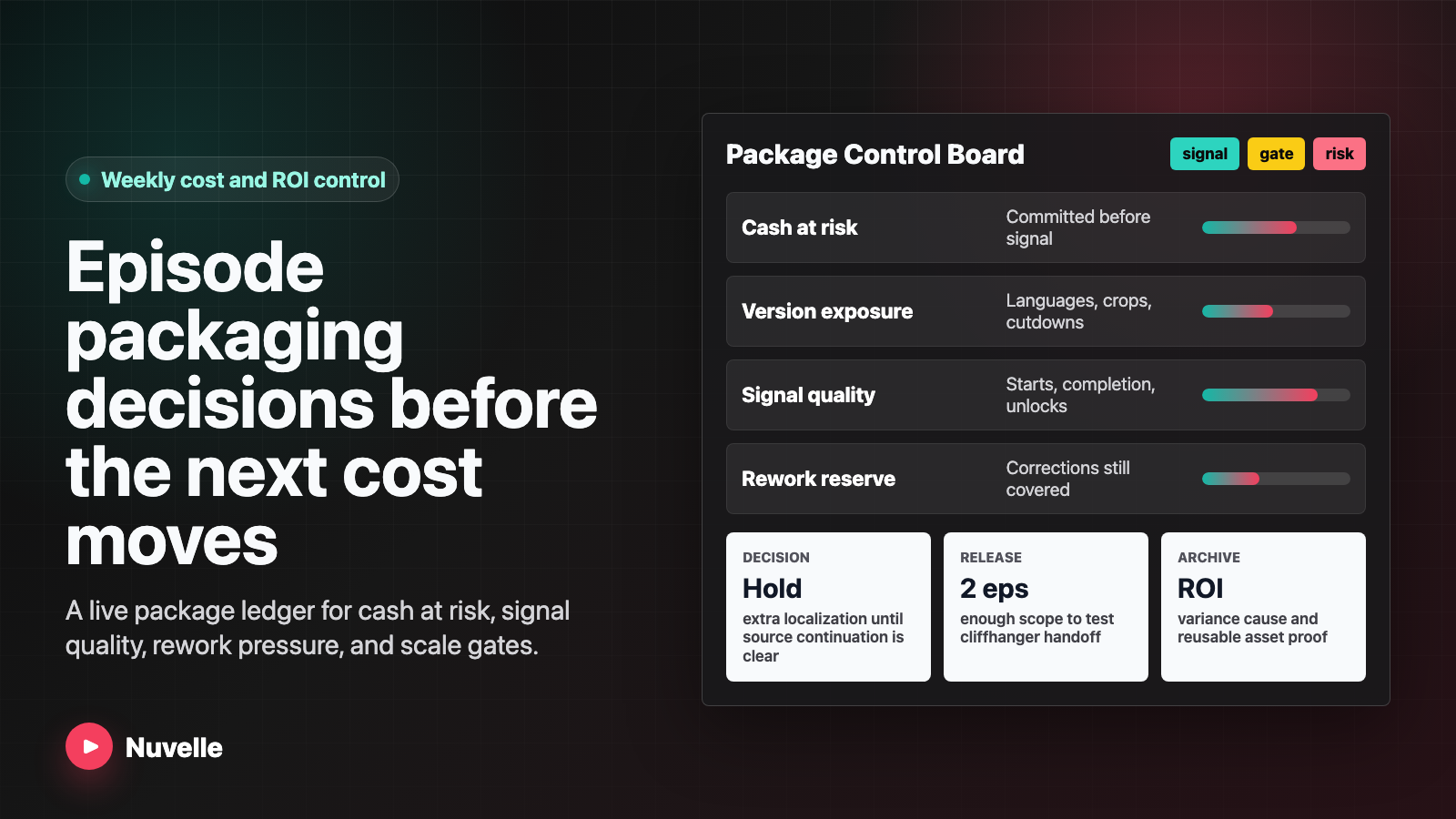
Start with one control board for every active package. Keep it small enough for a 30-minute weekly review.
| Control | What it answers | Owner | Weekly status |
|---|---|---|---|
| Package scope | What is included now and what is held behind a signal? | Producer | Green / yellow / red |
| Cash committed | How much spend is already committed before the next useful signal? | Finance | Green / yellow / red |
| Version exposure | Which languages, crops, platforms, and promo variants are live or pending? | Operations | Green / yellow / red |
| Rework pressure | Are corrections inside the planned reserve? | QC lead | Green / yellow / red |
| Signal quality | Are starts, completion, continuation, or paid actions interpretable? | Growth or analytics | Green / yellow / red |
| Reuse evidence | Which assets lowered the next package cost or cycle time? | Producer | Green / yellow / red |
| Next release decision | Expand, hold, revise, localize, or stop? | Decision owner | Written action |
The board should not become a status report filled with vague notes. In this episode packaging workflow: cost and ROI guide, each color needs an operating rule:
| Status | Meaning | Required action |
|---|---|---|
| Green | The package is inside approved scope, cost, QA, and signal rules. | Continue the approved plan. |
| Yellow | One assumption changed, but the package can still be managed. | Write the tradeoff and name the next check. |
| Red | The package exceeds a gate, hides cost, or lacks readable signal. | Stop new cost release until the owner decides. |
This keeps the episode packaging workflow: cost and ROI guide from becoming a one-time model. It becomes a weekly control habit.
Build the Package Ledger Before More Work Starts
A package ledger is different from a budget. A budget estimates what should happen. A ledger records what is now true.
Use one row per package:
| Field | Entry |
|---|---|
| Package ID | ___ |
| Series / story world | ___ |
| Episodes included | ___ |
| Source language | ___ |
| Approved markets and languages | ___ |
| Held-back markets and languages | ___ |
| Approved promo assets | ___ |
| Held-back promo assets | ___ |
| First signal date | ___ |
| Final measurement date | ___ |
| Decision owner | ___ |
| Stop / reduce rule | ___ |
Then add the weekly financial fields:
| Financial field | Formula or rule |
|---|---|
| Approved package cost | Cost approved at the original gate |
| New committed cost | Spend approved since the last review |
| Total committed cost | Original committed cost + new committed cost |
| Signal-gated cost still held | Approved-in-principle work not yet released |
| Rework reserve remaining | Planned reserve - actual rework cost |
| Conservative reusable value | Asset value only when a next use is confirmed |
| Cash at risk | Total committed cost - conservative reusable value |
This ledger exposes the difference between "the package is on schedule" and "the package is still economically controlled." A package can be on schedule and still be overexposed if too many versions were approved before the first useful signal.
Separate Three Types of Cost Movement
Every weekly review should classify cost movement into three types. This is one of the most useful disciplines in an episode packaging workflow: cost and ROI guide because it prevents all variance from being treated as the same problem.
| Cost movement | Definition | Example | Decision response |
|---|---|---|---|
| Scope expansion | The team chose to add work that was not in the approved package. | Add Spanish thumbnails before source continuation is known. | Require a signal or explicit exposure approval. |
| Estimate variance | The original estimate was wrong for the approved scope. | Subtitle timing takes longer than planned for the same language. | Update the next estimate and owner assumptions. |
| Quality failure | Rework appeared because the package missed a control. | Wrong episode number, mismatched title, failed export, or promise mismatch. | Fix the control before releasing more cost. |
This distinction matters because the remedy changes. Scope expansion needs a gate. Estimate variance needs better forecasting. Quality failure needs workflow repair.
If the weekly review simply says "costs increased," the next package will repeat the same mistake.
Connect Cost Movement to Viewer Signal
Packaging ROI depends on the relationship between cost and signal. A larger package may be justified when the signal is strong. The same cost can be irresponsible when the signal is weak or unreadable.
Use this weekly signal table:
| Signal | What it tells the team | Cost decision it can support |
|---|---|---|
| Qualified starts | The hook and promise are attracting the right viewer. | Release limited promo variants or test a second hook. |
| Episode-one completion | The opening episode delivers enough of the promise. | Continue source packaging or prepare episode-two handoff. |
| Episode-two continuation | The cliffhanger and sequence are working. | Approve additional episodes in the same package pattern. |
| Paid unlock or subscription start | The package connects to contribution. | Release more paid creative, localization, or scale scope. |
| Return viewing | The story world is creating habit potential. | Package a larger batch if quality controls are stable. |
Do not release more cost from a signal the package was not designed to read. For example, starts can justify a better hook test, but they do not automatically justify a full localization package. Localization should usually wait for evidence that the story promise, completion, and continuation can survive the source market.
For measurement design, connect this step with the vertical drama measurement and attribution playbook. An ROI guide is only as useful as the event definitions behind it.
The Weekly ROI Snapshot
The weekly snapshot should fit into one table and use the same definitions every time.
| Metric | Formula | Why it matters |
|---|---|---|
| Total package cost | Fixed cost + variable cost + version cost + rework cost | Shows full investment boundary. |
| Cash at risk | Committed cost before next signal - confirmed reusable value | Shows downside exposure. |
| Contribution per paid action | Net revenue per paid action - variable cost per paid action | Converts activity into economics. |
| Break-even paid actions | Total package cost / contribution per paid action | Gives growth a concrete target. |
| Current attributable contribution | Paid actions attributed to the package x contribution per paid action | Shows current return path. |
| Package ROI | (Attributable contribution - total package cost) / total package cost | Shows whether the package has paid back. |
| Learning-adjusted decision | Contribution + confirmed reuse + decision value compared with cash at risk | Helps evaluate tests that are not fully paid back yet. |
The last row needs discipline. Learning value should be counted only when it changes a next decision. A package that teaches the team to stop an unfit language version has decision value. A package that creates a vague "we learned a lot" note does not.
A Four-Part Weekly Decision Rule
Use the same decision rule every week:
Release the next cost only if scope is stable, cash at risk is inside the approved limit, signal quality is readable, and the next action is tied to contribution, reuse, or a specific learning decision.Break that into four gates:
| Gate | Pass question | If it fails |
|---|---|---|
| Scope gate | Is the package still the package we approved? | Freeze additions and rewrite the version matrix. |
| Exposure gate | Is cash at risk still inside the approved learning loss? | Delay optional versions or request explicit approval. |
| Signal gate | Do we have a readable viewer or commercial signal? | Improve tracking or wait before adding scope. |
| ROI gate | Does the next cost create contribution, reuse, or decision value? | Hold, reduce, or redirect the work. |
This is the weekly operating core of an episode packaging workflow: cost and ROI guide. It gives creative, finance, localization, and growth the same decision structure.
How to Handle Yellow Packages
Most real packages turn yellow before they turn red. The weekly workflow should make yellow useful.
Common yellow cases:
| Yellow case | What it means | Best response |
|---|---|---|
| Source package is clean, but completion is low | The promise may be attracting viewers without paying off. | Hold localization and diagnose episode-one delivery. |
| Starts are strong, but paid action is weak | The acquisition hook works, but the commercial handoff may not. | Test unlock moment, episode order, or CTA before expanding. |
| Localization cost is rising | The first language has more adaptation work than expected. | Use a short drama localization adaptation brief before approving more languages. |
| Rework reserve is half used before launch | QA is finding preventable issues early. | Fix the control before adding more deliverables. |
| Reusable asset value is unclear | The team created assets but has no confirmed next use. | Count reuse at zero until the next package uses it. |
| Paid cutdowns are requested before tracking is live | Growth wants speed before attribution is ready. | Run a tracking smoke test first. |
Yellow should not trigger panic or blind continuation. It should force a named tradeoff.
How to Handle Red Packages
A red package should stop new cost release, not necessarily stop the whole release. The difference matters.
Use this red-package response:
- Freeze optional scope.
- Name the failing gate.
- Separate sunk cost from remaining exposure.
- Identify the smallest useful release unit.
- Decide whether to repair, reduce, localize later, or stop.
The smallest useful release unit is often smaller than the approved package. A team may still release the source episode, hold the extra promo variants, delay a dub, and keep the next episode behind a signal gate.
Red package examples:
| Red condition | Immediate decision |
|---|---|
| Version matrix no longer matches the approved package | Rewrite scope before any more exports. |
| Cash at risk exceeds approved learning loss | Delay nonessential versions or get explicit approval. |
| Tracking cannot connect starts, completion, continuation, or paid actions | Fix measurement before claiming ROI. |
| Rework reserve is exhausted before launch | Diagnose quality failure and reduce new scope. |
| Source story signal is weak and localization is pending | Hold localization until the story package is repaired. |
For launch operations, pair this with the vertical drama launch day workflow so release, tracking, and episode handoff decisions are visible before live traffic arrives.
Run a Rolling Package Cohort Review
One package can be noisy. A rolling cohort reveals patterns. Review the last five to ten packages with the same fields:
| Package | Size | Main uncertainty | Cash at risk | Signal outcome | Cost variance cause | Next decision |
|---|---|---|---|---|---|---|
| Package A | 1 episode | New hook | $___ | Weak completion | Quality failure | Repair source package |
| Package B | 2 episodes | Continuation | $___ | Strong continuation | Estimate variance | Approve similar two-episode pattern |
| Package C | 3 episodes | Localization | $___ | Mixed market signal | Scope expansion | Hold added languages |
| Package D | 4 episodes | Stable series | $___ | Strong paid action | Low variance | Repeat package pattern |
The cohort review answers questions a single package cannot:
- Which package size usually creates readable signal?
- Which cost line repeatedly misses estimate?
- Which rework source is becoming normal?
- Which language or market expands cost before proof?
- Which reusable assets actually reduce future work?
- Which signals reliably predict paid action?
This is where an episode packaging workflow: cost and ROI guide becomes a compounding system. Each package should make the next estimate sharper.
Package Size Rules for Weekly Control
Use package size as a control lever, not a status symbol.
| Weekly evidence | Better next package | Reason |
|---|---|---|
| New story promise, weak or unknown signal | One episode | Protects cash while learning. |
| Starts are good, but continuation is unknown | Two episodes | Tests the handoff without overcommitting. |
| Continuation is stable, but paid action is unproven | Two or three episodes | Gives growth more material while holding scale. |
| Source package works, localization is unknown | Source package plus one signal-gated language | Keeps market cost behind proof. |
| Stable story, stable QA, stable contribution | Three or four episodes | Shared setup can lower friction without hiding exposure. |
The wrong lesson from a cost model is "bigger packages are cheaper." The right lesson is "bigger packages need stronger proof."
The Weekly Meeting Agenda
Keep the weekly meeting short and decision-led.
- Scope check: What changed since approval?
- Cost check: What new cash was committed?
- Signal check: What viewer or commercial evidence is readable?
- Variance check: Which cost line moved, and why?
- Reuse check: Which assets reduced future cost or cycle time?
- Decision check: What cost is released, held, reduced, or stopped?
- Archive check: What evidence must be saved for the next package estimate?
End the meeting with a written decision:
Package ID:
Status: green / yellow / red
Cost released this week:
Cost held this week:
Signal used:
Next decision date:
Owner:
Reason:
Without that decision record, the team will remember the meeting as alignment. The workflow needs it as evidence.
What to Archive After Each Package
Archive the materials that improve the next package. Do not save files only for storage.
| Archive item | Why it matters |
|---|---|
| Final version matrix | Shows what the package actually included. |
| Planned vs actual cost table | Improves future estimates. |
| Rework log | Identifies preventable quality failures. |
| Signal snapshot | Connects packaging choices to viewer behavior. |
| Paid-action or contribution summary | Connects package cost to ROI. |
| Reusable asset list | Shows which setup work will lower future cost. |
| Decision memo | Explains why the next package expanded, held, or stopped. |
This archive is also useful for teams testing new markets. When localization is added, the archive should include adapted titles, subtitle rules, cultural changes, thumbnail decisions, QA notes, and market-specific performance signals. The broader short drama localization beginner guide can help structure that first-market system.
Common Mistakes in Weekly Cost Control
Avoid these mistakes:
- Treating cost per episode as the only ROI metric.
- Counting all stored assets as reusable value.
- Releasing localization cost from start-rate signal alone.
- Ignoring rework because it sits in team time instead of vendor invoices.
- Changing the measurement window between packages.
- Adding paid cutdowns before tracking can read the result.
- Letting a yellow package expand because the calendar says launch is close.
- Calling a package successful when contribution is unclear and learning did not change the next decision.
The point of an episode packaging workflow: cost and ROI guide is not to slow production. It is to keep production speed connected to commercial evidence. A practical episode packaging workflow: cost and ROI guide should make the next release decision easier, not make the budget conversation heavier.
Final Checklist: Weekly Episode Packaging Workflow Cost and ROI Guide
Before releasing the next cost, confirm:
- The package scope still matches the approved version matrix.
- Cash at risk is visible.
- Reusable value is conservative and tied to confirmed next use.
- Rework is classified as scope expansion, estimate variance, or quality failure.
- Viewer signal is readable.
- Paid action or contribution logic is defined.
- Optional languages, dubs, thumbnails, and promo variants are behind gates unless proof supports them.
- The next action is written as expand, hold, revise, localize, or stop.
- The decision owner and next review date are named.
An episode packaging workflow: cost and ROI guide should help a short drama team do more than approve a package. It should help the team learn when a package deserves more investment, when it should stay small, and when the next dollar is better held for a clearer signal.
For Nuvelle, that discipline supports the broader content model: premium AI-crafted vertical dramas, daily release momentum, and story packaging that protects both speed and finish quality.