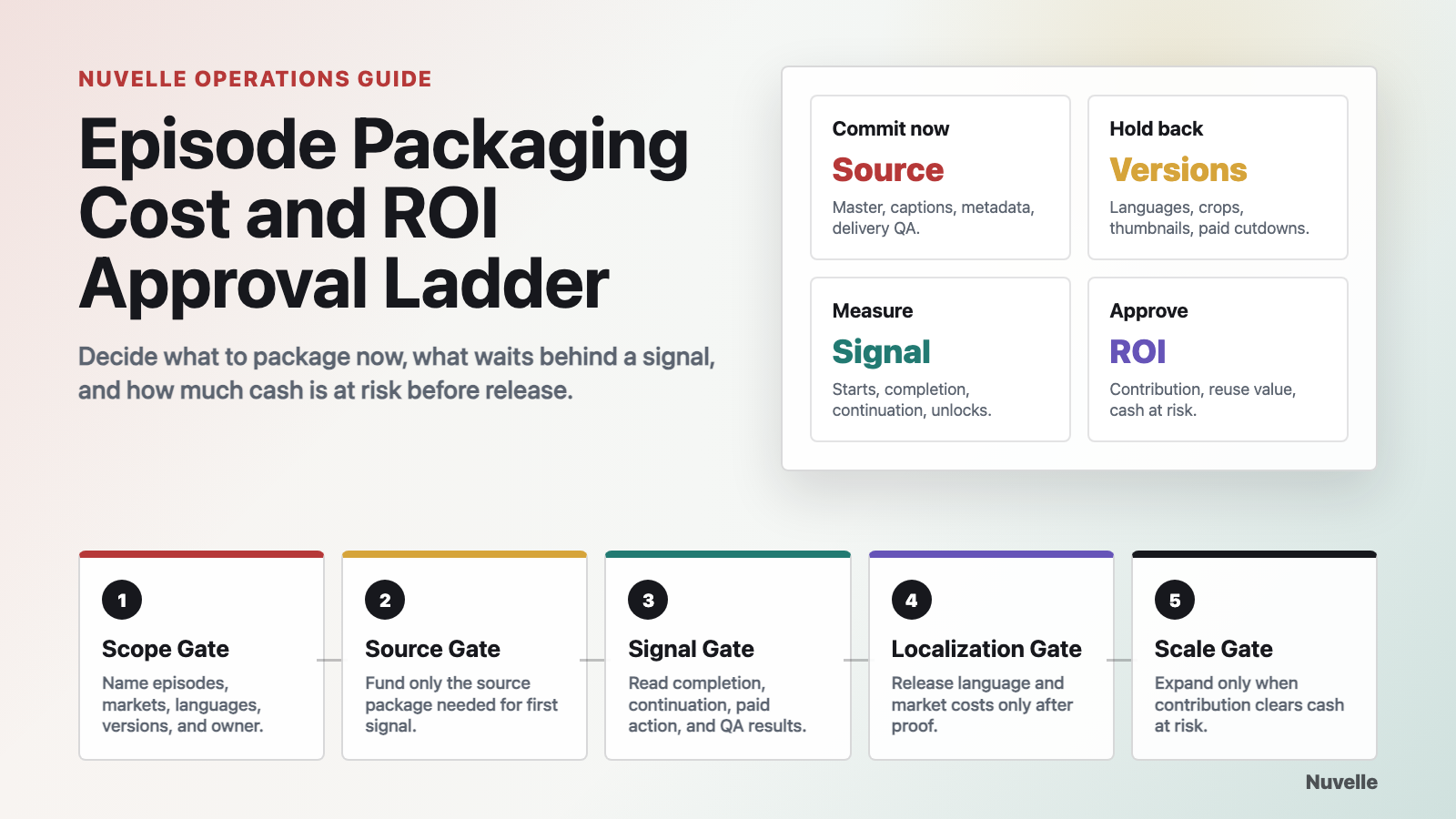
An episode packaging workflow: cost and ROI guide should do more than explain whether a finished episode was expensive. It should help a short drama team decide what to package now, what to delay, and what evidence must exist before the next cost is released.
That distinction matters because episode packaging is where creative, localization, metadata, thumbnails, paid cutdowns, app delivery, and measurement all meet. A team can approve "three episodes" and later discover that the real package includes three crops, two languages, four ad cutdowns, separate metadata sets, extra quality control, and a rework queue. The budget did not explode because one line item was wrong. It grew because the package was not defined as a commercial release unit.
This guide is a practical approval workflow for Nuvelle-style vertical drama teams that need premium, mobile-first episodes ready for daily discovery and paid unlock testing. Use it alongside the broader episode packaging workflow cost and ROI guide, the 2026 audit version, and the episode packaging ROI calculator template. This article focuses on the cost decision itself: how to approve a package without hiding cash at risk.
The Job of an Episode Packaging Workflow: Cost and ROI Guide
The job of an episode packaging workflow: cost and ROI guide is to turn a batch into a decision. A batch says, "these files move together." A decision says, "these costs are approved because they create release readiness, measurable learning, reusable assets, or contribution." In practice, an episode packaging workflow: cost and ROI guide is the shared language between production speed and business risk.
For short drama teams, the approval question should be:
Should we commit this package before the next viewer signal, or should part of the scope wait behind a gate?
That one question prevents three common mistakes.
First, it stops the team from treating all costs as equal. A clean source master and source-language captions may be required before the first market test. A third language dub, a large paid cutdown set, or an alternate thumbnail family may be better released only after the first signal.
Second, it keeps unit cost from overruling learning speed. A four-episode package may reduce setup cost per episode, but it can still be the wrong choice if the story promise, cliffhanger, or market angle is unproven.
Third, it makes ROI visible before the package goes live. Views, starts, continuation, unlocks, subscription starts, or retained viewers should be connected to contribution. Otherwise the team is approving production activity, not a return path.
Define the Cost Decision Before You Define the Cost
Before building a spreadsheet, write the decision in plain language:
| Decision field | What to write |
|---|---|
| Package question | What must this package prove? |
| Approved release unit | Which episodes, markets, languages, versions, and assets are included now? |
| Held-back scope | Which optional items wait for a signal? |
| Signal date | When will the first useful performance evidence arrive? |
| Decision owner | Who can release or stop the next cost? |
| Success action | Which viewer action ties to ROI? |
| Stop rule | What result forces reduce, rework, or pause? |
If this block is vague, the cost model will be vague. A package that says "prepare episodes 4 to 6 for launch" is not enough. A usable decision looks more like this:
Approve episodes 4 and 5 in source language for app release, one vertical paid trailer cutdown per episode, and one metadata set. Hold Spanish subtitles, Spanish thumbnails, and extra paid cutdowns until episode-one completion and episode-two continuation pass the agreed gate.
This sentence gives production, localization, marketing, and analytics the same scope. It also makes delay respectable. Holding a cost behind a signal is not indecision. It is how a packaging workflow protects learning speed.
Build a Cost Map by Commitment Timing
Most packaging budgets group costs by department. For approval, group them by when cash becomes committed. This is where an episode packaging workflow: cost and ROI guide becomes more useful than a normal post-production budget.
| Cost group | Examples | Approval treatment |
|---|---|---|
| Required before source test | Master finishing, source captions, source metadata, platform export, source QA | Usually approve now |
| Useful but gateable | Additional subtitles, alternate thumbnails, paid creative variants, extra crops, market-specific descriptions | Approve only if tied to a signal |
| Risk reserve | Rework, rush corrections, vendor redo, platform rejection, localization fixes | Name the reserve before launch |
| Reusable investment | templates, glossaries, naming rules, export presets, artwork system, validated hooks | Count conservatively only when next use is real |
Then calculate three totals:
Total package cost = required cost + gateable cost + risk reserve

Committed-before-signal cost = required cost + any gateable cost approved now

Cash at risk = committed-before-signal cost - conservative reusable value
This is the center of the episode packaging workflow: cost and ROI guide. The team may still approve a high-risk package, but it should do so with the exposure named.
For example, a team might approve source finishing and source metadata now, hold a second-language package until first-market continuation is known, and hold additional paid cutdowns until one hook proves it can attract qualified starts. The total opportunity remains available, but the upfront exposure is lower.
Use a Version Matrix So Scope Cannot Hide
Episode packaging gets expensive when version count is discovered after approval. The matrix does not need to be complicated. It just needs to make every multiplier visible.
| Scope driver | Approved now | Held behind signal | Owner |
|---|---|---|---|
| Episodes | ___ | ___ | Production |
| Source-language exports | ___ | ___ | Post |
| Subtitle languages | ___ | ___ | Localization |
| Dub languages | ___ | ___ | Localization |
| Metadata sets | ___ | ___ | Editorial |
| Thumbnail families | ___ | ___ | Creative |
| Paid trailer cutdowns | ___ | ___ | Growth |
| Platform crops | ___ | ___ | Delivery |
| QA passes | ___ | ___ | Operations |
The goal is not to make the package smaller by default. The goal is to avoid approving a small-sounding release that quietly becomes a large one.
A simple version formula helps:
Working versions = episodes x markets x languages x platform versions x promo variants
Even if your actual workflow has more nuance, this formula forces the right conversation. If one added language doubles the QA and metadata burden, the team should see that before the cost is treated as a small translation add-on.
For teams preparing a new market, connect this step with a short drama localization adaptation brief. Localization changes packaging cost because it changes titles, subtitles, cultural cues, thumbnails, QA, and sometimes the promise made in the first three seconds.
Tie ROI to Contribution, Not Production Efficiency
Production efficiency is useful, but it is not ROI. A package can lower cost per episode and still fail commercially if it does not create paid actions or retained viewers.
Use this basic model:
Contribution per paid action = net revenue per paid action - variable cost per paid action

Required paid actions = total package cost / contribution per paid action

Package ROI = (attributable contribution - total package cost) / total package cost
The paid action should match the business model. For a vertical drama app, useful actions may include:
- paid episode unlocks
- coin purchases
- subscription starts
- retained viewers who return inside the measurement window
- ad-supported completions when the model monetizes attention directly
Avoid calculating ROI from starts alone unless starts have a proven contribution path. A strong paid trailer can generate starts while episode completion, continuation, or unlock behavior remains weak. In that case the package may have a marketing signal, but not yet a packaging ROI signal.
Use a funnel table so the paid action is not invented at the end:
| Funnel input | Planned assumption | Actual result | Decision note |
|---|---|---|---|
| Qualified starts | ___ | ___ | Is the hook attracting the right viewer? |
| Episode-one completion | ___% | ___% | Does the opening deliver the promise? |
| Episode-two continuation | ___% | ___% | Does the package earn the next episode? |
| Paid-action rate | ___% | ___% | Does the unlock or subscription moment work? |
| Contribution per paid action | $___ | $___ | Is the economics assumption still valid? |
| Required paid actions | ___ | ___ | Did the package clear break-even? |
For measurement design, the adjacent vertical drama measurement and attribution playbook is the useful next read. Packaging ROI depends on clean events, not just clean exports.
Decide Package Size by Uncertainty
The right package size depends on what is still unknown. Use this decision table before approving one, two, three, or four episodes.
| If the main uncertainty is... | Prefer this package | Why |
|---|---|---|
| New story promise, genre, market, or vendor | One episode | Protects cash while the team learns whether the premise travels |
| Continuation from episode one to episode two | Two episodes | Lets the team test the handoff without overcommitting |
| Stable story and workflow, uncertain paid hook | Two or three episodes | Gives growth enough material while limiting locked scope |
| Stable templates, stable localization, proven continuation | Three or four episodes | Spreads setup cost across more release-ready assets |
| Market expansion with unknown language response | Source package plus signal-gated localization | Keeps translation, dub, and local artwork from moving before proof |
This is where many teams misuse an episode packaging workflow: cost and ROI guide. They look for the lowest cost per episode. The better question is which package size creates enough evidence before the next commitment.
A one-episode test can be economically correct even when its unit cost is higher. A four-episode package can be economically correct only when shared work is real, rework is controlled, and the team knows which signal would stop the next package from expanding.
Create a Cost Release Ladder
A cost release ladder is the operating system for approval. It tells the team what is funded now and what waits.
| Gate | Fund now | Evidence required to release next cost | Possible decision |
|---|---|---|---|
| Scope gate | Brief, version matrix, owner map | Package question and stop rule are written | Approve brief or hold |
| Source gate | Source master, captions, metadata, source QA | Source package passes creative and delivery QA | Approve source launch |
| Signal gate | Limited promo cutdowns and tracking QA | Starts, completion, continuation, or unlock signal reaches threshold | Expand, revise, or stop |
| Localization gate | First target language, local metadata, local QA | Source package shows enough continuation or paid action intent | Localize, adapt, or wait |
| Scale gate | More episodes, more cutdowns, more markets | Contribution and reuse justify added exposure | Scale package or reset |
This ladder keeps the package from becoming an all-or-nothing bet. It also creates a shared vocabulary for finance and creative teams. Creative leaders can protect story quality. Finance can see cash at risk. Growth can see when it is allowed to request more cutdowns or market versions.
For launch operations, connect the ladder to a vertical drama launch day workflow so tracking, destinations, episode handoff, and decision logs are ready before the campaign starts.
Price Rework Before It Happens
Rework is part of packaging economics. It should not appear only after the budget is already stressed.
Create a rework reserve with three fields:
| Rework source | Prevention step | Reserve treatment |
|---|---|---|
| Story continuity issue | Continuity lock before exports | Small reserve for source package |
| Subtitle or title mismatch | Shared glossary and final title approval | Medium reserve for localized package |
| Thumbnail promise mismatch | Promise-to-proof review before creative export | Medium reserve for paid package |
| Platform spec rejection | Delivery checklist before final render | Small reserve if specs are stable |
| Late market adaptation | Adaptation brief before translation | Larger reserve for first-market tests |
If the team is using AI-assisted production, add final-render review, character consistency, rights/provenance checks, and premium-finish QA as explicit lines. Nuvelle's brand promise is premium AI-crafted vertical drama, not cheap automation. The cost model should protect that promise.
Add Reuse Value Without Fooling Yourself
Reusable value is real only when it changes future cost or speed. A glossary, caption template, export preset, thumbnail structure, or validated hook can be valuable. A folder full of unused files is not.
Use this test:
| Asset | Count reuse value only if... |
|---|---|
| Caption template | It will be used in the next package without rebuilding rules |
| Character glossary | It is approved and required for future localization |
| Thumbnail system | It gives the next package a faster approved layout |
| Export preset | It reduces delivery work on the next release |
| Paid hook structure | It produced a measurable signal worth repeating |
| QA checklist | It prevented a known rework pattern |
When in doubt, discount reusable value. A conservative model is more useful than a generous one that makes every package look justified.
The Weekly Approval Packet
At the end of the workflow, the team should have a one-page approval packet. This is the simplest artifact an episode packaging workflow: cost and ROI guide can produce because it turns debate into a visible approval record. Copy this structure:
| Field | Entry |
|---|---|
| Package ID | ___ |
| Package question | ___ |
| Approved episodes | ___ |
| Approved markets/languages | ___ |
| Held-back scope | ___ |
| Total package cost | $___ |
| Committed-before-signal cost | $___ |
| Conservative reusable value | $___ |
| Cash at risk | $___ |
| Contribution action | ___ |
| Required paid actions | ___ |
| First signal date | ___ |
| Stop/reduce rule | ___ |
| Expand/localize rule | ___ |
| Owner | ___ |
Review this packet in the same cadence as creative and campaign decisions. Packaging should not live in a separate production spreadsheet while growth and finance make decisions from different numbers. A good episode packaging workflow: cost and ROI guide makes those teams argue from the same package ID, cost exposure, and signal date.
Common Approval Mistakes
Avoid these shortcuts:
- Approving a package from total cost without separating committed-before-signal cost.
- Treating localization as a small text add-on instead of a versioning, metadata, QA, and cultural adaptation cost.
- Choosing four episodes only because cost per episode looks lower.
- Counting reusable value for assets with no confirmed next use.
- Measuring starts but not completion, continuation, or paid actions.
- Letting paid creative variants multiply without a signal gate.
- Forgetting to archive actual cost, rework, and performance evidence for the next package.
Each shortcut makes the next estimate weaker. The point of an episode packaging workflow: cost and ROI guide is not to slow the team down. It is to make each package teach the next package what to approve faster.
Final Takeaway
The best episode packaging workflow: cost and ROI guide is an approval system. It defines the release unit, exposes cash at risk, prices rework, separates gateable scope, and connects package size to contribution. Keep the episode packaging workflow: cost and ROI guide close to the weekly approval meeting so every new package starts from the last package's evidence.
Use one episode when uncertainty is high. Use two episodes when continuation is the test. Use three or four only when shared work, localization readiness, tracking, and reuse are stable enough to justify the exposure.
For Nuvelle and other AI-native vertical drama teams, episode packaging is not just post-production. It is the bridge between story promise, daily release readiness, and measurable return. Treat it like a cost decision, and the workflow becomes easier to scale.