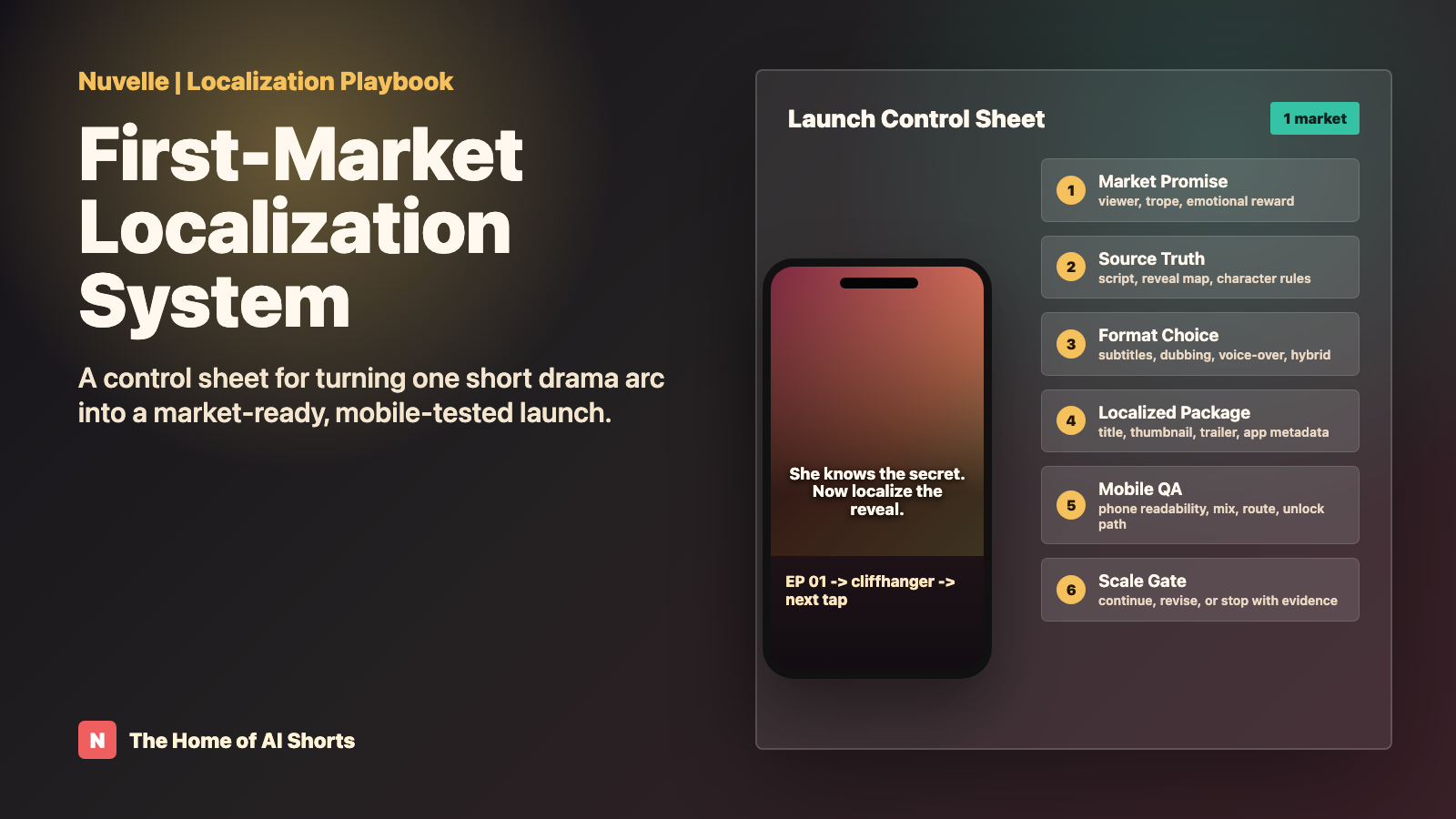
Short drama localization: beginner guide advice often starts with translation, but the stronger starting point is control. Before a team translates one line, it needs a small operating system for deciding what to localize, who approves it, where each asset lives, how the phone-viewing experience is tested, and what result will justify the next market.
That system matters because vertical short drama is not watched like a long film. A viewer may enter through a TikTok-style hook, read a localized title, watch a one-minute emotional turn, hit a cliffhanger, and decide within seconds whether the next episode is worth unlocking. If the dialogue is localized but the poster, subtitles, voice tone, app metadata, or next-episode path feels inconsistent, the market test becomes noisy.
This short drama localization: beginner guide gives producers, editors, growth teams, and local reviewers a practical first-market system. Use it when you have one short drama title, one target audience, and one launch window to prove whether the story travels.
If you need category definitions first, start with Nuvelle's foundational guide to short drama localization. If you already know the basics and need to package one episode, keep the first-episode localization kit open while you work.
Short Drama Localization: Beginner Guide Framework
The beginner mistake is treating localization as a language task. A better frame is:
Localize the viewer decision, not just the script.
For short drama, the viewer decision usually has five parts:
- Discovery: Does the localized title, poster, trailer, or ad promise the right fantasy?
- Comprehension: Can the viewer understand the relationship, conflict, and reveal without pausing?
- Emotion: Does the scene still create attraction, humiliation, revenge, shock, or longing?
- Continuation: Does the cliffhanger make the next episode feel necessary?
- Conversion: Does the app, landing page, or unlock path stay clear in the same language?
That is why your first localization system should cover seven lanes: market promise, episode scope, source assets, style rules, delivery format, QA, and scale decision.
The First-Market Control Sheet
Use one control sheet before work starts. Keep it simple enough that every stakeholder can read it in five minutes.
| Lane | Beginner Decision | Required Output |
|---|---|---|
| Market promise | Who is this version for, and what fantasy should she recognize first? | One-sentence audience and story promise |
| Pilot scope | Which episodes or arc will prove the story travels? | Episode list, runtime, and cliffhanger endpoint |
| Source truth | What files and story facts are final? | Versioned video, script, reveal map, character notes |
| Language style | How should characters sound in the target market? | Style guide, glossary, names, relationship terms |
| Format | Will this release use subtitles, dubbing, voice-over, or hybrid delivery? | Format decision with reason and owner |
| Packaging | What will the viewer see before playback? | Localized title, synopsis, thumbnails, trailer copy, app metadata |
| QA and launch | What must pass before publishing? | Mobile QA score, route check, analytics tags, scale gate |
This table is the working asset behind the rest of the article. A beginner team does not need a complex localization management platform on day one. It needs a visible record of decisions that prevents silent drift.
Step 1: Define the Market Promise Before the Language
Do not start with "Spanish version" or "Portuguese version." Start with a concrete viewer and emotional promise.
Weak brief:
- Translate the first three episodes into Spanish.
Useful brief:
- Localize the first revenge-romance arc for Mexican viewers who respond to betrayal, status reversal, and a heroine reclaiming power.
The second brief gives the local reviewer something to protect. She can judge whether the insult lands, whether a term of address feels natural, whether the title signals revenge rather than generic romance, and whether the heroine's comeback feels satisfying in the target market.
Nuvelle's approved content strategy treats vertical short drama as a mobile-first, high-emotion format built around romance, revenge, hidden identity, second chances, and cliffhangers. A localization brief should preserve that emotional density. It should not sand every local edge into neutral global English or neutral global Spanish.
Record four market-promise fields:
- Target viewer: country, age band, genre habit, and viewing context
- Primary trope: billionaire CEO, secret heir, revenge, forbidden love, werewolf romance, or another recognizable hook
- Emotional reward: rescue, payback, forbidden desire, status reversal, reunion, exposure, or transformation
- First decision point: the exact moment where the viewer should want the next episode
This keeps the team from localizing words while losing the reason the story was bingeable.
Step 2: Pick One Complete Viewing Arc
The first pilot should not be a whole catalog. It should also not be one isolated scene. Choose the smallest complete arc that lets a new viewer experience setup, emotional escalation, and a cliffhanger.
For many short dramas, that means:
- The opening ad or trailer hook
- The first two or three episodes
- The first major reveal or reversal
- The next-episode button, paywall, or app destination
- The localized title, synopsis, and thumbnail set
This scope is small enough to finish, but complete enough to test the real viewer journey. If a viewer sees a localized ad, lands on an English-only app page, then watches subtitled episodes with untranslated phone messages, the pilot is not measuring story-market fit. It is measuring operational gaps.
Use Nuvelle's short drama localization beginner workflow when you need the full execution sequence for one market. This guide focuses on the system that keeps that workflow controlled.
Step 3: Build the Source Truth
Localization rework usually begins with unclear source materials. A translator, dub director, or local editor should not have to infer the story from a video file and a messy subtitle export.
Create a source-truth folder with:
- Final video or clearly labeled picture-lock file
- Source script with speaker names
- Timecoded dialogue or subtitle draft
- Episode summaries
- Character list with relationships, status, and motivation
- Reveal map showing what the audience knows at each beat
- Glossary for names, companies, titles, ranks, and catchphrases
- On-screen text inventory for messages, signs, documents, and UI
- Trailer, thumbnail, title, synopsis, and app-store copy
- Rights notes for music, voice, image, and platform usage
The reveal map deserves special attention. Short dramas often depend on secrets: hidden identity, secret marriage, betrayal, mistaken status, a child no one knows about, or a past relationship that changes the present. A literal translation can accidentally reveal too much too early.
The source truth should answer one question for every scene:
What must the viewer know now, and what must stay hidden until later?
That question protects the cliffhanger.
Step 4: Write Style Rules for Drama, Not Grammar Alone
A language style guide for short drama should not read like a corporate glossary. It should help local reviewers preserve power, intimacy, insult, flirtation, and speed.
At minimum, define:
- Formal versus informal address
- How lovers, exes, rivals, parents, assistants, bosses, and enemies address each other
- Which names stay unchanged and which require pronunciation guidance
- How insults can be adapted without becoming too mild or too harsh
- How romantic lines should sound: earnest, possessive, restrained, teasing, or melodramatic
- How much regional slang is allowed
- How to handle messages, documents, and phone-screen text
- Subtitle punctuation, speaker changes, line length, and reading speed rules
- Dubbing tone, casting notes, emotional peaks, and pronunciation rules
This is where beginners should separate literal meaning from dramatic function.
| Line Type | What to Preserve | Common Beginner Failure |
|---|---|---|
| Threat | Power and consequence | Accurate words that sound too polite |
| Confession | Vulnerability and timing | Over-explaining the emotion |
| Insult | Status attack | Sanitizing the line until the scene has no bite |
| Reveal | New information and shock | Making the clue obvious too early |
| Cliffhanger | Urgency to continue | Translating the sentence but losing the final punch |
A useful local-review prompt is: Would a viewer in this market feel the same shift in power? If not, the line may need transcreation rather than direct translation.
Step 5: Choose the Delivery Format by Job
Subtitles, dubbing, voice-over, and hybrid localization are not quality tiers. They are different ways to solve different viewing problems.
Use this decision rule:
- Subtitles when speed, testing, and preservation of source performance matter most
- Dubbing when spoken-language immersion and character performance are central to the market test
- Voice-over when localized speech is useful but full character dubbing is not justified
- Hybrid when discovery and episode consumption need different treatments
For a deeper comparison, use the dedicated subtitles vs dubbing guide. For a beginner operating system, the key is assigning each format a job before vendors or editors begin work.
| Format | Best Beginner Use | Watch-Out |
|---|---|---|
| Subtitles | Fast pilot across one arc | Reading can compete with faces, phone messages, and fast cuts |
| Dubbing | Premium test for emotionally voice-led scenes | Casting, direction, sync, and mix add review complexity |
| Voice-over | Limited test, recap, or trailer variant | Can feel detached if used for intimate dramatic scenes |
| Hybrid | Subtitled ad plus dubbed episode, or subtitle pilot followed by dub scale-up | Inconsistency if the viewer journey is not documented |
Timed text should also be technically clean. The W3C WebVTT specification is a useful reference for cue-based text tracks, but a valid file is only the baseline. A subtitle track can be syntactically valid and still be exhausting on a phone. Always run a real-device reading pass.
Step 6: Localize the Package Around the Episode
Short drama localization includes the promise around the episode. The viewer meets the story through the title, poster, ad, trailer, platform description, app page, and genre labels before she evaluates the full scene.
Localize these assets together:
- Series title
- Episode titles or numbering pattern
- One-sentence hook
- Short synopsis and long synopsis
- Poster or thumbnail copy
- Trailer captions and end card
- Genre and trope labels
- Call to action
- App-store or landing-page metadata
- Support or account messages that appear during the journey
Apple's App Store Connect help documents localized app information, and Google Play provides guidance for localized store listings. Even if your first test is not a full app-store release, the principle applies: the public-facing metadata should match the localized viewing promise.
For example, a title that sounds elegant in the source language may fail if it hides the trope. A betrayal-revenge romance should quickly signal betrayal, return, exposure, or payback. A secret-heir story should signal hidden power without spoiling the exact reveal. A second-chance romance should make the old wound and renewed choice legible.
The package should never promise a different story from the episode. That mismatch may earn starts, but it weakens trust and makes retention data hard to interpret.
Step 7: Run Three QA Gates
Do not ask one person to "check the localization." Split QA into three gates with different jobs.
1. Story and Language QA
The local reviewer checks whether:
- Character voices are distinct
- Relationships and status are clear
- Reveals happen at the intended time
- The emotional function of key lines survives
- Names, ranks, family roles, and recurring terms stay consistent
- Sensitive scenes feel appropriate for the target market
2. Mobile Viewing QA
The episode is watched on representative phones at normal speed. Reviewers mark:
- Subtitles that disappear too quickly
- Text that covers facial reactions, clues, or on-screen messages
- Dubbing lines that feel late, flat, or poorly mixed
- Phone-screen messages that remain untranslated
- Cuts where comprehension breaks
- Episode transitions where the language changes unexpectedly
3. Route and Packaging QA
The growth or publishing owner checks:
- Localized title, thumbnail, trailer, and episode promise match
- Links open the intended route
- App or landing-page language stays consistent
- Unlock, account, payment, and support copy does not unexpectedly switch language
- Analytics tags distinguish source and localized assets
- The next-episode path works after the cliffhanger
The short drama localization launch checklist turns these checks into a release gate. Use it before the first public traffic push.
Step 8: Launch With a Decision Question
A beginner localization pilot should answer one decision question. Without that question, every metric becomes debatable.
Good decision questions include:
- Does this localized story promise earn qualified episode starts?
- Does subtitle or dubbed delivery produce stronger continuation for this audience?
- Does the first cliffhanger remain clear after cultural adaptation?
- Does localized packaging improve the quality of viewers reaching episode one?
- Is the title ready for a larger language rollout, or does the adaptation need another pass?
Pick metrics that match the question. A first-market pilot might track:
| Metric | What It Tells You |
|---|---|
| Ad or trailer click-through | Whether the localized promise earns attention |
| Episode start rate | Whether the package sets the right expectation |
| First-minute hold | Whether comprehension and pace survive |
| Next-episode tap | Whether the cliffhanger still compels |
| Unlock or subscription action | Whether the localized journey supports monetization |
| QA issue rate | Whether the production system is stable enough to repeat |
For campaign-level analysis, connect this pilot to a broader vertical drama marketing operations workflow. Localization should not live in a separate reporting lane from creative, retention, and paid acquisition.
Step 9: Decide Whether to Scale, Revise, or Stop
Do not scale a localized title because the team finished the files. Scale only when the pilot answers the decision question with enough confidence.
Use three possible outcomes:
| Outcome | When to Choose It | Next Action |
|---|---|---|
| Scale | QA passed, continuation is healthy, and the package attracts the intended audience | Localize the next arc or expand paid testing |
| Revise | The promise is strong but comprehension, format, or packaging has fixable issues | Repair the weak lane and retest the same arc |
| Stop | The story promise does not travel, or the pilot cannot isolate a fixable issue | Archive learnings and choose a cleaner title |
Beginners often fear stopping because localization took effort. But stopping a weak market/title match early protects the catalog. A clean "stop" result is valuable when it tells the team which story type, trope signal, format, or package should not be repeated.
The 10-Point Beginner Checklist
Before publishing the first localized short drama release, confirm:
- The target market and viewer promise are written in one sentence.
- The pilot arc includes discovery, playback, cliffhanger, and next-step assets.
- The source video, script, timecodes, character notes, and reveal map are versioned.
- The language style guide covers power, intimacy, insults, romance, and status.
- The delivery format has a defined job and owner.
- The localized package includes title, synopsis, thumbnail, trailer copy, and destination copy.
- Subtitles or dubbing are reviewed on real phones.
- On-screen text, messages, documents, and episode cards are translated or intentionally handled.
- Route, unlock, account, and support paths stay in the expected language.
- The pilot has one decision question and a scale, revise, or stop rule.
This is the practical core of a short drama localization: beginner guide. It turns localization from a one-off translation request into a repeatable market-learning system.
Common Beginner Mistakes
Translating the script before defining the viewer promise. This creates technically correct dialogue that may not sell the right fantasy.
Reviewing subtitles only in a spreadsheet. Short drama is mobile, fast, and visual. Readability must be judged on a phone.
Localizing episodes but not packaging. The title, thumbnail, trailer, app metadata, and call to action shape who starts the episode.
Choosing dubbing because it feels premium. A weak dub can damage character power. Test whether the format answers the market question.
Scaling before QA is stable. If version control, source assets, and route checks are messy in one market, they will multiply across languages.
Measuring translation output instead of viewer behavior. Finished files are not the win. The win is a localized viewing journey that earns continuation.
Where Nuvelle Fits
Nuvelle is built around premium AI-crafted vertical dramas, daily cliffhangers, and genre-first story worlds: billionaires, werewolves, second chances, sweet revenge, hidden identity, and emotional reversals. That positioning makes localization discipline especially important. The faster a story system can produce and test new arcs, the more important it becomes to protect story promise, character power, and mobile viewing quality across markets.
For teams building or studying this category, the goal is not to make every story sound generic. The goal is to make each localized version feel native enough to binge while preserving the dramatic engine that made the original work.
Use this short drama localization: beginner guide as the first layer. Then deepen the system with:
- Short drama localization budget and vendor decisions
- First-episode localization kit
- Subtitles vs dubbing decision matrix
- Localization QA and launch checklist
- Episode packaging workflow
Start with one market, one promise, one arc, and one decision rule. That is how a beginner localization effort becomes a repeatable growth system instead of a pile of translated files.