A vertical drama team usually feels relief when the first creative winner appears. One hook starts pulling qualified attention. One promise seems to travel. One episode path finally shows that viewers are willing to keep watching.
That is also the moment when many campaigns lose discipline.
The team duplicates the winning edit too quickly, raises budget before the episode funnel is understood, localizes the caption without localizing the promise, or lets every stakeholder request a new variation. The result is not scale. It is a larger test with weaker evidence.
This vertical drama marketing: workflow playbook is for the first 30 days after a promising creative winner. It gives short drama producers, growth leads, creative strategists, analysts, localization managers, and monetization owners a practical system for turning one winner into a controlled scale sprint.
Use it after the stages 1-3 vertical drama marketing workflow, the stages 4-7 operations workflow, the campaign operations kit, the measurement and attribution playbook, and the 9-to-5 launch-day workflow. Those guides establish the campaign system. This guide handles the fragile phase after the first signal: deciding what to branch, what to protect, what to localize, and when to stop.
Vertical Drama Marketing: Workflow Playbook for Scaling the First Winner
The first winner should not be treated as proof that the whole series, market, audience, or offer is solved. Treat it as a useful hypothesis with early evidence.
The operating question is:
Which part of the winning campaign can be repeated without breaking the viewer promise or hiding the first funnel break?
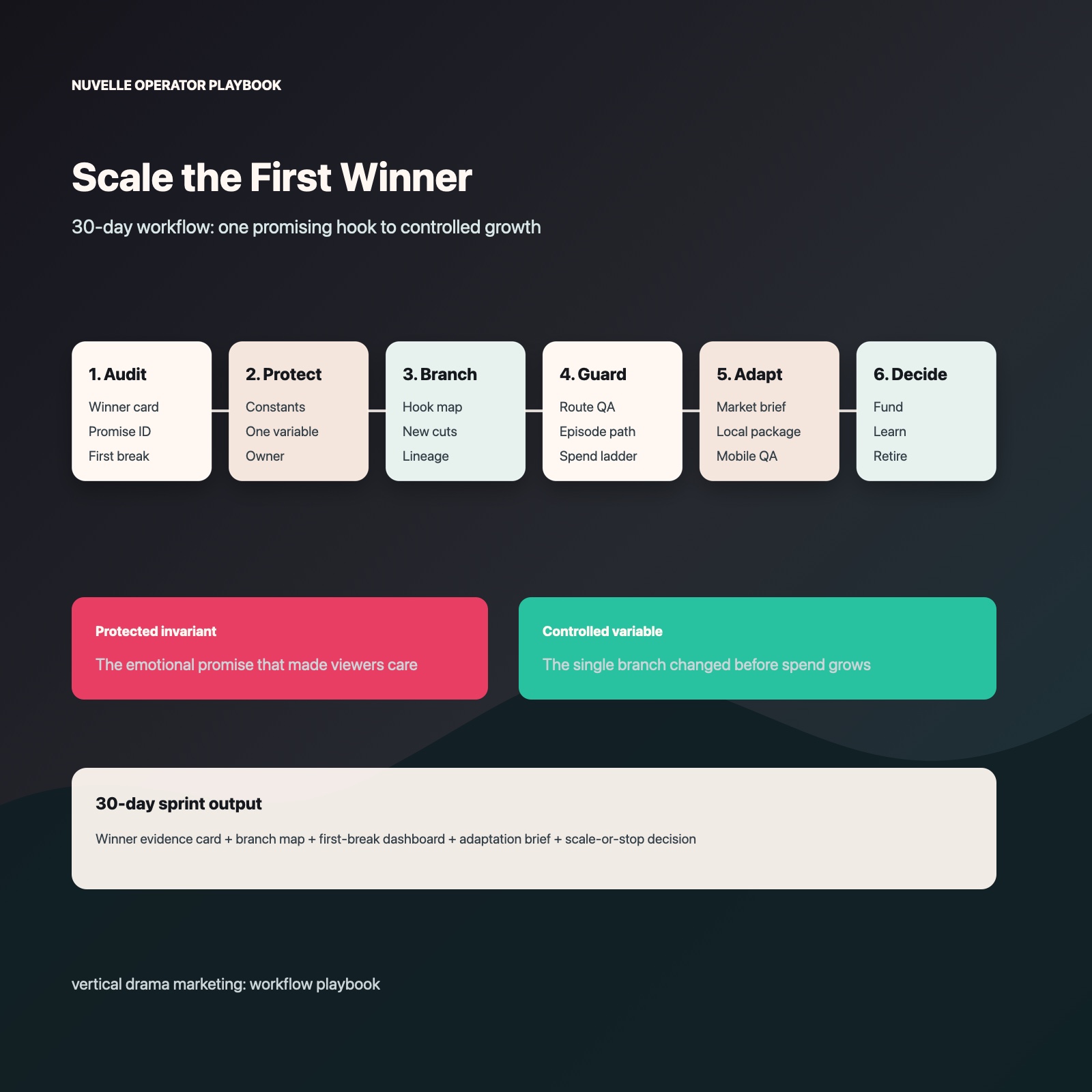
This 30-day workflow has six gates.
| Gate | Timing | Core question | Output |
|---|---|---|---|
| 1. Winner audit | Days 1-2 | What exactly won? | Winner evidence card |
| 2. Scale hypothesis | Days 2-4 | Which element should branch first? | Protected constants and test variable |
| 3. Creative branch plan | Days 4-10 | How do we make more without cloning noise? | Branch map and production queue |
| 4. Funnel protection | Days 7-14 | Is downstream behavior still healthy? | First-break dashboard and intervention log |
| 5. Market extension | Days 14-24 | Can the promise travel to a new audience or language? | Adaptation brief and route QA |
| 6. Scale or stop review | Days 25-30 | Does the evidence justify another cycle? | Fund, learn, maintain, or retire decision |
The value of this vertical drama marketing: workflow playbook is the order. Do not start with a larger creative batch. Start with the evidence card. Do not start localization with translated captions. Start with the emotional promise and the route. Do not raise spend because a dashboard looks exciting. Raise spend only when the handoff from ad to episode to unlock remains observable.
In practice, this vertical drama marketing: workflow playbook is a guardrail against premature scale. It gives every team the same sequence for turning a signal into a repeatable decision.
Gate 1: Build the Winner Evidence Card
A winning ad is not a strategy. It is an artifact with context.
Before anyone makes new versions, write a winner evidence card that documents what actually happened. This should be short enough for a weekly meeting and precise enough for a creative team to reuse.
| Field | What to record | Why it matters |
|---|---|---|
| Series and market | Title, country, language, platform, placement | Prevents a winner from being generalized too broadly |
| Story promise | The emotional contract made in the first seconds | Protects the reason the viewer cared |
| Hook family | Betrayal, humiliation, rescue, secret identity, forbidden choice, revenge, or another defined family | Lets the team compare similar promises |
| Opening proof | First image, line, action, caption, and sound cue | Identifies the specific attention device |
| Destination | Landing page, episode, app route, store route, or fallback | Shows whether the click was fulfilled |
| Episode package | Episode version, opening sequence, cliffhanger boundary, unlock point | Connects acquisition to viewing behavior |
| Offer state | Free episode, coin unlock, subscription, trial, or other model | Keeps commercial behavior interpretable |
| Evidence window | Dates, spend state, cohort, and tracking quality | Separates real signal from partial data |
| First break | Earliest meaningful weak point in the funnel | Points to the next operational fix |
The card should be written in plain language. “Creative 12A won” is not enough. “A public humiliation opening where the rejected wife reveals ownership of the company produced stronger qualified episode starts than two romance-first variants” is useful.
Use the vertical drama marketing measurement playbook to connect the card to stable IDs and cohort data. Google Analytics documentation on campaign URL parameters and recommended events can help teams standardize tracking, but the important internal rule is simpler: the promise ID, creative version, destination, episode package, and offer must remain traceable.
Winner Audit Checklist
- The winning creative is tied to one parent lineage, not a loose file name.
- The story promise is written as a sentence a producer would recognize.
- The destination and episode package are named.
- The first funnel break is identified or marked unknown.
- Tracking confidence is recorded.
- Any localization, route, payment, or compliance issue is noted before scale.
If the card cannot be completed, the campaign is not ready for the next gate. It may still be live, but it is not yet a controlled scale candidate.
This is why the first artifact in the vertical drama marketing: workflow playbook is an evidence card rather than a creative request list.
Gate 2: Choose One Scale Hypothesis
The first scale error is changing too many things at once.
A vertical drama campaign can branch by hook, edit length, caption, voice-over, protagonist framing, audience, market, destination, offer, or episode opening. If the team changes five of those in the next batch, the next result will be hard to explain.
This vertical drama marketing: workflow playbook uses a protected-constants model.
| Component | Protect or change? | Decision rule |
|---|---|---|
| Story promise | Usually protect | Change only if the winner was weak downstream |
| Series and episode package | Protect | Keep the viewing experience stable while branching creative |
| Market and language | Protect for the first branch | Extend later after proof remains stable |
| Audience | Change carefully | Expand one adjacent hypothesis at a time |
| Creative execution | Change first | Test new openings, captions, proof moments, and cuts around the same promise |
| Destination | Protect unless it caused the first break | Fix broken routes before creative scale |
| Offer | Protect unless monetization is the diagnosed issue | Avoid mixing creative learning with pricing or unlock tests |
A good scale hypothesis sounds like this:
The ownership-reveal promise is the invariant. We will test whether the same promise works better as a direct confrontation, a reaction-led scene, or a narrator-led recap while keeping audience, market, destination, episode package, and offer fixed.
A weak scale hypothesis sounds like this:
The ad worked, so let’s make more versions for Brazil, Mexico, and the United States with new captions, new audiences, a different landing page, and a new unlock offer.
The second plan may produce activity, but it will not produce clean learning.
The point of this vertical drama marketing: workflow playbook is not to slow the team down. It is to make every new branch easier to interpret.
Gate 3: Build a Creative Branch Map
Creative scale does not mean cloning the winning ad until performance decays. It means preserving the invariant while testing controlled branches.
Create a branch map with three layers.
Layer 1: Promise Branches
These are different emotional reasons to watch the same series.
Examples:
- Public humiliation becomes revenge.
- Secret marriage becomes exposure.
- Billionaire rescue becomes debt of protection.
- Forbidden attraction becomes social danger.
- Abandoned heroine becomes power reversal.
Promise branches should be limited. If the first winner is still new, build one or two adjacent promises, not a full board of unrelated tropes.
Layer 2: Execution Branches
These keep the promise stable but change the presentation.
| Branch | Example |
|---|---|
| Opening order | Start with insult, reveal, threat, or reaction |
| Voice | Dialogue-only, narrator-led, character confession, or text-led |
| Proof moment | Show the signed contract, the inheritance document, the rival reaction, or the rescue |
| Cut length | 8-12 seconds, 15-20 seconds, 25-35 seconds |
| End button | End on reveal, unresolved question, next threat, or app CTA |
| Mobile readability | Caption density, safe zones, face visibility, and sound-off comprehension |
TikTok’s Creative Center is useful for observing platform-native patterns and creative conventions. Treat it as inspiration, not attribution. The branch map should describe what your team is testing in your own story system.
Layer 3: Distribution Branches
These adapt the same creative logic for channel behavior.
- Short-form social ad.
- Organic teaser.
- Creator-style recap.
- App-store preview cut.
- Retargeting reminder.
- Localized market test asset.
Each branch should inherit the parent promise ID. If a branch changes the promise, destination, and offer, it is no longer a child branch. It is a new test.
Gate 4: Protect the Funnel While Spend Grows
The second scale error is letting media growth outrun the episode funnel.
A short drama ad can win attention while damaging economics. It may attract broad curiosity that does not become episode viewing. It may earn cheap starts but poor continuation. It may drive viewers to the paywall before the story has created enough value. A campaign team needs a first-break view before it raises spend materially.
Use this diagnosis table during the first two weeks.
| Pattern | Likely first investigation | Do this before raising spend |
|---|---|---|
| Strong click behavior, weak destination views | Deep link, page load, store fallback, geo availability | Run route QA on target devices |
| Strong destination views, weak episode starts | Title, poster, synopsis, CTA, sign-in friction | Align packaging with the ad promise |
| Strong starts, weak early progress | Opening pace, subtitle load, confusing setup, poor sound-off comprehension | Watch the first 30 seconds on a phone |
| Strong progress, weak completion | Episode length, mid-scene drag, promise delay | Recut or redirect to a tighter opening |
| Strong completion, weak continuation | Cliffhanger, next-episode card, autoplay, unlock timing | Fix transition and expectation |
| Strong paywall reach, weak paid action | Offer clarity, payment trust, currency, unlock value | Test offer explanation before changing the hook |
The 9-to-5 launch-day workflow handles the first-day control room. This gate extends that discipline into the first scale sprint.
Spend Ladder Rules
Use a spend ladder instead of a sudden jump.
- Hold: Keep spend capped while tracking, route, or episode handoff is uncertain.
- Expand slightly: Increase only the branch with clean downstream behavior.
- Split: Move budget from a clickable-but-weak branch into a lower-click, stronger-viewing branch when the episode data supports it.
- Localize: Fund a market extension only after the promise and route are documented.
- Pause: Stop a branch when it repeatedly creates the same first break and the fix is outside the branch variable.
The exact budgets are company-specific. The reusable rule is that budget movement should follow the first meaningful break, not the loudest metric.
That spend discipline is the commercial center of the vertical drama marketing: workflow playbook: scale only the signal that remains coherent after the click.
Gate 5: Extend the Promise to a Market or Audience
Market extension should not start with “translate the winner.” It should start with “why did this promise work, and what changes when a new audience sees it?”
For Nuvelle’s category, many high-performing vertical drama promises are emotionally legible across markets: betrayal, revenge, status reversal, hidden identity, second chances, and forbidden attraction. The details still matter. A workplace insult, family obligation, payment prompt, or romantic confession can carry different intensity in a new country or language.
Use an adaptation brief before creating localized assets.
| Brief field | Decision |
|---|---|
| Source winner | The exact creative, promise, destination, and episode package being adapted |
| Target audience | Country, language, age band, genre preference, and viewing context |
| Protected promise | The emotional reason to watch that must survive adaptation |
| Cultural risk | Status, family, gender, romance, humor, or social code that needs review |
| Localized package | Title, synopsis, captions, thumbnail, CTA, and offer language |
| Episode handoff | Where the promised moment appears in the localized viewing path |
| Measurement | Market, language, promise, creative, destination, episode, and offer IDs |
| QA owner | Native-language story review, mobile viewing review, and route review |
Nuvelle’s short drama localization beginner guide covers a broader first-market system. In this scale sprint, the adaptation brief has a narrower job: protect the source winner’s emotional function while making the full journey feel native enough to test.
Do not localize only the ad. Localize the promise path:
- Hook.
- Caption or voice-over.
- Title and synopsis.
- Poster or thumbnail.
- Destination language.
- Episode subtitles, dubbing, or voice-over.
- Unlock explanation.
- Support and fallback route where needed.
If the destination or episode remains in the wrong language, the campaign is not a fair market test. It is a translation-friction test.
Gate 6: Run the 30-Day Scale or Stop Review
At the end of the sprint, the team should not ask, “Did we get more views?” It should ask, “What did we learn that deserves the next cycle?”
Use four decisions.
| Decision | Use when | Next cycle |
|---|---|---|
| Fund | The promise, viewing behavior, and commercial path are strong enough to justify more production or spend | Expand creative, audience, or market one layer at a time |
| Learn | One important uncertainty remains but evidence is promising | Run a smaller controlled test with protected constants |
| Maintain | The campaign is useful but not a scale priority | Keep efficient branches live and limit new production |
| Retire | The same first break persists after reasonable fixes | Stop new spend and archive the learning |
The review should include five artifacts:
- Winner evidence card.
- Branch map.
- First-break dashboard.
- Adaptation brief if a market extension was tested.
- Decision log with owner, date, evidence, and next action.
This is where the weekly vertical drama decision cadence becomes practical. Weekly reviews produce decisions; the 30-day review decides whether the operating lane changes.
Copyable 30-Day Review Questions
- Which promise produced the best qualified episode starts?
- Which branch preserved continuation, not just clicks?
- Where did the first meaningful funnel break occur?
- Which fix actually changed behavior?
- Did localization preserve the source promise or create a new one?
- Which branch deserves more budget, more creative, or a new market?
- Which branch should be retired because the evidence is now clear?
If the team cannot answer these questions, the next cycle should be a measurement cleanup cycle, not a production expansion.
Common First-Winner Mistakes
Treating Clicks as the Winner
Clicks show attention. They do not prove that the viewer understood the story, started the episode, continued, reached the unlock point, or paid. Use downstream behavior as a guardrail.
Branching the Promise Too Quickly
If the first winning promise is not yet understood, changing the promise creates noise. Branch execution before changing the emotional contract.
Scaling a Broken Route
A deep link, app-store fallback, or localized destination that fails under real device conditions can make a strong creative look weak. Route QA belongs inside the scale workflow.
Localizing the Caption Only
The viewer experiences the ad, title, episode, offer, and support path as one journey. If only the caption is localized, the signal is contaminated.
Ignoring Disclosure and Platform Fit
Paid endorsements, creator-style ads, and influencer-like executions need clear disclosure practices. The FTC’s social media disclosure guidance is a useful reference when teams work with creators or creator-like paid assets. Platform policies and local rules should also be checked before launch.
The 30-Day Workflow Template
Use this template as the operating version of the vertical drama marketing: workflow playbook.
| Days | Work | Output |
|---|---|---|
| 1-2 | Audit the winner | Evidence card, tracking confidence, first break |
| 2-4 | Choose the scale hypothesis | Protected constants, one variable, owner |
| 4-7 | Build the branch map | Promise branches, execution branches, distribution branches |
| 7-10 | Produce and preflight branches | Creative queue, route QA, tracking smoke test |
| 10-14 | Run controlled spend | First-break dashboard, spend ladder decisions |
| 14-18 | Select extension path | Audience expansion, market adaptation, or funnel repair |
| 18-24 | Test the extension | Localized package or adjacent audience test |
| 24-27 | Consolidate evidence | Branch readout, adaptation readout, funnel diagnosis |
| 28-30 | Decide the next lane | Fund, learn, maintain, or retire |
The template is deliberately narrow. A team that repeats this sprint cleanly will learn more than a team that launches twenty unrelated variations and argues about which dashboard looks best.
Turn One Winner Into a Repeatable System
A first creative winner is valuable because it reveals a possible emotional contract between a story and an audience. It is not valuable because it gives the team permission to abandon structure.
This vertical drama marketing: workflow playbook turns the first winner into a controlled 30-day scale sprint: audit the win, choose one hypothesis, branch the creative without losing lineage, protect the episode funnel, adapt the promise before entering a new market, and make a clear scale or stop decision.
Nuvelle is the home of AI shorts, where every story is reimagined for fast, emotional mobile viewing. Explore the Nuvelle blog for more practical guides to vertical storytelling, short drama production workflows, localization, and audience growth.