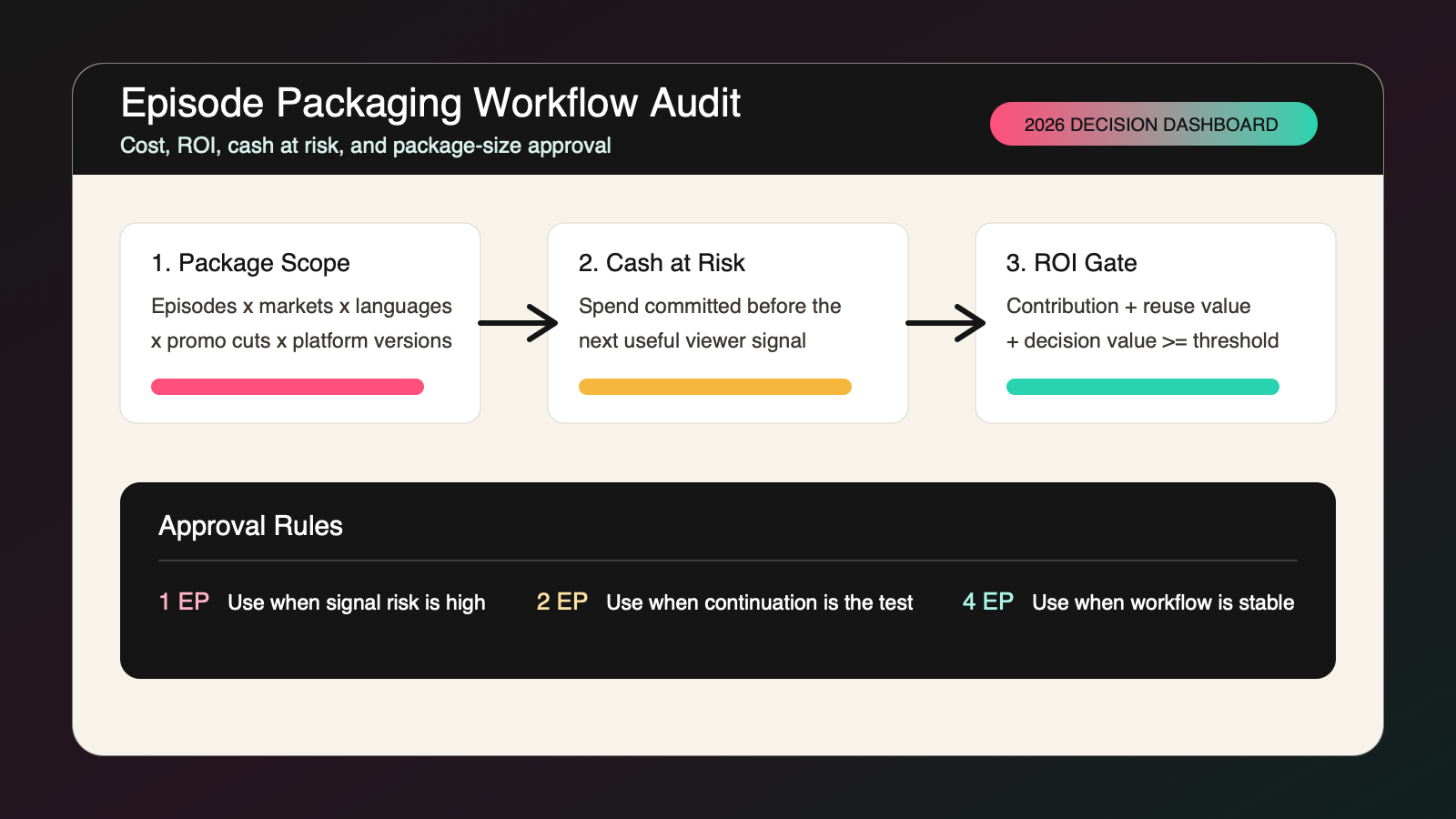
An episode packaging workflow: cost and ROI guide is most useful before a team approves the next batch, not after the money has already moved through captions, localization, exports, thumbnails, metadata, and campaign cutdowns.
For vertical short-drama teams, the hardest packaging decision is rarely "can we finish these episodes?" The harder question is "how much cash should we commit before the next viewer signal arrives?" A one-episode release can protect learning speed but repeat setup work. A four-episode package can reduce repeated work but expose more cost if the story, market, or paid creative angle is wrong.
This audit version is a companion to Nuvelle's broader episode packaging workflow cost and ROI guide. Instead of rebuilding the entire cost model, it gives producers, marketers, and finance leads a practical approval check: when to package, when to hold, what to measure, and how to keep packaging economics from becoming invisible overhead.
Nuvelle is an AI-native vertical drama platform, so packaging decisions sit close to the business model. Episodes are short, mobile-first, and designed for fast continuation. That makes packaging speed valuable, but only when the release unit preserves creative quality, market fit, and measurable learning.
The Packaging Decision in One Sentence
Approve an episode package only when the savings from shared work, the value of release readiness, and the learning from a defined test are greater than the cash at risk before the next performance signal.
That is the core job of an episode packaging workflow: cost and ROI guide: turn a production batch into an investment decision that can be approved, measured, and improved.
That sentence contains the whole audit:
- Shared work: setup, templates, naming rules, caption style, artwork system, metadata structure, export presets, and QA rhythm.
- Release readiness: the ability to publish, localize, promote, and measure without emergency rework.
- Learning: a specific question the package will answer, such as whether the cliffhanger, language version, thumbnail concept, or unlock point deserves more spend.
- Cash at risk: the dollars committed before the team has enough signal to continue, pause, or revise.
If the package does not improve at least two of those four areas, it is probably a file batch rather than a real packaging workflow.
Where Packaging ROI Usually Leaks
Packaging ROI often leaks in ordinary places. None of them look dramatic in isolation, which is why teams need an audit before approval.
1. The Package Has No Test Question
A release package should answer a business question. For example:
- Does the Spanish metadata angle improve start rate?
- Does the new cliffhanger structure lift episode-two continuation?
- Does a paid trailer cutdown produce cheaper qualified viewers?
- Does a two-episode package preserve enough learning speed compared with a four-episode package?
If the team cannot name the question, it cannot evaluate ROI. The package may still be operationally necessary, but it should not be described as an ROI-driven decision.
2. Fixed Costs Are Recreated for Every Episode
The economic reason to package episodes is shared setup. If the team rebuilds caption styling, thumbnail rules, export folders, localization notes, metadata naming, and platform delivery checks for every episode, the package loses its main advantage.
The audit should ask which costs happen once per package and which costs repeat per episode, per market, or per creative version. If everything repeats, the team is not packaging. It is just moving multiple files through the same delay.
3. The Version Matrix Is Discovered Too Late
"Three episodes" rarely means three deliverables. It may mean:
| Source episodes | Markets | Languages | Promo versions | Total working versions |
|---|---|---|---|---|
| 3 | 1 | 1 | 2 | 6 |
| 3 | 2 | 2 | 2 | 24 |
| 4 | 3 | 3 | 3 | 108 |
The exact math depends on the team, but the audit principle is stable: version count should be known before approval. Late discovery creates rush fees, missed launch dates, confused QA, and weak attribution.
Teams that are preparing first-market expansion should connect this packaging audit with a short drama localization budget guide, because language versions change the true cost of a package faster than most teams expect.
4. Rework Is Treated as an Exception
Rework is not rare enough to ignore. Captions drift. Audio levels miss the target. Character names change between versions. A thumbnail is approved before the localized title is final. A paid cutdown gives away the wrong reveal.
The audit should reserve a rework allowance for each package. The allowance can be simple:
| Risk level | Use when | Suggested planning treatment |
|---|---|---|
| Low | Same market, same language, stable templates | Small review buffer |
| Medium | New creative angle, new paid cutdowns, or new metadata pattern | Named rework line item |
| High | New language, new vendor, new genre format, or new platform spec | Separate contingency gate before full package approval |
This is not pessimism. It is how packaging stops hiding cost until the week of release.
Episode Packaging Workflow: Cost and ROI Guide Audit Table
Use this audit table before approving a package. It is deliberately compact so it can fit into a weekly production or marketing meeting.
| Audit question | Pass signal | Fail signal | Decision |
|---|---|---|---|
| What is the package test question? | One measurable question is written in the brief | The package is justified only as "more efficient" | Hold until the test question is clear |
| What work is shared across the package? | Shared assets are named and owned | Every episode still has separate setup | Reduce package size or rebuild workflow |
| How many versions exist? | Version matrix lists episodes, markets, languages, promo cuts, and platforms | Versions are estimated verbally | Do not approve final cost |
| What cash is committed before signal? | Cash at risk is visible by stage | Only total budget is shown | Add stage-level approval gates |
| What is the break-even action? | Required paid starts, unlocks, or subscriptions are calculated | ROI depends on vague "better engagement" | Add contribution model |
| What can be reused? | Templates, captions, metadata, cutdowns, and translation memory are tagged | No archive value is assigned | Treat package as single-use |
| What stops the package? | Kill, revise, and continue rules are written | Team will decide after launch informally | Define the stop rule now |
The table forces the team to separate operational confidence from economic confidence. A package can be easy to produce and still be a poor investment.
Build the Approval Model in Five Steps
The audit does not need a complex spreadsheet. It needs consistent categories and a few formulas that everyone understands. A practical episode packaging workflow: cost and ROI guide should make those formulas visible before production momentum hides them.
Step 1: Define the Release Unit
Write the package in one line:
Package = [episodes] x [markets] x [languages] x [platform versions] x [promo cutdowns]
Example:
Package = 3 episodes x 1 market x 2 languages x 1 app release x 2 paid cutdowns
This prevents the team from approving one scope and producing another.
Step 2: Separate Fixed, Variable, and Risk Costs
Use three buckets:
- Fixed package costs: brief, folder setup, naming system, template setup, master QA plan, shared metadata structure.
- Variable costs: per-episode exports, captions, localized copy, audio checks, thumbnails, platform uploads, and promo edits.
- Risk costs: expected rework, rush correction, vendor redo, rights cleanup, late localization changes, and launch delay.
The basic formula is:
Total package cost = fixed package cost + variable version cost + risk allowance
If the package includes AI-assisted production or synthetic assets, add rights, consistency, and final-render review as explicit cost lines. Nuvelle's positioning treats AI production as premium and film-grade, so the audit should protect finish quality rather than assume automation removes review.
Step 3: Calculate Cash at Risk by Gate
Cash at risk is the spend committed before the next useful signal. A simple gate model works:
| Gate | Commit only enough to | Continue if |
|---|---|---|
| Brief gate | Define scope and test question | The test question connects to a measurable action |
| Prototype gate | Finish a sample episode/version | QA and creative review pass without major rework |
| Package gate | Finish the approved release unit | Cost per version stays inside threshold |
| Launch gate | Publish and promote | Tracking is live and the release path is clean |
| Scale gate | Expand package size or markets | Contribution and continuation justify more spend |
This approach is especially important for short drama teams because the viewer journey moves quickly from first impression to next episode. A weak early signal should change the next packaging decision before the team commits to a larger batch.
Step 4: Tie ROI to a Paid Action
Avoid calculating ROI from views alone unless the business monetizes views directly. For most vertical drama teams, better actions include:
- Episode starts from qualified users
- Episode-two continuation
- Unlocks after the free episodes
- Subscription starts
- Ad-supported completions
- Return viewing within a defined period
Use contribution, not revenue alone:
Required paid actions = package cost / contribution per action
Then compare the required actions with realistic traffic and conversion assumptions. If the package needs a conversion rate the team has never approached, the package should be smaller or the creative test should change.
For a deeper spreadsheet companion, use Nuvelle's episode packaging ROI calculator template.
Step 5: Assign Learning Value Carefully
Learning has value only when it changes the next decision. A package can teach the team which market, language, hook, thumbnail, character dynamic, or unlock point deserves more investment. But learning value should not become a vague excuse for overspending.
Give learning value a practical test:
- Will this package change the next package size?
- Will it change the target language or market?
- Will it change paid creative spend?
- Will it change the story opening or cliffhanger style?
- Will it create reusable assets for future episodes?
If the answer is no, count the package mainly on contribution and reuse, not learning.
One-Episode, Two-Episode, and Four-Episode Approval Rules
Package size should match uncertainty.
Choose One Episode When Signal Risk Is High
A one-episode package is best when the team is testing a new genre, new character relationship, new language market, new vendor, new app flow, or new paid creative angle.
The upside is fast learning and lower cash at risk. The downside is repeated setup work. One episode is a rational choice when the team would rather pay some duplicated setup cost than lock several episodes into an unproven direction.
Choose Two Episodes When Continuation Is the Main Question
A two-episode package is useful when the question is not only "will viewers start?" but "will they continue?" This is common in vertical drama because the first cliffhanger and second-episode handoff often determine whether a viewer trusts the story enough to keep going.
The audit should check whether episode two is ready enough to protect the test. If episode one launches but episode two is delayed or inconsistent, the team may misread creative demand as audience disinterest.
Choose Four Episodes When the System Is Stable
A four-episode package can make sense when templates, localization, QA, metadata, paid cutdowns, and platform delivery are already stable. The main benefit is spreading setup cost over more releases and giving the campaign team enough material to test angles.
The risk is committing too much before the next signal. Four episodes should require a stronger approval bar:
- A clear version matrix
- Known rework patterns
- Live tracking
- Stable creative direction
- Defined stop rule
- Reusable templates or language assets
If those conditions are missing, a four-episode package is usually a schedule decision, not an ROI decision.
A Simple ROI Threshold for Weekly Approval
Use a threshold that can be discussed in a weekly meeting:
Approve the package if base-case contribution + reuse value + decision value is at least 1.5x cash at risk.
This threshold is not a universal benchmark. It is a management rule that gives the team a margin for rework, tracking error, and creative uncertainty.
For example:
| Scenario | Cash at risk | Base contribution | Reuse value | Decision value | Approval signal |
|---|---|---|---|---|---|
| Small test package | $2,000 | $2,200 | $400 | $800 | Strong |
| Unclear four-episode package | $8,000 | $6,000 | $900 | $600 | Weak |
| Stable localization package | $5,000 | $5,400 | $1,200 | $1,100 | Strong |
The numbers are illustrative assumptions. The habit matters more than the example: do not approve package size from total budget alone. Approve it from exposure, contribution, reuse, and decision value.
What to Archive After Launch
The packaging workflow is not finished when the episodes go live. Archive the evidence needed for the next estimate:
- Final package brief
- Version matrix
- Approved masters
- Caption and localization files
- Thumbnail and metadata variants
- Paid cutdowns
- QA notes
- Rework log
- Spend by cost bucket
- Launch date and market
- Tracking status
- Starts, continuation, unlocks, subscriptions, or other target actions
- Decision for the next package
This archive is what turns one package into an operating system. Without it, the team repeats the same debate every week with less evidence than it thinks it has.
For teams connecting packaging to campaign operations, Nuvelle's vertical drama marketing workflow playbook is a useful adjacent read because packaging and paid creative should not operate as separate systems.
Common Mistakes to Avoid
Avoid these approval shortcuts:
- Approving package size because the calendar is full.
- Calling every batch an ROI win without separating fixed and variable cost.
- Using views as the only success measure.
- Treating localization as a text task instead of a versioning and QA task.
- Forgetting to price rework.
- Launching without a stop rule.
- Archiving final files but not cost, QA, or performance evidence.
- Expanding to more episodes before the team knows why the last package worked.
These mistakes are common because packaging feels operational. But in short drama, operations and revenue are tightly connected. A confusing title, late caption fix, weak thumbnail, or broken continuation path can change the economics of a package.
Final Takeaway
The best episode packaging workflow: cost and ROI guide is not a spreadsheet that makes every larger batch look efficient. It is an approval system that protects learning speed, exposes cash at risk, and makes reuse visible.
Use one episode when uncertainty is high. Use two episodes when continuation is the test. Use four episodes only when the workflow is stable enough to turn shared work into real savings.
For Nuvelle and other vertical drama teams, the packaging decision should always connect creative readiness with measurable return. A release-ready episode is valuable. A release-ready package with a clear test question, controlled risk, and reusable assets is more valuable because it teaches the next package what to do.