Creator Monetization: Implementation Checklist for Offer Packaging and CTA Rollout
A creator monetization: implementation checklist becomes useful when it turns a promising revenue idea into something a viewer, sponsor, buyer, or licensing partner can actually act on.
Most monetization plans fail in the handoff between strategy and the first public call to action. The team may know the offer, but the landing page is vague. The CTA changes by channel. The proof is scattered across posts, screenshots, analytics exports, and DMs. The launch calendar sends people to a destination that has not been tested on a phone. By the time the first buyers arrive, nobody can tell whether the problem is demand, packaging, pricing, traffic quality, or fulfillment.
This guide sits between Nuvelle's broader creator monetization implementation checklist and the pre-launch payment and fulfillment QA checklist. Use the canonical checklist to choose the revenue system. Use this article to package the offer, write the buyer-facing proof, map CTAs across channels, and run the first seven days without losing the evidence you need for a decision.
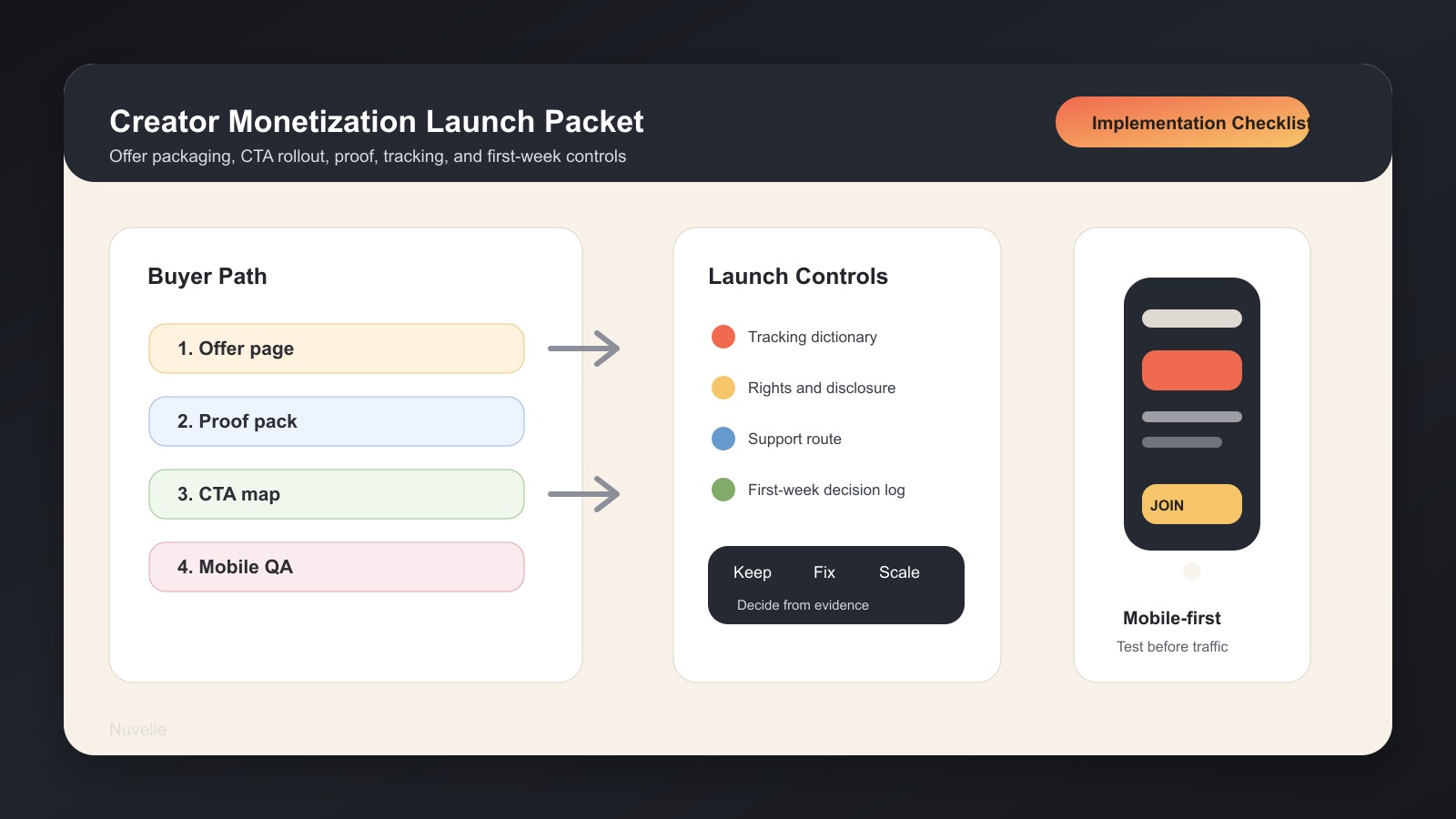
The outcome is one launch packet: one offer page, one CTA map, one proof pack, one tracking dictionary, one support route, and one decision log.
Important: This is an operating framework, not legal, tax, accounting, or platform-policy advice. Use current official sources and qualified professionals for decisions specific to your business, location, contracts, claims, taxes, and publishing channels.
The Offer Packaging Checklist at a Glance
Use this creator monetization: implementation checklist when the offer has passed basic demand and economics review, but before you send traffic to it. At this stage, the creator monetization: implementation checklist should behave like a launch packet rather than a brainstorm.
| Workstream | Required output | Launch stop signal |
|---|---|---|
| Offer page | One clear buyer promise, scope, price, timing, and next step | A buyer needs a DM to understand what is being sold |
| Proof pack | Evidence that supports the promise without overstating results | Claims depend on anecdotes, screenshots, or unsupported outcomes |
| CTA map | One primary action per channel, with approved wording and destination | Captions, bio links, emails, videos, and pages point to different actions |
| Tracking dictionary | Stable source, medium, campaign, content, offer, and market IDs | The team cannot compare which post or channel produced buyer actions |
| Rights and disclosure | Commercial use, sponsorship, affiliate, and endorsement rules checked in context | The paid path creates unclear disclosure or unapproved asset use |
| Mobile QA | Buyer can understand and act from a phone in under one minute | The page, checkout, form, or confirmation breaks on mobile |
| First-week review | A keep, fix, pause, or scale decision with evidence | The launch ends with opinions but no comparable operating data |
Do not turn on every channel at once. Launch the smallest visible path that can answer whether the offer is understood, trusted, and operationally deliverable.
When This Checklist Fits
Use this creator monetization: implementation checklist after the team has selected one primary revenue channel and before public promotion begins.
It works for:
- Memberships, subscriptions, paid communities, and bonus access
- Digital products, templates, toolkits, paid downloads, and course pilots
- Sponsorship packages and brand partnership intake
- Affiliate campaigns and recommendation hubs
- Workshops, coaching, services, audits, and production support
- Licensing, localized content packages, finished assets, and format rights
- Vertical-drama teams packaging bonus scenes, sponsor integrations, creator education, or production assets
If you are still deciding what to sell, start with the 30-day creator monetization checklist template. If sponsorship is the selected channel, use the sponsor campaign operations checklist after this packet is built. If money is already moving and the issue is reporting, use the creator monetization revenue tracking guide.
Step 1: Write the Offer Page Before You Build the Campaign
The offer page is not only a sales page. It is the operating source of truth for the launch. In this creator monetization: implementation checklist, every CTA, caption, email, sponsor deck, checkout label, and support response should point back to the same promise.
Start with this one-sentence structure:
For [specific buyer], this offer provides [specific outcome, access, or asset]
through [format and timing], so they can [desired progress]
without [main friction].
Examples:
- For serialized romance fans, this membership provides monthly bonus scenes and early access through a private feed, so they can stay inside the story world without chasing every social post.
- For emerging short-form creators, this toolkit provides reusable episode packaging worksheets through a downloadable workbook, so they can launch a cleaner content offer without hiring a full operations consultant.
- For a consumer brand, this sponsorship package provides a three-part vertical story integration with defined usage rights, so the brand can test narrative creative without producing the series itself.
The offer page should answer eight questions without requiring a sales call:
| Page element | What it must answer |
|---|---|
| Buyer | Who is this for, and who is it not for? |
| Promise | What does the buyer receive or achieve? |
| Format | Membership, product, service, sponsor package, affiliate hub, license, or event |
| Scope | What is included, excluded, capped, or separately priced? |
| Timing | When does access, delivery, publication, or reporting happen? |
| Price or next step | Buy, apply, book, request, join, download, or inquire |
| Support route | Where does the buyer go if something fails? |
| Evidence | What proof supports the promise? |
If the page cannot answer these questions, do not compensate with heavier promotion. Fix the page first.
Offer page checklist
- The H1 or first screen names the offer plainly.
- The first paragraph says who it is for and what changes after purchase or approval.
- Price, billing cadence, or inquiry path is visible before deep scrolling.
- Deliverables, access rules, usage rights, or service boundaries are specific.
- Refund, cancellation, revision, access, or eligibility rules are linked or summarized.
- Proof supports the exact promise and avoids unsupported performance claims.
- The CTA uses one verb consistently: buy, join, book, apply, request, or download.
- The buyer can find support without sending a social DM.
Step 2: Build a Proof Pack That Matches the Promise
A creator monetization launch needs proof, but proof should not become hype. The proof pack is the evidence the team can safely reuse in the page, caption, pitch, email, and sponsor conversation.
Use three proof lanes:
| Proof lane | Good evidence | Weak evidence |
|---|---|---|
| Demand proof | Repeated viewer questions, waitlist signups, repeat views, comments asking for more, buyer conversations | Generic likes or one viral post |
| Capability proof | Prior finished work, sample asset, preview lesson, episode package, testimonial, case example | A promise to build it later |
| Operations proof | Delivery calendar, fulfillment workflow, rights register, support process, reporting sample | "We will handle it manually" |
For vertical-drama and short-form teams, proof often comes from the content system itself: episode completion, repeat viewing, comments requesting the next scene, sponsor-ready story integrations, localization tests, or packaged production assets. Keep the proof tied to the paid promise. A viral cliffhanger does not automatically prove demand for a creator course. A strong sponsor report does not automatically prove demand for a membership.
Proof copy rules
- Say what the proof actually shows.
- Date time-sensitive proof.
- Separate examples from guarantees.
- Do not imply typical results from an unusually strong post.
- Do not use a testimonial, logo, screenshot, likeness, or campaign result unless the team has permission to use it commercially.
- Store the underlying evidence next to the claim so it can be checked later.
The U.S. Federal Trade Commission's Disclosures 101 for Social Media Influencers explains that material connections should be disclosed clearly and placed where people are likely to notice them. Treat that as a launch-copy discipline: if a claim, endorsement, affiliate link, gifted product, or sponsor relationship appears in the monetization path, the disclosure must travel with the content experience, not hide in a separate internal note.
Proof pack checklist
- Each major claim has an evidence link.
- Testimonials, examples, logos, screenshots, and analytics excerpts have usage permission.
- Sponsor, affiliate, gifted, employment, ownership, or investor relationships have disclosure language.
- Results are framed as examples unless qualified evidence supports broader claims.
- The proof pack includes at least one operational proof point, not only audience proof.
- The final page uses the same proof language approved in the pack.
Step 3: Choose One Primary CTA and Two Support CTAs
The first launch should have one primary action. Too many CTAs make learning harder because every buyer path produces a different signal. A focused creator monetization: implementation checklist keeps the next action stable long enough to learn.
Use this decision table:
| Offer stage | Primary CTA | Support CTA |
|---|---|---|
| Demand validation | Join the waitlist | Reply with a question, vote on a format |
| Manual presale | Apply or request invite | Book a short fit call |
| Digital product | Buy or download | Preview sample |
| Membership | Join | See member benefits |
| Sponsorship | Request campaign scope | Download media kit |
| Service | Book or apply | View sample deliverable |
| Licensing | Request rights package | View asset catalog |
One support CTA can reduce friction. Two can handle different buyer readiness levels. More than that usually means the offer page is trying to serve too many audiences.
CTA wording rules
Make the verb match the next step:
- Use Join when access starts after signup.
- Use Buy when payment is immediate.
- Use Download when the asset is delivered instantly.
- Use Apply when not every buyer is accepted.
- Use Request scope when a sponsor or license must be reviewed.
- Use Book when the calendar is the next action.
Do not use vague CTAs such as "learn more" when the page already explains the offer. Use a precise next step.
CTA checklist
- One primary CTA is chosen for the first seven days.
- The CTA verb matches the actual next action.
- The CTA destination is the same across all launch channels unless intentionally tested.
- Support CTAs are limited to one or two.
- The CTA appears in the first screen and again after proof or FAQ.
- Captions, emails, landing pages, and link-in-bio labels use the same approved wording.
Step 4: Create the Channel CTA Map
A creator monetization campaign usually fails quietly when every channel uses different wording. The CTA map prevents that.
Create one row per channel:
| Channel | Audience state | CTA placement | Approved wording | Destination | Tracking ID | Owner |
|---|---|---|---|---|---|---|
| TikTok or Reels | Cold or returning viewers | Video end card, caption, link in bio | Join the bonus-scene list | Offer page | ||
| YouTube | Search or subscriber audience | Description, pinned comment, end screen | Download the worksheet | Offer page | ||
| Warm audience | Mid-email and closing button | Buy the launch workbook | Checkout | |||
| Website | Intent-driven visitor | Inline module, sticky CTA, related article | Request sponsor scope | Intake form | ||
| Community | Engaged fans or buyers | Pinned post, announcement, DM auto-reply | Apply for early access | Application form | ||
| Sponsor outreach | Commercial partner | Deck, email, scope card | Request campaign scope | Intake page |
For a vertical-drama team, the CTA should fit the story moment. A cliffhanger clip should not suddenly push an unrelated consulting offer. It may point to bonus access, episode unlock, a waitlist, or a behind-the-scenes production asset depending on the audience. If the team is using story content to sell creator education, the bridge needs to be explicit: show the packaged workflow or breakdown that the paid product expands.
The vertical drama marketing workflow is useful here because the hook, destination, and next action need to feel connected rather than stitched together after the content is posted.
Channel map checklist
- Every launch channel has one row in the CTA map.
- Each row names the audience state: cold, warm, buyer, sponsor, partner, or fan.
- The CTA wording is approved before scheduling.
- The destination URL is tested on mobile.
- Tracking IDs are assigned before publishing.
- The owner knows what to do if comments, DMs, or support questions arrive.
Step 5: Lock the Tracking Dictionary Before Launch
Tracking does not need to be sophisticated on day one. It does need to be consistent. The tracking section of a creator monetization: implementation checklist is what turns a launch into reusable evidence.
Google Analytics documents manual campaign parameters such as utm_source, utm_medium, and utm_campaign, with optional parameters like utm_content and utm_term. Google also notes that parameter values are case-sensitive, which is why a small naming dictionary matters. Use the official Campaign URL Builder guidance as the baseline if Google Analytics is part of the measurement stack.
Create controlled values for:
| Field | Example |
|---|---|
offer_id |
bonus-scenes-monthly |
campaign_id |
2026-q3-bonus-scenes-launch |
source |
instagram, tiktok, youtube, email, blog |
medium |
organic-social, paid-social, email, referral, owned-blog |
content_id |
ep03-cliffhanger-caption-a |
market |
us, mx, br |
language |
en, es, pt |
creator_or_account |
main-account, founder-account, show-account |
Use lowercase and hyphens. Avoid spaces, emojis, punctuation experiments, and one-off abbreviations. The naming system should be boring enough that another person can use it under deadline pressure.
Tracking checklist
- The offer has a stable
offer_id. - The launch has one
campaign_id. - Every scheduled CTA has source, medium, campaign, and content values.
- Paid and organic links are separated.
- Link-in-bio, spoken CTA, QR code, coupon, and DM paths have a tracking workaround.
- A transaction, lead, application, or inquiry record captures the offer and campaign when possible.
- The first-week report can compare buyer actions by channel and content.
Step 6: Attach Rights, Disclosure, and Recordkeeping to the Packet
Do not leave rights and disclosure as final publishing memory. Attach them to the launch packet.
For each monetized path, answer:
| Area | Required check |
|---|---|
| Sponsor or affiliate relationship | Is the relationship disclosed where viewers will notice it? |
| Claims | Are product, income, performance, health, or comparative claims supported and approved? |
| Testimonials | Is commercial usage allowed? |
| Music, footage, artwork, voice, likeness, and templates | Are the assets cleared for the paid use, market, edit, and duration? |
| Paid media or whitelisting | Is permission separate from ordinary organic posting? |
| Localization | Are translated claims, captions, disclosures, and rights still accurate? |
| Records | Are contracts, invoices, receipts, expenses, and approvals stored? |
For tax and recordkeeping context, the IRS says business records should support income, expenses, and credits, and its recordkeeping guidance explains common supporting documents such as sales slips, invoices, receipts, deposit information, and purchase records. The IRS self-employed individuals tax center also centralizes guidance for self-employed tax responsibilities. A creator launch packet should make those records easier to find; it does not replace professional bookkeeping or tax advice.
If YouTube is part of the launch, review its current paid product placement, sponsorships, and endorsements guidance and make the platform declaration step part of the publishing checklist when it applies.
Rights and records checklist
- The paid use is covered in the rights register.
- Sponsor, affiliate, gifted, or endorsement disclosure is written for every format used.
- YouTube or other platform-specific paid-promotion settings are assigned to a publisher.
- Commercial screenshots, testimonials, logos, and analytics excerpts have permission.
- Contracts, invoices, receipts, payment confirmations, refund records, and approvals have folders.
- Localization, paid-media, edit, and whitelisting rights are not assumed from organic posting rights.
Step 7: Run Mobile QA Like a Buyer
Most creator monetization happens on a phone, even when the operation is managed on a laptop. Test the launch path on the device where the buyer will act.
Run this five-minute QA:
- Open the channel content from a phone.
- Tap the CTA exactly as a viewer would.
- Confirm the page loads quickly enough to understand the offer.
- Read the first screen without context from the internal plan.
- Tap the primary CTA.
- Complete the form, checkout, application, or inquiry path using a test action.
- Confirm the buyer message, receipt, or next-step email is correct.
- Verify the internal record receives the right offer and campaign identifiers.
- Save screenshots of the viewer path.
- Record every manual step the team had to remember.
The goal is not perfect automation. The goal is to expose ambiguity before promotion creates volume.
Mobile QA checklist
- Link-in-bio, caption, description, story, email, and blog CTAs point to the intended destination.
- The first screen says what the offer is and who it is for.
- The primary CTA is visible without hunting.
- Checkout, form, booking, or inquiry fields work on mobile.
- Confirmation copy includes access, timing, support, and reference details.
- Internal records capture source, campaign, content, offer, and buyer status where possible.
- Screenshots are stored in the launch evidence folder.
Step 8: Prepare the First-Week Decision Log
Do not wait until the launch ends to decide what matters. Define the first-week decision before the first CTA goes live. Without this final section, a creator monetization: implementation checklist can still end as a collection of tasks instead of a decision system.
Use this scorecard:
| Signal | What to count | What it helps decide |
|---|---|---|
| CTA visibility | Impressions, opens, views, click-through, replies | Did people notice the offer? |
| Offer comprehension | Questions, objections, form drop-off, DM themes | Did people understand the promise? |
| Buyer action | Purchases, applications, inquiries, sponsor requests, downloads | Did the offer create real demand? |
| Conversion quality | Refund risk, unqualified leads, support burden, buyer fit | Did the CTA attract the right people? |
| Fulfillment burden | Hours per buyer, manual steps, exceptions, delays | Can the team deliver without breaking cadence? |
| Revenue quality | Booked revenue, cash collected, contribution, receivables | Is the launch commercially useful? |
| Trust risk | Complaints, disclosure issues, claim questions, rights gaps | Is scale safe? |
Choose one of four decisions:
| Decision | Use when | Next action |
|---|---|---|
| Keep | The offer is understood, operationally stable, and commercially useful | Continue the campaign and improve one bottleneck |
| Fix | Demand exists but packaging, tracking, proof, or fulfillment has a clear gap | Pause expansion, fix the gap, relaunch a smaller test |
| Pause | Interest is weak or buyer quality is poor | Stop promotion and return to demand research |
| Scale | Demand, contribution, fulfillment, and trust signals are strong | Add one channel, market, segment, or format at a time |
Do not scale only because revenue appeared. Scale only when the team can explain where the revenue came from, what it cost to deliver, and why a larger audience will not create avoidable risk.
A Copyable 7-Day Rollout Plan
Use this plan for the first public run.
| Day | Work | Evidence to save |
|---|---|---|
| Day 0 | Final offer page, proof pack, CTA map, tracking dictionary, rights check, mobile QA | Screenshots, test transaction or test form, final URLs |
| Day 1 | Soft launch to the warmest audience segment | Link checks, comments, replies, first buyer actions |
| Day 2 | Review comprehension and support questions | Question log, objections, page edits |
| Day 3 | Publish one stronger proof-led CTA | Content ID, source, click and action data |
| Day 4 | Check payment, fulfillment, and support path | Delivery evidence, exception queue |
| Day 5 | Run a second channel only if Day 1-4 path is stable | Channel comparison notes |
| Day 6 | Reconcile buyer actions to records and cash where applicable | Transaction, lead, application, or inquiry ledger |
| Day 7 | Make keep, fix, pause, or scale decision | Decision memo and next owner |
The first week should produce a learning asset, not just a launch memory. Preserve the decisions so the next monetization test starts with better evidence.
FAQ
What should a creator monetization implementation checklist include before launch?
A creator monetization implementation checklist should include the offer page, proof pack, CTA map, tracking dictionary, rights and disclosure check, mobile QA, support route, and first-week decision log. Strategy is not enough; the checklist has to prove the buyer path.
How many revenue channels should a creator launch at once?
Most creators should launch one primary revenue channel first. A membership, sponsor package, product, service, affiliate hub, or license can each work, but launching several at once makes attribution, fulfillment, and buyer feedback harder to interpret.
What is the best CTA for a creator monetization launch?
The best CTA is the one that matches the next real action. Use "buy" for immediate purchase, "join" for access, "apply" for selective entry, "book" for a calendar path, "download" for an instant asset, and "request scope" for sponsorship or licensing.
How do creators track a monetization launch without a complex stack?
Start with stable naming. Use one offer_id, one campaign_id, controlled source and medium values, and unique content IDs for major CTAs. Then make sure buyer actions, leads, or inquiries preserve those values whenever possible.
What should stop a creator monetization rollout?
Stop or narrow the rollout when the offer page is unclear, proof is unsupported, disclosures are missing, rights are uncertain, mobile checkout fails, buyer actions are unqualified, or fulfillment depends on one person's memory.
Final Take
A creator monetization: implementation checklist should make the paid path visible before traffic arrives. The offer page explains the promise. The proof pack supports it. The CTA map keeps promotion consistent. The tracking dictionary preserves the learning. Rights, disclosure, mobile QA, and the first-week decision log protect trust while the team learns what buyers actually do.
For Nuvelle and other AI-native vertical drama teams, this matters because attention can move faster than operations. Package one monetization path, test it with evidence, and scale only after the promise, delivery, and measurement system can survive real demand.