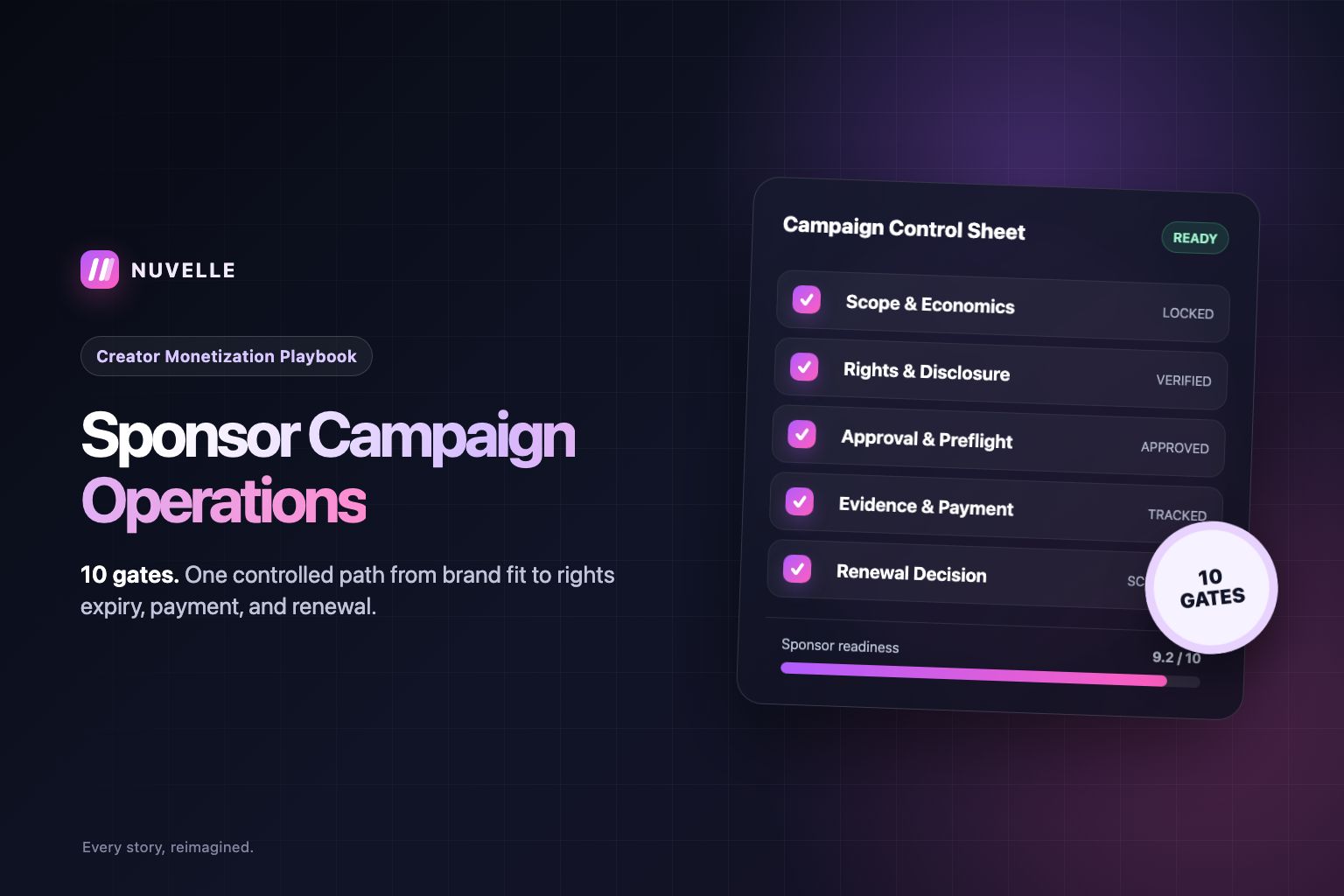
A creator monetization implementation checklist becomes real the moment a sponsor says yes. Until then, a media kit, rate card, and list of dream brands are only sales materials. After the yes, the creator has to turn a promise into a controlled campaign: define the scope, confirm rights, produce the content, collect approvals, publish on time, preserve evidence, invoice correctly, and decide whether the partnership deserves a renewal.
That operating layer is where otherwise attractive deals become unprofitable. A creator may agree to one video and later discover that the brand expected raw files, paid-ad usage, multiple revisions, category exclusivity, or publication across several channels. The campaign can still generate revenue while consuming more time, rights, and attention than the fee justified.
This guide is the sponsor-delivery companion to Nuvelle's broader creator monetization implementation checklist. Use it after you have selected sponsorships as a revenue channel and before you accept a campaign into production.
Important: This is an operating framework, not legal, tax, or accounting advice. Contract, disclosure, rights, and tax decisions should be reviewed by qualified professionals for your business and jurisdiction.
The Sponsor Campaign Checklist at a Glance
Every sponsored campaign should pass ten gates.
| Gate | Required outcome | Stop signal |
|---|---|---|
| 1. Fit | The brand, audience, content, and creator values align | The campaign requires a claim or behavior the creator cannot support |
| 2. Economics | The fee covers production, revisions, rights, and delivery | The deal only works if no revision or delay occurs |
| 3. Scope | Deliverables, channels, dates, and owners are explicit | “One campaign” is the only scope description |
| 4. Rights | Usage, term, territory, edits, whitelisting, and exclusivity are recorded | The brand requests broad rights without defined limits |
| 5. Disclosure | The disclosure method works in the actual content format | Disclosure is planned only for the caption or description |
| 6. Production | The concept, proof points, assets, and review path are ready | The creator begins filming before the brief is usable |
| 7. Approval | Feedback is consolidated and tied to agreed review rounds | Several stakeholders send conflicting edits |
| 8. Publication | The final asset, CTA, link, disclosure, and timing are verified | The scheduled post differs from the approved version |
| 9. Evidence | Live links, screenshots, analytics, and delivery records are saved | The team relies on disappearing dashboards or chat threads |
| 10. Settlement | Invoice, payment, renewal decision, and rights expiry are tracked | The campaign is “done” when the post goes live |
The purpose of the creator monetization implementation checklist is not to add bureaucracy. It is to make the invisible parts of a sponsorship visible before they become expensive.
1. Run a Fit Check Before Discussing Deliverables
The fastest way to damage a sponsor campaign is to treat any available budget as good budget.
Start with four fit questions:
- Audience fit: Would the offer make sense to the people who already watch, read, or follow the creator?
- Content fit: Can the product appear naturally inside the creator's normal format and storytelling style?
- Claim fit: Can the creator personally support every statement the campaign requires?
- Reputation fit: Would the creator be comfortable with the partnership remaining searchable for years?
For a short-form storyteller or vertical-drama team, content fit is especially important. A sponsor insertion that interrupts the emotional promise of a scene can reduce both campaign performance and audience trust. The integration needs a story function: it can trigger a decision, reveal status, solve a production problem, or support the viewing experience. It should not feel pasted onto the finished asset.
Fit gate checklist
- The target audience overlaps with the creator's actual audience.
- The product category is consistent with the creator's public positioning.
- The requested talking points can be expressed truthfully in the creator's own voice.
- The campaign does not require an unsupported performance, health, income, or comparative claim.
- Existing sponsor conflicts and category commitments have been checked.
- The creator can explain why the partnership is useful to viewers in one sentence.
If the campaign fails this gate, decline it before producing a concept. Reworking a poor fit rarely fixes the underlying trust problem.
2. Price the Entire Obligation, Not Just the Post
A sponsor fee pays for more than the published content. It may also pay for concept development, preproduction, recording, editing, revisions, account access, reporting, usage rights, exclusivity, and the opportunity cost of replacing an organic post.
Build the economics before confirming the rate.
| Cost or obligation | Planning question |
|---|---|
| Creative development | How many concepts, scripts, hooks, or storyboards are included? |
| Production | Which people, locations, props, tools, and production days are required? |
| Editing | How many formats, durations, captions, and aspect ratios are needed? |
| Review | How many review rounds are included, and what counts as a revision? |
| Publishing | Which accounts, markets, languages, and time windows are included? |
| Reporting | Which metrics, screenshots, exports, and reporting dates are required? |
| Usage | Can the brand repost, edit, advertise, sublicense, or retain the content? |
| Exclusivity | Which competitors or categories become unavailable, and for how long? |
| Payment risk | Is payment tied to publication, acceptance, results, or a long payment term? |
Use a simple contribution estimate:
Expected campaign contribution
= campaign fee
- platform or payment fees
- direct production cost
- contractor cost
- paid asset or music cost
- expected revision cost
- incremental reporting and fulfillment cost
Do not assign a false precision to rights or exclusivity. Instead, record them as separate commercial decisions. A one-month organic usage permission is not the same product as perpetual paid advertising rights.
Economics gate checklist
- The fee, currency, payment schedule, and payment trigger are recorded.
- Direct production and contractor costs are estimated.
- Included concepts, versions, and revision rounds are capped.
- Usage and exclusivity are priced or explicitly excluded.
- Cancellation, rescheduling, and kill-fee treatment are documented.
- The campaign has a minimum acceptable contribution threshold.
For a deeper worksheet, use the 30-day creator monetization checklist template before accepting the first deal in a new format.
3. Convert the Deal Into a One-Page Scope Card
Email threads are not a campaign operating system. Create one scope card that gives every participant the same answer.
This is the point where the creator monetization implementation checklist becomes a shared production record instead of a private to-do list.
Copyable sponsor campaign scope card
| Field | Required entry |
|---|---|
| Campaign ID | Stable internal identifier |
| Brand and agency | Contracting party and working contacts |
| Creator owner | Person accountable for final delivery |
| Audience and market | Intended viewer, country, and language |
| Campaign objective | Awareness, traffic, lead, sale, install, or content production |
| Deliverables | Exact quantity, format, duration, channel, and aspect ratio |
| Core message | One approved audience takeaway |
| Required proof points | Claims or product facts the brand supplies and supports |
| Prohibited content | Topics, visual elements, or claims that cannot appear |
| CTA | Exact desired viewer action |
| Tracking | Link, code, landing page, UTM, or platform tag |
| Disclosure | On-content and caption disclosure method |
| Milestones | Brief, concept, rough cut, final, publication, and report dates |
| Review rounds | Number, response window, and revision definition |
| Usage rights | Media, term, territory, edit rights, paid usage, whitelisting |
| Exclusivity | Category, named competitors, territory, and duration |
| Fee and terms | Amount, deposit, invoice date, due date, and payment trigger |
| Evidence | Required live links, screenshots, files, and analytics exports |
The scope card does not replace a contract. It is the execution view of the agreement. If the scope card and signed terms disagree, stop and resolve the difference before production.
Scope gate checklist
- Every deliverable has a quantity, format, channel, owner, and due date.
- The campaign objective and CTA are specific.
- Required talking points and prohibited claims are separated.
- Tracking links or codes have an owner and test date.
- Review rounds and feedback deadlines are explicit.
- The scope card matches the signed commercial terms.
4. Build a Rights and Exclusivity Register
Rights language can change the value of the deal more than the number of posts.
Record each permission as a structured field rather than saving one long clause in a folder.
| Rights field | Example choices to record |
|---|---|
| Organic reposting | Allowed or not allowed; named brand accounts |
| Paid media | Allowed or not allowed; platforms and campaign type |
| Whitelisting or creator licensing | Allowed or not allowed; account, access method, term |
| Editing | No edits, technical edits only, or approved derivative edits |
| Raw files | Included, separately priced, or excluded |
| Territory | Named countries or worldwide |
| Term | Start date, end date, renewal rule |
| Sublicensing | Allowed or excluded; named partners if applicable |
| Exclusivity | Category, named competitors, channels, territory, duration |
| Takedown | Trigger, notice period, archive handling |
Set a rights-expiry reminder when the campaign is created. Do not wait for the brand to remember. The creator should know when paid usage, exclusivity, or reposting permission ends and whether a renewal conversation should begin.
Rights gate checklist
- Every usage permission has a medium, term, and territory.
- Paid use and organic reposting are separate fields.
- Raw files and edit rights are explicit.
- Whitelisting access has a start date, end date, and revocation owner.
- Exclusivity names the category or competitors and the covered channels.
- Rights expiry and renewal reminders are scheduled.
5. Make Disclosure Part of the Creative
Disclosure is not a publishing afterthought. It must work in the format viewers actually experience.
The U.S. Federal Trade Commission's Disclosures 101 for Social Media Influencers explains that creators should disclose material connections and place disclosures where people are likely to notice them. Platform tools can help, but the disclosure plan should not depend on a hidden description or a viewer opening extra text.
YouTube also requires creators to identify paid promotion in relevant videos and provides a paid-promotion declaration in its publishing workflow. Review the current YouTube paid product placement and endorsement guidance before publishing on that platform.
Translate those requirements into production checks:
- Put disclosure into the spoken or on-screen creative when appropriate for the format.
- Keep the wording understandable without insider abbreviations.
- Verify that the disclosure remains visible after platform cropping, caption overlays, and safe-area adjustments.
- Preserve the disclosure in cutdowns and alternate versions.
- Recheck the live post rather than assuming the scheduled version rendered correctly.
Disclosure gate checklist
- The material connection is disclosed in clear language.
- The disclosure appears in the content experience, not only a hidden area.
- The platform's branded-content or paid-promotion setting is configured when required.
- Shorter edits and translated versions preserve the disclosure.
- The final live post is checked on a phone.
6. Run Production From an Approved Brief
A usable brief separates three kinds of information:
- Required: factual points, product appearance, disclosure, CTA, deadlines, and technical specifications.
- Flexible: hook, setting, story device, performance, pacing, and visual execution.
- Prohibited: unsupported claims, unsafe use, competitor references, unlicensed assets, and excluded topics.
This structure protects the creator's voice while making review easier. It also prevents subjective feedback from appearing late as if it were a missing requirement.
For narrative short-form content, create a story-first concept statement:
The viewer watches [character or creator] face [tension or desire].
The sponsor product enters because [story reason].
The viewer should feel [emotion] and then take [CTA].
That is more useful than “feature the product naturally.” It gives the sponsor something specific to approve and gives the creator a reason for the integration to exist.
Production gate checklist
- The brief separates required, flexible, and prohibited elements.
- The concept has one hook, one audience promise, and one CTA.
- Product facts and claims have an approved source.
- Music, footage, talent, locations, and other assets are cleared for the intended use.
- Technical specs cover duration, aspect ratio, captions, safe areas, and file delivery.
- The production schedule includes contingency time before publication.
7. Control Feedback With a Revision Ledger
“Small changes” can destroy campaign economics when they arrive from multiple stakeholders over several days.
Use a revision ledger with these fields:
| Field | Purpose |
|---|---|
| Version | Identifies the exact file under review |
| Reviewer | Names the person authorized to submit feedback |
| Timestamp | Preserves the review window |
| Timecode or section | Locates the requested change |
| Request | States the desired change |
| Reason | Links the change to scope, facts, compliance, or preference |
| Scope status | Included, out of scope, or requires clarification |
| Resolution | Accepted, declined, replaced, or deferred |
Require consolidated feedback. If an agency, brand manager, legal reviewer, and product team all participate, one campaign contact should reconcile conflicts before the feedback reaches the creator.
Approval gate checklist
- One file version is designated as the current review version.
- One contact submits consolidated feedback.
- Comments include timecodes or exact sections.
- Included revision rounds are tracked.
- New concepts, new deliverables, and scope changes trigger a commercial review.
- Final approval is recorded before scheduling.
8. Use a Preflight Check Before Publication
The creator monetization system should prevent the wrong file, link, caption, disclosure, or date from going live.
Treat this preflight as the publication gate inside the creator monetization implementation checklist, not as an optional final review.
Run this preflight on the final scheduled post:
- Final approved media file is attached.
- Caption and on-screen text match the approved version.
- Sponsor and product names are spelled correctly.
- CTA link, code, landing page, and UTM parameters work.
- Required account tags and platform partnership settings are active.
- Disclosure is clear in the live format.
- Thumbnail, crop, captions, and safe areas work on a phone.
- Publication date, time, timezone, and embargo are correct.
- A rollback owner knows what to do if the post is incorrect.
- The evidence folder is ready before the content goes live.
The preflight should be completed by someone other than the person who made the final edit when the team is large enough. A second set of eyes is useful because the errors are usually small and highly consequential.
9. Preserve Delivery Evidence and Campaign Results
Publication is a milestone, not the end of fulfillment.
Create a campaign evidence folder containing:
- Signed agreement and final scope card
- Approved brief and final approved files
- Revision ledger and approval record
- Live URLs and publication timestamps
- Phone screenshots showing disclosure and placement
- Tracking link or code configuration
- Platform analytics exports at agreed reporting dates
- Sponsor acceptance or delivery confirmation
- Invoice, payment status, and correspondence about settlement
- Rights and exclusivity expiry dates
The IRS advises businesses to keep records that clearly show income and expenses and to retain supporting documents such as invoices, receipts, and deposit information. Its small-business recordkeeping guidance is a useful starting point for discussing a retention policy with a qualified accountant.
For ongoing revenue operations, connect sponsor evidence to the creator monetization revenue tracking and weekly operations guide. That companion explains how to reconcile booked revenue, cash collected, fees, contribution, delivery status, and attribution.
Evidence gate checklist
- Live URLs and screenshots are saved immediately after publication.
- Analytics are captured at every contracted reporting date.
- Delivery and acceptance are documented.
- The invoice references the campaign ID and agreed milestone.
- Payment, dispute, and overdue status are visible in the revenue ledger.
- Rights and exclusivity expiry dates remain connected to the campaign record.
10. Close With a Renewal Decision, Not a Thank-You Email
Every campaign should end with a decision: renew, revise, hold, or stop.
Score the campaign across five dimensions from 1 to 5:
| Dimension | Question |
|---|---|
| Audience response | Did viewers engage without a material trust or retention penalty? |
| Sponsor outcome | Did the campaign deliver the agreed objective and evidence? |
| Contribution | Did the fee justify direct cost and operating time? |
| Operational fit | Could the campaign be repeated without disrupting core publishing? |
| Rights value | Were usage and exclusivity compensated appropriately? |
Then assign the next action:
- Renew: Strong fit, acceptable contribution, clean delivery, and a repeatable format.
- Revise: Good audience or sponsor outcome, but scope, rights, rate, or workflow must change.
- Hold: Evidence is incomplete, payment is unresolved, or the format needs another test.
- Stop: Poor fit, weak economics, excessive revisions, rights conflict, or trust risk.
Schedule the renewal conversation before usage rights or exclusivity expire. The proposal should reference what was learned, not merely offer the same package again.
A 14-Day Sponsor Operations Setup Plan
Use this condensed creator monetization implementation checklist to install the workflow before the next deal.
Days 1–2: Define acceptance rules
- Write the audience, claim, reputation, and category-conflict tests.
- Set minimum campaign contribution and payment requirements.
- List deal terms that require professional review.
Days 3–4: Build the campaign records
- Create the campaign ID convention.
- Build the scope card, rights register, revision ledger, and evidence folder template.
- Connect campaign IDs to the revenue ledger.
Days 5–6: Standardize briefs and pricing
- Separate required, flexible, and prohibited brief fields.
- Define base deliverables and separately priced options.
- Set included review rounds and scope-change rules.
Days 7–8: Install disclosure and publication controls
- Create disclosure examples by content format.
- Build the phone-based publication preflight.
- Assign rollback ownership.
Days 9–10: Build reporting and settlement
- Define analytics capture dates.
- Create invoice and delivery-confirmation steps.
- Add payment and rights-expiry reminders.
Days 11–12: Simulate a campaign
- Run one fictional deal through all ten gates.
- Test the tracking link, approval path, evidence folder, and invoice handoff.
- Record every ambiguous field or missing owner.
Days 13–14: Approve the operating standard
- Fix the gaps found during the simulation.
- Publish one internal checklist with owners and stop signals.
- Decide who can accept scope, rights, revisions, and publication.
The result is not a complicated agency process. It is a lightweight system that lets a creator accept good sponsor demand without letting each new deal reinvent the business.
Creator Monetization Sponsor Readiness Score
Give one point for every “yes.”
The score converts the creator monetization implementation checklist into a simple decision about whether sponsor volume should increase.
- Do you have written sponsor acceptance rules?
- Can you estimate campaign contribution before quoting a fee?
- Does every deal receive a one-page scope card?
- Are usage rights and exclusivity stored as structured fields?
- Does the disclosure plan work inside the actual content format?
- Does the brief separate required, flexible, and prohibited elements?
- Is sponsor feedback consolidated in a revision ledger?
- Does every scheduled post pass a phone-based preflight?
- Can you retrieve delivery evidence, analytics, and invoice status by campaign ID?
- Does every completed campaign receive a renewal decision?
| Score | Readiness | Required action |
|---|---|---|
| 0–3 | Fragile | Do not add sponsor volume; install scope, rights, and disclosure controls first |
| 4–6 | Usable | Run one low-complexity pilot and document every exception |
| 7–8 | Controlled | Accept repeat campaigns, but tighten weak gates before scaling |
| 9–10 | Repeatable | Standardize the package and negotiate from evidence |
Build a Sponsorship System That Protects the Story
The best sponsor campaign is not simply the one with the highest fee. It is the one that fits the audience, preserves the creator's voice, compensates the full obligation, delivers cleanly, and creates evidence for a better next decision.
That is why a creator monetization implementation checklist needs sponsor operations. It turns a commercial promise into a repeatable workflow and makes the real cost of scope, rights, revisions, and fulfillment visible before the campaign consumes the calendar.
For teams working in episodic vertical storytelling, pair this workflow with Nuvelle's vertical drama marketing weekly decision cadence. The same discipline—one promise, one owner, one evidence trail, and one next decision—helps both sponsored content and story-led growth remain repeatable.
Frequently Asked Questions
What should be in a creator sponsorship checklist?
A creator sponsorship checklist should cover fit, economics, scope, usage rights, exclusivity, disclosure, production, approvals, publication, reporting, invoicing, payment, and renewal. It should also state who owns each decision and what stops the campaign from moving forward.
How many revision rounds should a creator include?
There is no universal number. The agreement should specify the included rounds, the feedback window, what counts as a revision, and what becomes a new concept or out-of-scope request. The operating goal is to keep the commercial obligation measurable.
What are usage rights in a creator deal?
Usage rights describe how the sponsor may use the content beyond the creator's original publication. Record the media, term, territory, editing permission, paid-media use, whitelisting, raw-file access, and sublicensing treatment. Obtain qualified legal advice for contract language and rights decisions.
Where should sponsored content disclosures appear?
The disclosure should be clear and noticeable in the way viewers actually experience the content. Do not rely only on a buried description. Check current FTC guidance and the rules of each publishing platform for the specific campaign.
When is a sponsored campaign complete?
A campaign is not complete at publication. It is complete when delivery evidence is preserved, required reports are sent, acceptance is recorded, the invoice and payment are tracked, rights and exclusivity dates are scheduled, and the renewal decision is documented.
How should creators track sponsor revenue?
Use a stable campaign ID that connects the agreement, deliverables, analytics, invoice, payment, direct costs, contribution, and rights status. Keep booked revenue, cash collected, net revenue, and contribution as separate measures.
What is the biggest sponsor monetization mistake?
The most common operating mistake is pricing only the post while leaving revisions, reporting, paid usage, raw files, exclusivity, and stakeholder approvals undefined. The campaign then expands after the rate is fixed.
How often should the creator monetization implementation checklist be reviewed?
Review it after every pilot, whenever a sponsor format or platform changes, and at least quarterly during active monetization. Update the checklist when repeated exceptions reveal that the documented process no longer matches the real work.