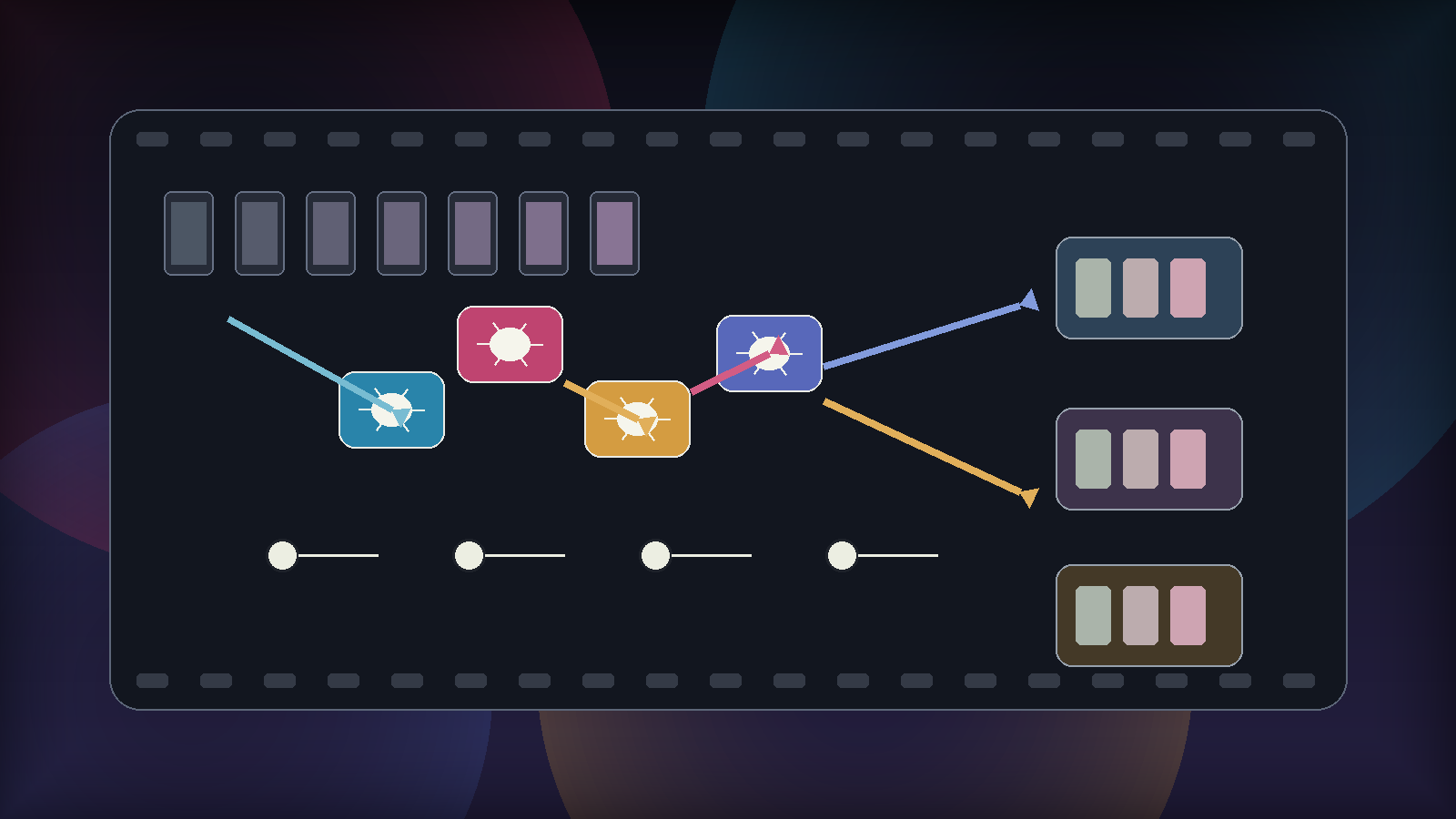
AI Trailer Production: Comparison and Alternatives When the Generator Is Not Enough
AI trailer production: comparison and alternatives becomes useful only after a team admits the hard part: a trailer is not approved because a model can generate video. A trailer is approved because the opening promise is clear, the source material is truthful, the edit survives revision, and the campaign team can ship versions without losing the story.
That is why a one-click AI trailer generator is rarely the whole answer. It may create a polished starting point, but commercial trailers still need story selection, asset control, caption timing, sound, rights evidence, localization, and performance learning. For short-drama, app, creator, game, and product teams, the smarter question is not “Which AI trailer maker is best?” It is “What should replace the generator when this specific trailer job breaks?”
This guide compares AI trailer production alternatives through a replacement map. Use it when you already know the common options but need a practical way to choose between a generator, source-footage edit, AI storyboard, reference-driven video, motion design, pickup shoot, freelancer, agency, or in-house hybrid workflow.
Nuvelle’s lens is story-first. Nuvelle is an AI-native vertical drama platform, not a vendor selling trailer software. For vertical romance and short drama, the trailer must make the next tap feel urgent: betrayal, forbidden attraction, hidden identity, revenge, power reversal, or an unanswered cliffhanger. AI helps when it protects that promise. It fails when it produces atmosphere without proof.
The Short Answer
The best AI trailer production alternative is the one that replaces the weakest part of the trailer system.
| If the generator fails because... | Replace it with... | Why this usually works |
|---|---|---|
| The story promise is unclear | AI storyboard or animatic | Tests the trailer logic before polishing the wrong idea |
| The trailer feels impressive but untrue | Source-footage re-cut | Anchors the trailer in real scenes, characters, product behavior, or approved assets |
| One decisive visual is missing | Live-action pickup or controlled generated insert | Solves a named gap instead of rebuilding the whole trailer |
| Characters, products, or locations drift | Shorter reference-driven shots plus source proof | Limits continuity risk to the few moments generation can own |
| The trailer looks flat but the assets are approved | Motion design | Adds pace, titles, reveals, and visual energy without inventing story facts |
| Captions and localization keep breaking the edit | Hybrid versioning workflow | Separates stable visual proof from flexible text, voice, and market variants |
| The team lacks execution capacity | Freelancer or agency | Adds accountable production, but only after the brief defines proof and handoff |
| Trailer demand repeats every week | In-house hybrid workflow | Turns learning, templates, manifests, and QA into reusable production muscle |
The replacement rule is simple: compare AI trailer production: comparison and alternatives by the failure you need to fix. Do not buy a bigger generator when the real issue is a vague brief, missing footage, weak captions, unclear rights, or no review owner.
Why One-Click Trailer Generators Break Down
AI trailer tools are useful. They can create visual options quickly, help teams explore style, and reduce the blank-page problem. But a commercial trailer is a compound deliverable, not a single rendered clip.
A finished trailer usually needs:
- a defined viewer and next action
- a story or product promise
- approved footage, stills, screenshots, or beat sheets
- a first-three-seconds hook
- an edit structure
- title cards, captions, and sound
- source and rights documentation
- localization or versioning rules
- export formats for paid social, organic, app stores, websites, and internal review
- a measurement plan after launch
Most one-click workflows are strongest at generating raw material. They are weaker when the team needs to prove that the trailer is accurate, editable, localizable, rights-ready, and repeatable.
That is the gap this AI trailer production: comparison and alternatives article is meant to close. Instead of ranking tools by demo quality, it gives you a replacement system for the part of production that is actually failing.
The Replacement Map
Start with the trailer failure. Then choose the smallest replacement that solves it.
| Trailer failure | Diagnostic question | Best replacement | Stop signal |
|---|---|---|---|
| Weak promise | Can a new viewer say what this is about after three seconds? | AI storyboard, animatic, or source-footage outline | The team needs extra explanation to understand the trailer |
| False promise | Does the trailer show something the audience cannot actually watch, use, or buy? | Source-footage re-cut | The most clickable moment is invented or misleading |
| Continuity drift | Do faces, products, locations, costumes, or worlds change distractingly? | Source proof plus short reference-driven inserts | The generated sequence carries too much narrative continuity |
| Missing proof | Is one shot, reaction, object, or interface behavior absent? | Pickup shoot, screen capture, or controlled generated insert | The missing proof is central to the buying or watching decision |
| Flat energy | Are approved assets clear but too static? | Motion design, title rhythm, sound cue, and edit pacing | Motion hides the proof instead of sharpening it |
| Localization breakage | Does the edit collapse when captions, dubbing, or title cards change? | Hybrid versioning workflow | Text covers the proof or voice timing changes the meaning |
| Rights uncertainty | Can the team document footage, voices, likeness, music, fonts, references, prompts, and outputs? | Rights manifest and provenance review | Nobody can say where a key asset came from |
| Handoff failure | Can another editor revise the trailer next week? | Freelancer/agency handoff rules or in-house template | The finished file is the only usable artifact |
This replacement map keeps AI trailer production: comparison and alternatives grounded in the job to be done. A generated insert may be the right answer for scale. A source re-cut may be the right answer for trust. A motion-design pass may be the right answer for speed. A freelancer may be the right answer for accountability. The winner depends on the failure.
That is the practical advantage of AI trailer production: comparison and alternatives as a replacement map: every method is judged by the production weakness it repairs.
Alternative 1: Source-Footage Re-Cut
Use a source-footage re-cut when the campaign already has real material: episodes, app screens, product clips, interviews, gameplay, creator footage, or approved stills. This is often the safest replacement when an AI trailer generator produces a glossy but inaccurate trailer.
Source footage wins on story truth. For Nuvelle-style vertical drama, the real scene matters: the insult before the revenge, the first look before the forbidden romance, the hidden identity clue before the power reversal. If the trailer promises a moment that the viewer cannot find in the episode, the campaign may win a tap but lose trust.
Best use cases:
- the first episode already has a strong conflict
- character continuity matters
- the product behavior must be exact
- legal or brand review is strict
- the team needs a fast paid-social version
Weaknesses:
- it cannot show what was never captured
- existing footage may lack a clean cold open
- low-quality source assets may need finishing work
- the trailer can feel small if the world needs scale
Use this replacement when the generator invented too much. Keep the edit tight, add motion titles or captions only where they clarify the promise, and document every source asset.
Alternative 2: AI Storyboard or Animatic
Use an AI storyboard or animatic when the trailer idea is not yet clear enough to finish. This is the right replacement for teams that keep asking tools to polish a weak concept.
The storyboard’s job is not to look final. Its job is to prove sequence: first image, conflict, proof, escalation, open loop, next action. If that sequence does not work in rough form, a better render will not save it.
Best use cases:
- the team has a script or concept but no locked trailer structure
- stakeholders disagree about the hook
- a generated video workflow is consuming time before the idea is approved
- the campaign needs several openings before choosing one
- a vendor must prove understanding before producing final assets
Weaknesses:
- rough visuals can be mistaken for bad creative
- it still needs an editor or producer to translate structure into a finished trailer
- it may under-test sound, caption rhythm, and emotional pressure
Use this replacement before spending serious production time. A storyboard is a cheap way to learn that the revenge reveal belongs at second one, not second fifteen.
Alternative 3: Reference-Driven Generative Video
Use reference-driven generative video when the trailer needs a controlled insert that source footage cannot provide. Official tool positioning makes this category easy to understand. Runway describes Gen-4 around consistent characters, objects, and locations from references. Google DeepMind positions Veo as a cinematic video generation model, with current Veo messaging emphasizing video with audio. Adobe Firefly’s AI video generator page presents text-to-video and image-to-video for B-roll, cinematic scenes, and product videos.
Those capabilities are useful, but they do not remove the need for production judgment. The generated shot should have a narrow job:
- show a city, mansion, storm, transformation, or world scale
- create a missing transition
- visualize a concept before a shoot
- extend a poster or still into a moving beat
- test a mood or opening image
The generated shot should not carry the whole truth of the trailer unless the underlying story, product, or rights path supports it.
Best use cases:
- the missing visual is short and specific
- references are approved
- the shot does not need long character continuity
- the team can keep prompts, references, outputs, and edit notes
- the final trailer has source proof around the generated insert
Weaknesses:
- continuity can drift across longer sequences
- generated details can imply claims or story facts that are not true
- rights and provenance review may become harder if the team does not log inputs and outputs
- revisions can be unpredictable if the prompt is doing too much
Use this replacement when the generator should own one gap, not the whole campaign.
Alternative 4: Motion Design
Motion design is often the most underrated AI trailer production alternative. If the team already has approved posters, stills, screenshots, clips, logos, reviews, app-store imagery, or episode frames, motion design can add pace without inventing new facts.
Motion design is strong for:
- title cards
- reveal timing
- split-screen comparisons
- countdowns
- kinetic captions
- poster-to-video movement
- app screenshots
- genre cards
- localized text layers
It is especially useful for short drama because mobile viewers often need the hook to explain status and consequence quickly: “He fired the woman who bought his empire,” “She married him for revenge,” “The Luna he rejected came back as queen.” The visual proof still matters, but motion can make the proof legible at speed.
Weaknesses:
- it can feel thin if there is no emotional proof
- overdesigned captions can cover the important shot
- templates can make unrelated campaigns look the same
Use motion design when the source assets are truthful but the trailer lacks rhythm, hierarchy, or mobile readability.
Alternative 5: Pickup Shoot or Screen Capture
Use a pickup when one missing proof beat is blocking the trailer. This can be live action, product capture, screen recording, voice pickup, creator reaction, object close-up, or a short practical shot.
The mistake is treating a pickup like a new production. Keep it narrow:
Pickup request:
Missing proof:
Why the current trailer fails without it:
Exact shot:
Maximum runtime:
Aspect ratio:
Talent/object/location:
Rights needed:
Fallback if unavailable:
Deadline:
Best use cases:
- the trailer needs one reaction, object, interface behavior, or reveal
- the current footage almost works
- a generated substitute would be misleading
- the shot can be captured quickly and legally
Weaknesses:
- coordination can slow the edit
- permissions and releases still matter
- a broad pickup list can become a mini-shoot
Use this replacement when truth is cheaper than simulation.
Alternative 6: Freelancer, Agency, or In-House Hybrid
Sometimes the missing piece is not software. It is ownership.
A freelancer can be the right AI trailer production alternative when the job is bounded and the team needs one accountable editor or AI video operator. An agency can be the right alternative when stakeholder management, localization, paid-social versioning, sound, rights documentation, and delivery coordination are the actual risks. In-house hybrid production makes sense when trailer demand repeats often enough that templates, manifests, and learnings become more valuable than one-off output.
Compare these service models by work product, not charisma.
| Model | Best when | Evidence to request |
|---|---|---|
| Freelancer | One campaign, one owner, bounded revisions | Editable files, source manifest, revision notes, prompt/output logs |
| Agency | Complex launch, multiple stakeholders, many versions | Scope map, staffing model, review cadence, localization plan, rights process |
| In-house hybrid | Recurring trailer needs and repeatable learning | Templates, QA checklist, training plan, performance review cadence |
Do not outsource the brief. A vendor can improve the trailer, but the internal team should still define the viewer, next action, mandatory proof, forbidden claims, rights constraints, and success metric. Without that internal standard, AI trailer production: comparison and alternatives turns into a portfolio review instead of a shipping decision.
The Replacement Worksheet
Before choosing any AI trailer production alternative, fill out this worksheet.
Campaign:
Viewer:
Next action:
Primary promise:
Mandatory proof:
Open loop:
Approved source assets:
Missing assets:
Forbidden claims or visuals:
Required runtime:
Required aspect ratios:
Languages:
Caption rules:
Sound rules:
Rights evidence available:
Review owner:
Decision deadline:
Measurement:
Then score each possible replacement from 1 to 5.
| Criterion | Weight | What a 5 means |
|---|---|---|
| Story truth | 5 | The trailer accurately promises what the viewer can watch, use, or buy |
| Hook clarity | 5 | The first three seconds make the promise obvious |
| Continuity control | 4 | Faces, products, locations, and style stay stable enough for the job |
| Revision isolation | 4 | One note can be fixed without rebuilding the trailer |
| Rights readiness | 5 | Sources, likeness, voice, music, fonts, references, and outputs are documentable |
| Localization flexibility | 3 | Captions, voice, and title layers can adapt without breaking the proof |
| Finishing burden | 4 | Cleanup, sound, captions, color, and QA effort are realistic |
| Handoff quality | 3 | Files, manifests, logs, and approvals can be reused |
| Learning value | 3 | The workflow teaches something useful for the next trailer |
Replacement score = sum(rating x weight) / 180
Stop signal = any score of 1 on story truth, hook clarity, or rights readiness
This worksheet keeps AI trailer production: comparison and alternatives from becoming a taste debate. If a source re-cut scores higher on truth and rights, use it. If motion design scores higher on revision isolation and localization, use it. If a generated insert scores high on missing proof but low on rights readiness, log the issue before the trailer reaches paid media.
A Practical 48-Hour Replacement Test
Use this sprint when the team is stuck between options.
Hour 0-2: Lock the trailer job
Write one sentence:
This trailer is approved when it makes [viewer] want to [next action]
because it clearly proves [promise] with [mandatory proof] and leaves [open loop].
Hour 2-6: Build three replacements
Create three small tests, not three full trailers:
- a source-footage re-cut
- a storyboard or motion-design version
- a generated insert or pickup plan for the named missing proof
Hour 6-24: Finish only enough to judge
Make each version comparable:
- same destination
- same runtime range
- same first-three-seconds standard
- same caption readability check
- same rights note
- same reviewer
Hour 24-36: Score and diagnose
Use the replacement worksheet. Record the best version and the repair needed.
Winner:
Why it won:
Weakest score:
Repair:
Rights issue:
Localization issue:
Handoff issue:
Decision:
Hour 36-48: Produce the master path
Do not finish every option. Finish the winner, keep the runner-up as fallback, and save the learning for the next campaign.
This is where AI trailer production: comparison and alternatives becomes an operating system. The team is not simply choosing a tool. It is choosing a repeatable way to repair the trailer.
Rights and Provenance Are Production Criteria
Rights review belongs inside the replacement decision, not after the final export. The U.S. Copyright Office maintains a dedicated artificial intelligence resource hub, and provenance initiatives such as C2PA and Content Credentials exist because origin and editing history matter in modern creative workflows. The practical takeaway for a trailer team is straightforward: document inputs and outputs while the work is being made.
Keep a trailer-level manifest:
- source footage and stills
- scripts, beat sheets, and story references
- prompts, reference images, model outputs, and edit notes
- talent likeness and voice permissions
- music, sound effects, fonts, templates, and stock
- captions, translations, dubbing files, and localized exports
- final versions, destinations, dates, and owners
This manifest is not bureaucracy. It protects the winning trailer from being pulled apart later because nobody can explain how a visual, voice, song, or generated shot entered the asset.
Internal Links for the AI Trailer Cluster
If you need a broader decision system, start with Nuvelle’s guide to AI trailer production comparison and alternatives by campaign constraint. If you need to compare production methods with a weighted matrix, use the AI trailer production comparison scorecard. If you are buying external help, use the AI trailer production procurement checklist. If the problem is the opening hook, use the AI trailer production first three seconds hook test.
This article sits between those pieces. It answers the replacement question: when a generator is not enough, what should take over the failing part of production?
Final Recommendation
Treat AI trailer production: comparison and alternatives as a replacement decision, not a tool ranking.
Use a generator when you need fast visual exploration. Replace it with source footage when truth matters most. Replace it with a storyboard when the promise is unclear. Replace it with motion design when approved assets need rhythm. Replace it with a pickup or controlled generated insert when one proof beat is missing. Replace it with a freelancer, agency, or in-house hybrid workflow when the problem is ownership, not output.
For Nuvelle-style vertical drama, the standard is even sharper: the trailer must sell the next episode without betraying the story. AI production can make that faster and more flexible, but the winning trailer still comes from a clear promise, a truthful proof beat, and a workflow that can be repeated.