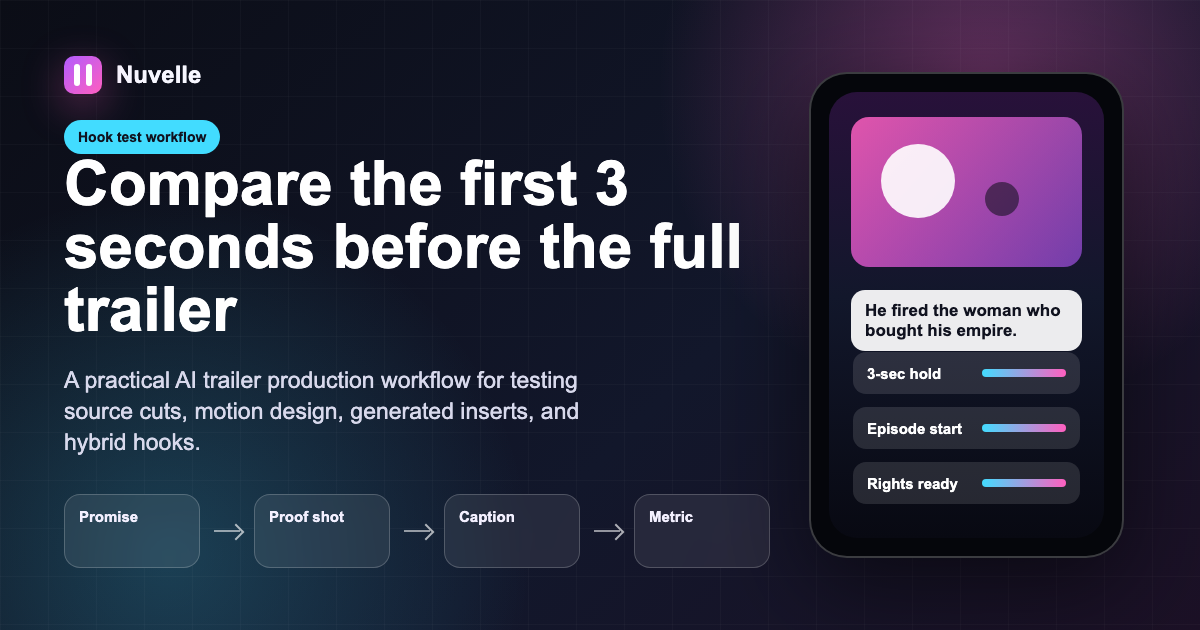
AI trailer production: comparison and alternatives gets practical when the team stops asking which tool can make the prettiest trailer and starts asking which workflow can make a viewer stay past the first three seconds.
That opening is where many AI trailer workflows fail. A generated shot may look expensive, but if it does not orient the viewer, prove the story promise, or create a clear open loop, the rest of the trailer has to recover from a weak start. For vertical drama, mobile app, creator, and product campaigns, the first three seconds are not decoration. They are the testable unit that decides whether the trailer earns enough attention for the full edit to matter.
This guide compares AI trailer production alternatives through one narrow operating question: how should you build and test the hook? Use it when you already understand the broad options but need a repeatable way to choose between a source-footage re-cut, an AI storyboard, reference-driven generation, motion design, a pickup shot, a freelancer, an agency, or an in-house hybrid workflow.
That narrower frame keeps AI trailer production: comparison and alternatives useful for teams that already know the tool landscape but need a decision system for campaign performance.
The Short Answer
For most trailer teams, the best first-three-seconds workflow is not a full AI trailer generator. It is a hook cell: one opening promise, one proof shot, one caption/title layer, one sound cue, and one measurable next action. Build three to five hook cells before finishing the master trailer.
| Hook problem | Best first alternative | Why it usually wins |
|---|---|---|
| You have strong finished footage | Source-footage re-cut | Fastest path to story truth and recognizable characters |
| The opening idea is unclear | AI storyboard or animatic | Tests structure before polishing the wrong moment |
| You have key art but no movement | Motion-design hook | Keeps approved visuals stable while adding pace |
| One proof shot is missing | Live-action micro-shoot | Captures the exact reaction, object, or reveal viewers need to trust |
| The world needs scale | Reference-driven generative video | Adds visual range when references and shot specs are tight |
| You need many localized openings | Hybrid versioning workflow | Separates stable proof from language, caption, and title variants |
| Your team lacks an operator | Freelancer or agency | Adds accountable execution if the hook brief is specific |
The rule: compare AI trailer production: comparison and alternatives by hook approval speed, not by render speed. A method wins when it can make a clear opening, survive revision, document asset rights, and teach the next trailer what worked.
Why the First 3 Seconds Change AI Trailer Production: Comparison and Alternatives
A full trailer comparison can hide weak openings. A beautiful 30-second cut may still start too slowly, make the wrong promise, or bury the emotional proof after the viewer has already swiped away.
The first three seconds expose the real production tradeoff:
- Source footage protects story truth but may lack a clean cold-open image.
- AI storyboards reveal whether the promise is legible before the team spends credits or vendor time.
- Generative shots can create scale, but they may introduce continuity or rights questions.
- Motion design is controllable, but it can feel thin if it never proves a character, product, or conflict.
- Pickups can solve one decisive missing moment, but only if the shot list stays narrow.
- Freelancers and agencies can accelerate execution, but only after the internal team defines what the hook must prove.
For Nuvelle-style vertical drama, the hook must sell the next tap: humiliation, betrayal, hidden identity, forbidden attraction, revenge, power reversal, or an unanswered choice. Nuvelle is an AI-native vertical drama platform, not an AI tool vendor, so the production standard is story-first. AI is useful when it helps the audience understand why the next episode matters.
Build the Hook Cell Before the Trailer
Use this one-cell template before choosing any AI trailer production alternative:
Hook cell:
Viewer:
Next action:
Promise:
Mandatory proof:
Open loop:
First image:
First caption:
Sound cue:
Source asset:
Production method:
Rights evidence:
Fallback if it fails:
Metric to watch:
The hook cell is intentionally small. It prevents the team from turning every comparison into a full trailer build. If the first image, first caption, and first sound cue do not make the promise obvious, the production method is not ready for finishing.
This is the operating difference between a demo and AI trailer production: comparison and alternatives. A demo asks whether the output looks possible; a hook cell asks whether the opening can earn action.
For a vertical romance drama, a usable hook cell might look like this:
Viewer: Romance-drama viewer scrolling at night
Next action: Watch episode 1
Promise: She was humiliated before the wedding, but she owns the company
Mandatory proof: The public insult and the private reveal
Open loop: Does he realize who she is before he destroys his own future?
First image: Close-up of her removing the fake employee badge
First caption: "He fired the woman who bought his empire."
Sound cue: Sharp stop, then low pulse
Source asset: Episode 1 office confrontation, approved still, logo lockup
Production method: Source re-cut plus motion title
Rights evidence: Episode footage, music license, font license
Fallback if it fails: Start on the public insult instead of the identity reveal
Metric to watch: 3-second hold and first episode start
That is a stronger starting point than asking a tool to “make a cinematic trailer.” It defines the viewer reaction before the production route.
AI Trailer Production: Comparison and Alternatives for Hook Cells
Use the matrix below to compare methods at the hook level.
| Alternative | Best hook use | Weakest point | Approval question |
|---|---|---|---|
| Source-footage re-cut | Real performance, real conflict, real product behavior | Cannot show what was never captured | Does the first shot truthfully match the watchable story or usable product? |
| AI storyboard or animatic | Testing several openings before finishing | Not usually final polish | Does the viewer understand the promise without extra explanation? |
| Motion-design hook | Posters, key art, screenshots, title cards, countdowns | Can lack emotional proof | Is the movement adding clarity or only energy? |
| Reference-driven generative video | Missing scale, impossible moment, transformation, setting | Continuity and rights review | Can this shot stay short, controlled, and non-misleading? |
| Live-action micro-shoot | One missing reaction, object close-up, interaction, proof beat | Scheduling and permissions | Is the pickup replacing only a locked editorial gap? |
| Synthetic presenter or voice-led open | Product, explainer, recap, or localization-heavy trailer | Can feel generic for drama | Does it orient the viewer faster than a story image would? |
| Freelancer | One accountable maker for a bounded hook test | Personal capacity and handoff | Can the maker return editable files, notes, and evidence? |
| Agency | High-stakes launch with many approvals or versions | Overbuilt for simple tests | Does coordination risk justify the cost? |
| In-house hybrid | Recurring trailer demand and learning loops | Fixed process before proof | Will this hook data improve future campaigns? |
The best method is often a hybrid. Protect story-critical proof with source footage or a pickup. Use AI generation only for named gaps. Use motion design for captions, title cards, and speed. Use an editor, freelancer, or agency to make the hook feel inevitable rather than assembled.
The 5-Hook Bake-Off
Instead of comparing full trailers, run a five-hook bake-off. Each hook is a separate, three-second asset with the same destination and the same measurement window.
| Hook type | Use when | Production route |
|---|---|---|
| Conflict hook | The story has a public insult, betrayal, threat, or impossible choice | Source footage or pickup |
| Reveal hook | The strongest moment is hidden identity, secret power, or before-and-after proof | Source footage plus motion title |
| Question hook | The asset needs a clear mystery without showing the answer | Storyboard, motion design, or re-cut |
| Scale hook | The story or product needs a larger world than the source footage shows | Reference-driven generative insert |
| Localization hook | The same story must work across languages or markets | Hybrid versioning with stable proof and flexible text/audio |
Bake-Off Brief
Campaign:
Audience:
Destination:
Approved source assets:
Non-negotiable story or product truth:
Forbidden claims or visuals:
Required aspect ratio:
Required caption style:
Languages:
Music and sound rules:
Rights restrictions:
Review owner:
Decision deadline:
Ask each method or vendor to return:
- Three hook cells, each under five seconds.
- One note explaining the promise, proof, and open loop for each hook.
- One rights/provenance note for source footage, references, generated output, music, voice, and fonts.
- One editable handoff or project-file description.
- One recovery idea if the winning hook fails after launch.
Do not let one vendor test a polished 30-second trailer while another tests only a rough storyboard. The comparison must use the same acceptance standard.
That common standard is what makes AI trailer production: comparison and alternatives measurable instead of taste-driven.
Score the Hook, Not the Render
Score every hook from 1 to 5. Multiply by the weight.
| Criterion | Weight | What a 5 means |
|---|---|---|
| Immediate clarity | 5 | The viewer knows who or what the trailer is about within one second |
| Story or product truth | 5 | The hook accurately promises what the audience can watch, use, or buy |
| Emotional pressure | 4 | The first moment creates urgency, curiosity, status reversal, danger, desire, or consequence |
| Visual continuity | 4 | Faces, products, locations, and style do not drift in a distracting way |
| Caption readability | 3 | Text is readable on mobile without hiding the proof |
| Sound cue fit | 3 | Audio sharpens the beat instead of masking confusion |
| Revision isolation | 4 | One note can be fixed without rebuilding the entire trailer |
| Rights readiness | 5 | Source footage, likeness, voice, music, fonts, references, and outputs are documentable |
| Localization flexibility | 3 | Text, voice, and pacing can adapt without breaking the visual proof |
| Learning value | 4 | The result teaches a repeatable insight for the next trailer |
Hook score = sum(rating x weight) / 200
Stop signal = any score of 1 on story truth, rights readiness, or immediate clarity
This scorecard makes AI trailer production: comparison and alternatives less subjective. A generated opening might score high on scale but low on story truth. A re-cut might score high on proof but low on readability. A motion-design hook might score high on revision control but low on emotional pressure. The score tells you what to fix before you scale the trailer.
In practice, AI trailer production: comparison and alternatives should produce a ranked shortlist, a repair plan, and a rights note before the team invests in the master cut.
Match the Alternative to the Hook Failure
The fastest fix depends on why the hook failed.
| Failure | Likely cause | Better alternative |
|---|---|---|
| Viewers do not know what is happening | The hook starts with atmosphere instead of proof | Storyboard the promise, then re-cut |
| Viewers understand but do not care | The opening lacks pressure or consequence | Conflict hook or reveal hook |
| The shot looks impressive but misleading | Generation invented story details | Source-footage proof or tighter references |
| The character looks inconsistent | Generated sequence carries too much continuity | Shorter generated insert, source footage, or pickup |
| The caption is doing all the work | Visual proof is weak | Replace the first image before rewriting copy |
| The hook works in English but fails in Spanish or Portuguese | Text timing, cultural cue, or voice emphasis does not transfer | Hybrid localization hook |
| Stakeholders keep requesting opposite changes | Acceptance standard is vague | Return to the hook cell and define mandatory proof |
Use this diagnosis before you buy a new tool or change vendors. Many weak AI trailer hooks are not tool failures. They are brief failures.
That is why AI trailer production: comparison and alternatives works best when every alternative is judged against the same hook failure, not against a vendor reel.
Where Current AI Video Tools Fit
Tool pages change, so use official positioning as a starting point rather than a ranking.
LTX Studio positions itself as an all-in-one creative studio for AI video production and lists workflows such as text-to-video, image-to-video, script-to-video, video-to-video, and AI storyboarding. That makes it relevant when the hook problem involves planning, controlled shot building, or turning a script into visual structure.
Runway describes Gen-4 around consistent characters, locations, objects, and world consistency from references. That is relevant when the hook needs a generated insert that must still preserve a subject, setting, or style across shots.
Adobe Firefly's AI video generator page highlights text-to-video and image-to-video generation for B-roll, cinematic scenes, and product videos. That makes it a candidate for teams already working inside Adobe-style creative review and finishing workflows.
Google DeepMind describes Veo as a video generation model for cinematic video, with newer Veo messaging including video with audio. That matters when the production team is testing cinematic generation capabilities, though an approved trailer still needs editing, rights review, and delivery QA.
CapCut's AI video generator page emphasizes ready-to-use social creation with avatars, templates, text-to-video, automated storyboarding, and editing-oriented features. That is useful when the hook problem is fast social packaging, captions, templates, or creator-style versioning.
The production lesson is simple: do not ask “Which AI trailer maker is best?” Ask which part of the hook each tool or production route can own: structure, first image, visual proof, title layer, sound, captions, localization, export, or learning.
For this use case, AI trailer production: comparison and alternatives is less about ranking tools and more about assigning ownership across the hook system.
Rights and Provenance Belong in the Hook Test
Rights review should not wait until the master trailer is finished. If the winning hook becomes the paid-social asset, it must be documentable.
Keep a hook-level rights manifest:
- source footage and stills
- talent likeness and voice permissions
- music, sound effects, fonts, templates, and stock
- prompts, reference images, generated outputs, and edit notes
- caption, dubbing, and localization files
- export versions and platform placements
- approval owner and approval date
The U.S. Copyright Office maintains AI guidance and reports focused on copyright and artificial intelligence. Content Credentials and the C2PA ecosystem focus on media provenance and edit-history transparency. A trailer team does not need to turn each hook test into a legal memo, but it does need evidence before a winning hook gets scaled.
Use this rule:
If the team cannot document where the first image, voice, music cue, font,
or generated reference came from, do not make that hook the paid-media winner.
A 48-Hour Hook Testing Workflow
Use this workflow when a campaign needs a trailer soon but the opening is not yet proven.
Hour 0-2: Lock the Promise
Write one sentence:
The trailer is approved when it makes [viewer] want to [next action]
because it shows [mandatory proof] and leaves [open loop].
For a short drama, the next action might be “watch episode 1.” For a product, it might be “start trial.” For an app, it might be “install and open.” Do not approve a hook that optimizes curiosity while misleading the destination.
Hour 2-6: Inventory the Assets
Separate assets into four groups:
| Asset group | Examples | Hook use |
|---|---|---|
| Protected proof | finished scenes, product behavior, real reaction, approved reveal | Must stay truthful |
| Flexible packaging | captions, title cards, voiceover, overlays, logo, CTA | Can be versioned |
| Possible gaps | missing reaction, missing wide shot, missing transformation, unclear action | Candidate for generation or pickup |
| Restricted material | unlicensed music, unclear likeness, unofficial references, claims not approved | Exclude or document before use |
Hour 6-16: Build Five Hook Cells
Create five openings, not five full trailers. Keep each one narrow enough to revise quickly.
At least two should use protected proof. At least one can test motion design. At least one can test a generated insert if the source assets need scale. At least one should test a localization-friendly opening where the text layer can change without rebuilding the image.
Hour 16-24: Review for Truth Before Style
Before judging polish, ask:
- Does the first image match the actual story, product, or episode?
- Would a viewer understand the promise with sound off?
- Does the caption reveal too much, too little, or the wrong thing?
- Can this hook be revised without rebuilding the full trailer?
- Can the rights evidence travel with the asset?
Reject hooks that look exciting but make a promise the destination cannot keep.
Hour 24-36: Finish the Shortlist
Polish only the top two or three. Add sound, captions, color, crop, logo, CTA, and export settings. Keep the internal names stable:
campaign_hook_A_conflict_sourcecut_9x16_en_v01
campaign_hook_B_reveal_motion_9x16_en_v01
campaign_hook_C_scale_generated_9x16_en_v01
Stable names make performance analysis possible after launch.
Hour 36-48: Launch, Measure, and Decide
Use one destination and one audience segment. Track enough to make a decision:
| Metric | What it tells you |
|---|---|
| 3-second hold | Did the opening stop the swipe? |
| 25% view | Did the promise sustain attention? |
| Click or episode start | Did the hook create enough intent? |
| Install or trial start | Did the trailer match the destination promise? |
| Paid unlock or conversion | Did the hook attract the right viewer, not only any viewer? |
If one hook wins attention but loses downstream action, treat it as a mismatch. The best trailer hook is not always the one with the highest hold rate. It is the one that brings the right viewer into the right next action.
How to Choose the Final Production Route
After the hook bake-off, choose the production route by what needs to repeat.
| If the winning hook came from... | Scale by... |
|---|---|
| Source footage | Building a reusable scene-select and caption workflow |
| Motion design | Creating layered templates and title systems |
| Generated insert | Tightening reference packs, rights logs, and continuity QA |
| Micro-shoot | Turning pickups into locked shot lists, not open-ended shoots |
| Freelancer | Standardizing briefs, handoffs, and backup capacity |
| Agency | Keeping approvals and versioning inside the statement of work |
| In-house hybrid | Connecting hook names to campaign performance every week |
This is where AI trailer production: comparison and alternatives becomes an operating system. The hook test tells you which method earns attention. The final route tells you which method can repeat without losing story truth, rights readiness, or delivery speed.
Once the winning hook is named, AI trailer production: comparison and alternatives should move from debate to operating cadence: document the method, save the evidence, and feed the result into the next campaign.
For adjacent decisions, use Nuvelle's AI trailer production comparison scorecard, the AI trailer production alternatives decision guide, the software vs freelancer vs agency vs in-house comparison, and the procurement checklist for AI trailer production.
FAQ
Should we test AI-generated hooks before source-footage hooks?
Only if the campaign lacks usable source footage or the hook requires a visual world that does not exist. If approved footage already proves the story or product, start there. AI generation is strongest when it solves a named gap, not when it replaces truthful proof by default.
How many hook variants should a small team make?
Three is enough for a small campaign: one conflict hook, one reveal hook, and one question hook. A larger paid campaign can test five or more, but the team should still keep the destination and audience constant during the first read.
Can a one-click AI trailer maker produce the whole hook?
Sometimes it can produce useful raw material. It still needs human selection, captioning, sound, rights review, export QA, and performance naming. Treat the output as a candidate hook cell, not an automatically approved trailer.
What is the biggest mistake in AI trailer hook testing?
Testing visual novelty instead of promise quality. A hook can be cinematic and still fail because it does not explain the protagonist, conflict, proof, or open loop. The viewer does not reward production method. The viewer rewards clarity under pressure.
How should multilingual trailer hooks be compared?
Keep the proof image stable and vary the language layer, voice, caption pacing, and cultural cue. If a hook only works because of an English pun or caption rhythm, it may not be the right master for Spanish, Portuguese, German, French, Japanese, or Chinese versions.
Final Decision Rule
Use AI trailer production: comparison and alternatives as a hook-testing process before it becomes a vendor or software decision.
Choose the alternative that can answer four questions:
- Does the first image truthfully prove the story, product, or offer?
- Can the caption and sound make the promise legible on mobile?
- Can the team revise, localize, and document the hook without rebuilding from scratch?
- Does the hook drive the right next action, not only a longer view?
When the answer is yes, the production route is doing its job. The method may be AI, source footage, motion design, a pickup, a freelancer, an agency, or a hybrid system. What matters is that the first three seconds earn attention without breaking the promise the rest of the trailer has to keep.