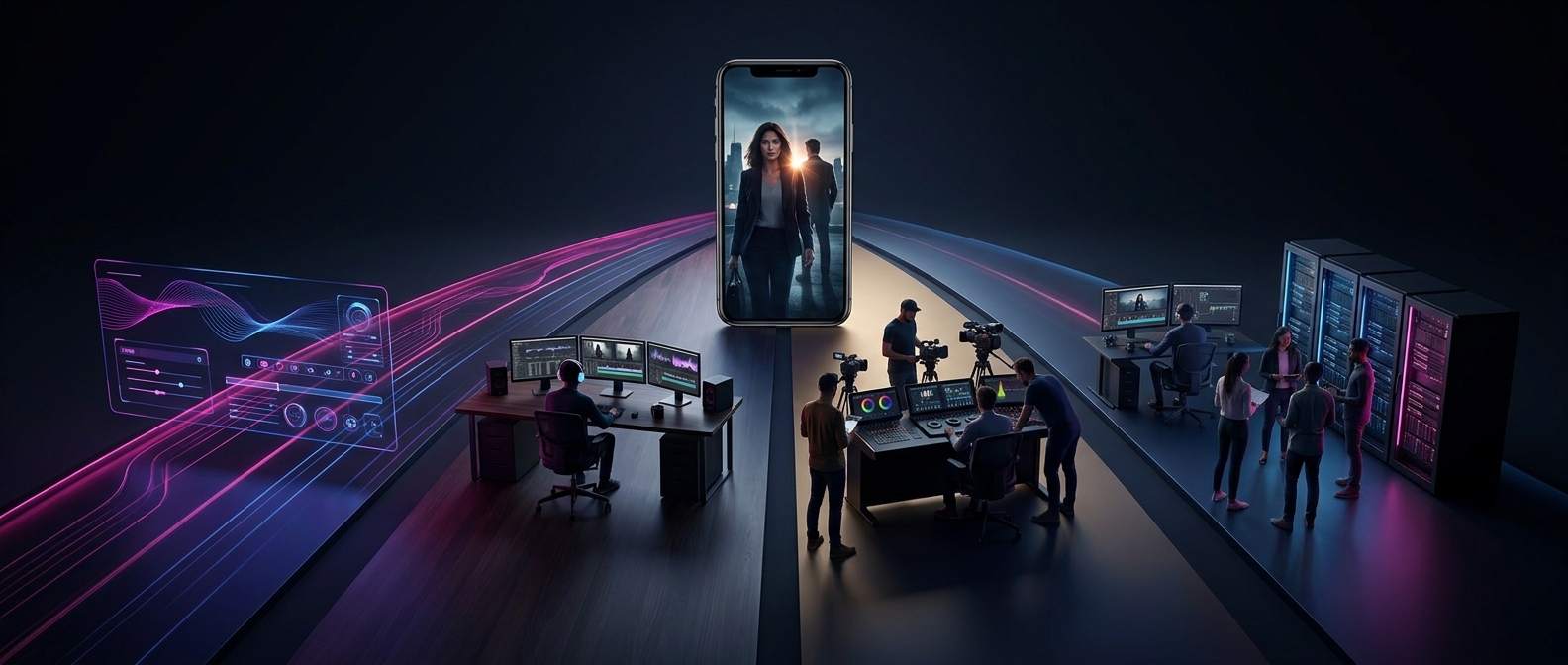
AI trailer production has four practical buying models: use software yourself, hire a freelance editor, engage a production agency, or build an in-house hybrid workflow. Each can produce a strong trailer. Each can also become expensive when the brief is vague, source material is weak, or the team measures generation speed instead of approval speed.
The best choice is not the option with the most impressive demo. It is the option that can protect the story promise, survive revisions, clear rights review, and deliver every required version without turning one trailer into an open-ended production experiment.
This comparison explains when each model works, what it leaves to your team, which hidden costs to include, and how to run a paid pilot before committing a campaign.
The Short Answer
| Production model | Best when | Your team must own | Main risk |
|---|---|---|---|
| AI trailer software | You have an operator, a clear brief, and time to test | Creative direction, selection, editing, sound, rights, and QA | Buying a tool without budgeting for finishing |
| Freelance editor | You have usable footage or assets and need one accountable maker | Brief, asset access, approvals, and specialist support | One person becomes the bottleneck |
| Production agency | The campaign is high-stakes, multi-format, or deadline-sensitive | Executive decisions, access, and approval speed | Paying for coordination you do not need |
| In-house hybrid | Trailer production is recurring and learning compounds | Team capability, workflow design, vendor bench, and governance | Building fixed overhead before volume justifies it |
For a one-off test with strong source footage, a freelance editor is often the cleanest starting point. For a concept-stage teaser, software plus a capable editor can test the story quickly. For a launch with many stakeholders, formats, languages, or rights dependencies, an agency may reduce delivery risk. For a short-drama team producing new hooks every week, an in-house hybrid system can turn trailer learning into a repeatable advantage.
First Decide What You Are Actually Buying
“AI trailer” can describe several different deliverables:
- A concept animatic used to test a pitch or campaign direction
- A social teaser assembled from existing footage
- A generated cinematic trailer built from a script and references
- A performance-led trailer with actors, dialogue, and controlled pickups
- A localized trailer package with several languages, ratios, runtimes, and captions
- A set of hook variants for paid acquisition
These are not interchangeable. A rough animatic can prove structure without being suitable for public release. A beautiful generated shot can improve scale without carrying the full narrative. A source-footage cut can preserve story truth but still need new titles, sound, or a missing reaction.
Before choosing a supplier, define the acceptance standard:
The trailer is approved when it communicates [audience promise], includes [mandatory proof], passes [rights and brand checks], and is delivered in [versions, languages, ratios, and runtimes].
If that sentence is incomplete, vendor comparison will be unreliable.
Option 1: Use AI Trailer Software Yourself
Software is attractive because it appears to compress production into a subscription and a prompt. In practice, products cover different parts of the workflow.
LTX Studio is positioned around story development, storyboards, scenes, characters, and timeline-based creation. Runway focuses on generative media creation and control. Adobe Firefly connects generative video with a broader creative workflow. CapCut combines AI-assisted creation with social editing, captions, templates, and delivery tools.
That range matters because “software” may mean a planning workspace, a shot generator, an editor, or a multi-model suite. Most trailer projects still need someone to make five human decisions:
- Which story promise will drive the click?
- Which shots are usable rather than merely attractive?
- Which continuity errors can the audience notice?
- Where should music, silence, dialogue, and impact land?
- What must be changed for each channel and language?
Choose software when
- Your team already has an editor, producer, or creative operator.
- The project can tolerate experimentation and discarded outputs.
- You need rapid concept, storyboard, hook, or shot exploration.
- The source assets and references are organized.
- The team can review usage terms, permissions, and final outputs.
Avoid software-only production when
- Nobody owns the edit after generation.
- The trailer depends on stable faces, chemistry, or complex interactions.
- The deadline leaves no recovery time for failed shots.
- Stakeholders expect unlimited changes without changing scope.
- The organization has no process for documenting footage, likeness, voice, music, font, and output rights.
Hidden cost to include
Do not compare only the subscription or credit price. Include operator time, prompt and reference preparation, generation retries, editorial selection, cleanup, compositing, audio, captions, localization, exports, and review.
For a broader method-level comparison, use the AI trailer production comparison scorecard. It scores seven workflows by story truth, continuity, revision control, delivery fit, rights readiness, and finishing burden.
Option 2: Hire a Freelance Trailer Editor
A freelancer gives the project one accountable maker without the overhead of a full agency. This model works especially well when the team already has footage, artwork, a script, or a rough cut and needs someone to shape it into a persuasive sequence.
The critical distinction is between a general video editor and a trailer editor. Trailer work requires compression: introducing a character, conflict, reversal, and open loop in seconds. For vertical drama, the editor must also understand mobile framing, readable captions, face scale, fast orientation, and the emotional cut point that drives the next episode.
Choose a freelancer when
- The scope can be described as one primary trailer plus a bounded version set.
- A producer can answer questions and consolidate feedback.
- Source material is available and reasonably organized.
- The project benefits from direct collaboration with one maker.
- Specialist tasks such as sound, motion design, or generation can be added only when needed.
Ask these questions before hiring
- Can you show a trailer where the final result used the same kind of source material we have?
- Which parts will you create personally, and which parts require another specialist?
- How do you handle generated footage, synthetic voice, music, fonts, and stock licensing?
- What is included in the first cut and the revision rounds?
- How do you price additional runtimes, aspect ratios, languages, and hook variants?
- What happens when a mandatory shot fails or the source footage cannot support the brief?
- Which project files, prompts, timelines, and editable assets are handed over?
Hidden cost to include
A low editing quote can become expensive if your team must find clips, rebuild missing references, write the trailer from scratch, manage several specialists, or translate unstructured feedback. Budget producer time as well as editor time.
The main operational risk is concentration. If one person owns the story, edit, sound, generation, and exports, illness or overload can stop delivery. A clear handoff package and backup specialist reduce that risk.
Option 3: Hire a Trailer Production Agency
An agency sells more than editing. It usually sells coordinated capacity: creative development, producing, editing, motion design, sound, generation, localization, versioning, project management, and delivery.
That coordination becomes valuable when the trailer touches many systems at once. A global launch may require brand, legal, product, distribution, localization, talent, and media teams to approve different elements. A small internal team can spend more time managing those dependencies than making the trailer.
Choose an agency when
- The launch date is fixed and missing it is costly.
- Several stakeholders or markets must approve the work.
- The campaign needs a master trailer plus many cutdowns and localizations.
- The source material is incomplete and may require pickups, design, generation, or reconstruction.
- The team needs production management, not only creative execution.
Ask these questions before signing
- Who is the day-to-day creative lead, editor, producer, and final decision-maker?
- Which work is performed in-house and which is subcontracted?
- Is the estimate based on a locked source package or an assumption that assets are ready?
- What are the explicit approval milestones?
- Which revisions change the fee or schedule?
- How are AI-generated materials, voice, likeness, music, stock, and project files documented?
- What recovery plan applies if the hero concept fails?
- Does the final handoff include editable masters and a reusable versioning system?
Hidden cost to include
Agency cost rises when feedback is fragmented. Five stakeholders sending separate notes can create contradictory work even when the agency is efficient. Assign one internal approver, consolidate feedback, and define which comments are mandatory.
The other risk is overbuying. A coordinated agency team is valuable for complexity. It can be unnecessary for a single source-footage re-cut with one reviewer and two exports.
Option 4: Build an In-House Hybrid Workflow
An in-house hybrid model does not mean hiring every specialist. It means keeping the reusable operating system inside the company while using software, freelancers, and agencies selectively.
The internal system usually includes:
- Trailer briefs and beat-sheet templates
- Approved asset manifests and rights records
- Character, product, and visual-reference packs
- Editing, caption, and delivery presets
- A prompt and shot-test library
- A named freelance and agency bench
- Review gates and approval owners
- Performance notes connected to creative versions
This model is strongest when production repeats. A short-drama publisher may test several openings, emotional beats, languages, and aspect ratios every week. The value is not merely lower cost per trailer. It is the ability to remember which promises, shots, captions, runtimes, and cliffhangers perform.
Choose an in-house hybrid when
- Trailer demand is recurring rather than occasional.
- The team needs to connect creative variants to campaign results.
- Source assets, characters, and brand rules recur across releases.
- Fast iteration matters after launch.
- Leadership is willing to fund process ownership, not only tools.
Avoid building too early when
- Trailer volume is still uncertain.
- There is no internal producer or creative owner.
- Every project uses different rights, formats, and audiences.
- The team is buying software before proving a repeatable brief.
Hidden cost to include
Fixed capability is not free. Include hiring, training, workflow maintenance, storage, subscriptions, quality assurance, and management. The model becomes attractive when learning and reusable assets compound across enough releases.
AI Trailer Production Comparison Matrix
Score each model from 1 to 5 for your project. Multiply by the weight.
| Criterion | Weight | Software | Freelancer | Agency | In-house hybrid |
|---|---|---|---|---|---|
| Speed to first rough cut | 3 | ||||
| Story and brand control | 5 | ||||
| Character or product continuity | 5 | ||||
| Revision isolation | 4 | ||||
| Multi-format delivery | 3 | ||||
| Localization capacity | 3 | ||||
| Rights documentation | 5 | ||||
| Recovery from failed shots | 4 | ||||
| Internal management burden | 4 | ||||
| Reusable learning | 4 |
Do not choose from the total alone. Mark three rows as non-negotiable. For example, a short-drama launch may require character continuity, speed to variants, and reusable learning. A brand campaign may prioritize rights documentation, product truth, and delivery completeness.
Compare Total Approved-Deliverable Cost
Use the same equation for every bid and build option:
Total approved-deliverable cost =
software and generation
+ creative strategy and script
+ asset preparation
+ editing and motion design
+ cleanup and compositing
+ music, voice, and sound
+ rights and compliance review
+ captions and localization
+ feedback and project management
+ exports, QA, and delivery
+ recovery reserve
Then estimate three cases:
| Case | Assumption |
|---|---|
| Best | The concept works, source assets are clean, and feedback is light |
| Expected | Normal shot failures, two consolidated review rounds, and a full delivery set |
| Recovery | The hero concept fails, a rights issue appears, or a mandatory shot must be replaced |
The recovery case reveals the real difference between models. Software may be cheap to retry but expensive in operator time. A freelancer may be efficient until specialist work is required. An agency may cost more initially but absorb coordination. An in-house team may recover fastest when it owns the assets, project files, and learning history.
Use a Paid Pilot Instead of a Demo
A demo answers, “Can this supplier make something impressive?” A paid pilot answers, “Can this production model deliver our work?”
Give each serious candidate the same test:
- One source pack: script, footage, character references, brand rules, rights notes, and delivery requirements.
- One 20–30 second brief: the same audience promise and mandatory beats.
- One difficult shot: the face, interaction, product behavior, location, or transformation most likely to fail.
- One mandatory revision: replace a specific beat without rebuilding unrelated work.
- One delivery matrix: at least two ratios or runtimes, plus captions if required.
- One handoff requirement: editable timeline, source manifest, and usage documentation.
Measure:
- Hours to the first structurally usable cut
- Percentage of shots that survive into the approved version
- Number of continuity and story-truth failures
- Time required for the mandatory revision
- Internal management hours
- Completeness of rights and source documentation
- Percentage of required versions that pass QA
For non-one-click paths you can test, see six AI trailer production alternatives. The guide covers source-footage recuts, animatics, motion design, micro-shoots, presenter workflows, and hybrid production.
Copy This One-Page Trailer Production Brief
Project:
Audience:
Conversion action:

One-sentence promise:
Watch because [protagonist or product] must [urgent goal]
before [consequence], but [reversal] changes the choice.

Mandatory beats:
1.
2.
3.

Approved source assets:
Restricted or unverified assets:
Missing assets:

Required deliverables:
- Runtime(s):
- Aspect ratio(s):
- Language(s):
- Caption format(s):
- Thumbnail or poster variants:

Non-negotiable gates:
- Story or product truth:
- Character, likeness, or brand continuity:
- Rights documentation:

Review process:
- Internal owner:
- Consolidated feedback deadline:
- Included revision rounds:
- Final approver:

Handoff:
- Editable project files
- Source and rights manifest
- Fonts, music, voice, and stock records
- Prompt and generated-output records where applicable
This brief makes bids easier to compare because every option is pricing the same outcome.
Rights and AI Usage Checks
Tool access is not the same as permission. Review the current terms for every software product and supplier before production, because model availability and usage conditions can change.
Maintain a rights manifest for:
- Source footage and photography
- Actor, voice, and likeness permissions
- Music, sound effects, fonts, templates, and stock
- Brand and product assets
- Prompts, references, generated outputs, and edits
- Territory, channel, duration, and paid-media use
- Required disclosures or provenance metadata
The U.S. Copyright Office’s AI initiative explains its ongoing work on copyright and artificial intelligence. For production teams, the practical rule is to document human authorship, source permissions, and every transformation rather than assuming a generated output creates a complete rights record by itself.
If provenance matters to the campaign, review Content Credentials and the underlying C2PA approach. Provenance metadata does not replace consent or licensing, but it can help record how an asset was created or changed.
Which AI Trailer Production Model Should You Choose?
Choose software when
You already have the operator, editorial judgment, and review process. Buy the missing capability, not the promise of a complete automated trailer.
Choose a freelancer when
You have a bounded deliverable, usable assets, and one internal owner. Hire for the actual bottleneck: story editing, motion design, generation, sound, or localization.
Choose an agency when
Coordination and deadline risk are more expensive than the agency premium. Use the agency to manage complexity, not to compensate for slow internal decisions.
Choose an in-house hybrid when
Trailer production repeats often enough that briefs, assets, project files, prompts, delivery presets, and performance learning can be reused.
FAQ
Is AI trailer software cheaper than hiring an editor?
The software fee may be lower, but total cost depends on operator time, failed generations, editing, sound, captions, rights review, localization, and delivery. Compare total approved-deliverable cost, not the first invoice.
Should I hire a freelancer or an AI trailer agency?
Hire a freelancer for a bounded project with organized assets and a clear internal approver. Hire an agency when the work requires several specialists, markets, stakeholders, or a fixed launch date.
What is the best alternative to an AI trailer generator?
If footage exists, start with a source-footage recut. If only a concept exists, use an animatic. If one performance beat is missing, shoot a controlled pickup. If the trailer needs several methods, use a hybrid workflow.
Can an in-house team use freelancers and agencies?
Yes. A strong in-house hybrid keeps the brief, assets, rights records, approval process, project history, and performance learning internally while bringing in specialist capacity when needed.
How should short-drama teams produce trailers?
Protect faces, chemistry, plot truth, and the core reversal with controlled source material. Use generation, motion design, synthetic voice, or pickups only to solve named gaps. Create several opening hooks, but keep the same clear reason to watch the next episode.
How do I compare AI trailer vendors fairly?
Give each candidate the same source pack, brief, difficult shot, mandatory revision, delivery matrix, and handoff requirement. Measure approval speed, usable-shot rate, continuity failures, management time, rights completeness, and delivery QA.
Final Decision Rule
Choose the production model that makes the hardest requirement routine.
If the hard part is exploring ideas, software may win. If it is shaping strong source footage, hire an editor. If it is coordinating a complex launch, use an agency. If it is producing and learning every week, build an in-house hybrid system.
The goal is not to maximize AI. The goal is to deliver an accurate, emotionally clear, rights-ready trailer that gives the audience one irresistible reason to watch what happens next.