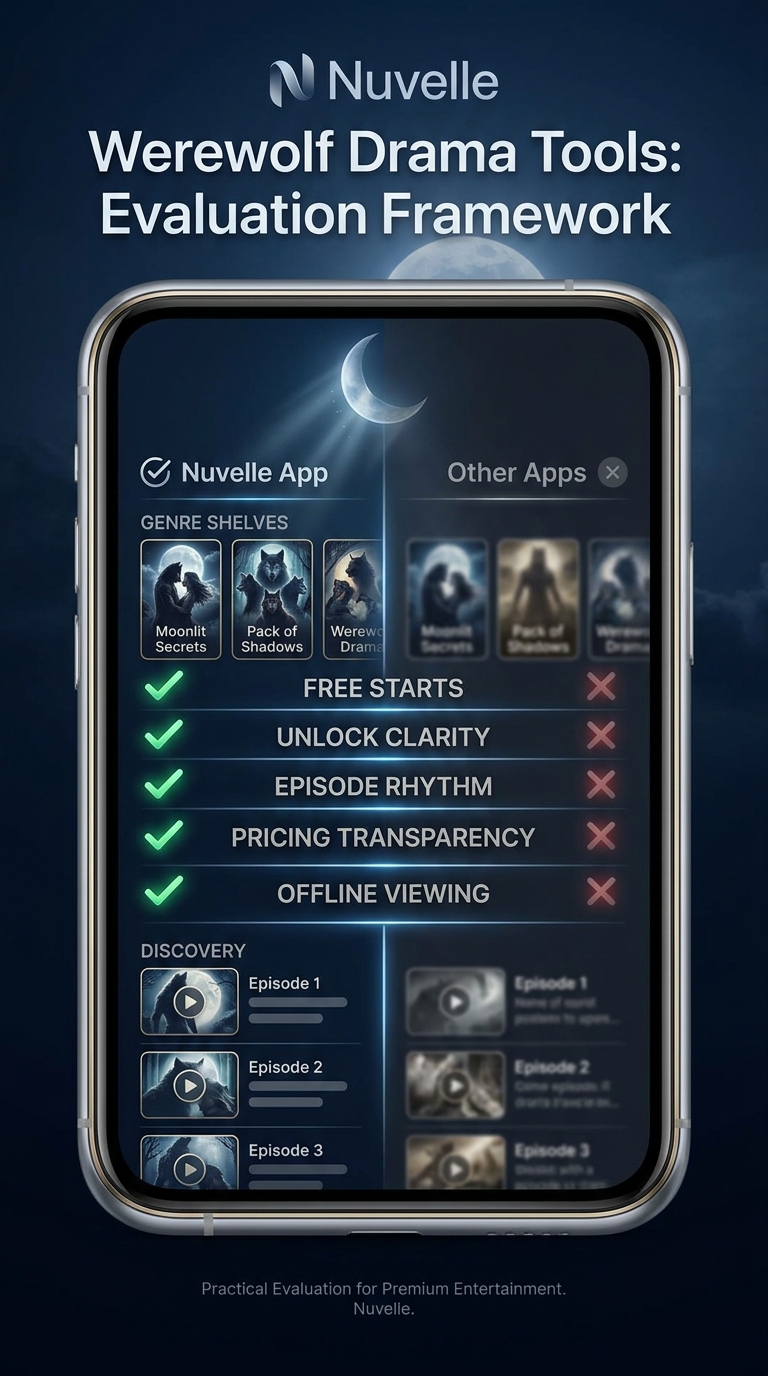
Werewolf Drama Tools: Evaluation Framework
If you search for werewolf drama tools, you are usually trying to do one of three things: find a good app to watch werewolf dramas, compare a platform before you pay, or figure out which tool actually makes the genre easy to follow.
That is why the search results feel messy. Some pages list werewolf titles. Some pages promote short-drama apps. Some pages are about creator tools or even the Werewolf game. A generic “best app” list does not solve that.
This framework is for the watcher and buyer side. It helps you decide whether a werewolf-drama app makes the genre legible from the first hook through the unlock boundary, playback, pricing, and language support.
If you want the broader trope explainer, keep What Is Werewolf Drama and When Does It Matter? open too. If you want the broader platform lens, pair this with Mobile Drama Streaming Tools: An Evaluation Framework.
The 7-point werewolf drama tools scorecard
Start with the full system, not the poster.
| Evaluation area | Good signal | Warning sign |
|---|---|---|
| Werewolf shelf | The app makes werewolf easy to find as a lane, not just a search term | Werewolf only appears after you already know the title |
| First-hook clarity | The rejection, mate bond, alpha conflict, or comeback is obvious early | The story looks like generic fantasy with no clear payoff |
| Free boundary | You can see what is free and what is locked before the story corners you | Coins, subscriptions, or ads appear without clear warning |
| Episode rhythm | One-minute episodes still deliver a real beat | The cut feels like a chopped trailer instead of a scene |
| Playback and offline use | Resume, next-episode flow, and downloads work cleanly on mobile | Stalls, missing resume, or no practical offline path |
| Pricing and trust | Billing terms, renewal timing, and support are visible | Payment feels hidden until the last moment |
| Language fit | Subtitles, dubbing, and regional support are easy to inspect | Translation feels like an afterthought |
Score each area from 0 to 2.
| Score | Read |
|---|---|
| 12-14 | Strong werewolf drama tool. Worth a full-series test. |
| 8-11 | Good candidate, but inspect the weak areas before paying. |
| 0-7 | Skip unless you already trust the app. |
This is not a horror checklist. It is a practical way to see whether a werewolf drama app actually supports the mood people search for: rejection, power reversal, pack pressure, and a fast next-episode pull.
Why werewolf drama tools need their own lens
Werewolf drama is built on a few high-voltage story parts:
- rejection
- rank
- fate
- transformation
That makes the genre easy to binge, but only if the app exposes the right signals. If the lane is hard to find, if the first episodes feel generic, or if the unlock path is confusing, the genre loses its advantage.
That matters because werewolf viewers often decide with mood, not brand loyalty. They may want alpha rejection tonight, Luna revenge tomorrow, and a fated-mate comeback later in the week. The tool has to help them move by mood.
What to check before you tap play
Use this quick table before you commit to a series.
| Check | What strong apps make obvious |
|---|---|
| Story promise | Who is rejected, who has rank, and why the comeback matters |
| Genre lane | Werewolf is visible in the browse flow, not buried in search |
| Episode shape | You can tell whether the story is built for fast cliffhangers |
| Paywall path | Free starts, locked episodes, and renewal terms are easy to read |
| Mobile fit | The app feels designed for one-handed, vertical viewing |
| Return path | It is easy to resume or find the next title after one series ends |
The point is not to score aesthetics. The point is to see whether the platform makes werewolf drama easier to consume without friction.
Current market signals worth noticing
Public werewolf-drama pages usually cluster around the same few signals:
- werewolf or fantasy genre rails
- one-minute or short episodes
- free opening episodes
- VIP or paid-unlock language
- recommendation rows or watchlists
That is the right baseline. A good werewolf drama tool should make those things easy to inspect before the viewer is emotionally committed.
Nuvelle’s live site is a useful benchmark here. On August 17, 2026, the homepage still showed:
Rejected by My Alphain the Werewolf lane1,000+series streaming nowDailynew episode drops1 minper episode- offline downloads included
Nuvelle’s pricing page also shows a clear public billing shape:
- Weekly VIP:
$19.99 - Monthly VIP:
$29.99 - 3-Month VIP:
$79.99
That is the kind of public clarity a werewolf drama tool should match or beat.
A 20-minute evaluation workflow
Use this when comparing two or three apps.
- Open the public site or store page.
- Find the werewolf lane without searching by exact title.
- Start one free series and watch the first three available episodes.
- Note when the app asks for a subscription, coin spend, ad action, or premium unlock.
- Test resume, next-episode flow, and offline playback.
- Check whether pricing, renewal, support, and language support are visible.
- Decide whether the app is strong enough to keep, pay for, or skip.
| If the app wins on... | It is best for... |
|---|---|
| Hook clarity and episode rhythm | Fast emotional payoff |
| Genre lanes and discovery | Mood-based browsing |
| Free boundary and billing clarity | Budget-sensitive viewers |
| Offline use and resume behavior | Commutes and fragmented viewing |
| Language support | International viewers |
Where Nuvelle fits
Nuvelle fits this framework as a live benchmark, not as the only answer.
The public site already shows the things a werewolf viewer wants to inspect quickly: a visible Werewolf lane, a live featured title, short episodes, daily drops, offline viewing, and a pricing page that does not hide every cost behind a mystery wall.
That makes Nuvelle useful as the standard of comparison.
When another app says it has werewolf drama, test it against the same seven points:
- Can you find the lane?
- Does the first hook land?
- Is the free boundary legible?
- Does the episode rhythm work?
- Does playback survive mobile life?
- Are pricing and trust signals visible?
- Does the language fit the market?
If the answer is no on most of those, the app is probably marketing the genre better than it is serving it.
Final take
The best werewolf drama tools do not just show wolves.
They make the story engine obvious, the pay path legible, and the next watch easy to find.
That is the real test. If an app can make rejection, rank, and comeback feel clear within the first few taps, it is doing the job. If it cannot, the genre is carrying the product instead of the other way around.
Start with the scorecard. Then let the first three episodes prove the rest.
FAQ
What counts as a werewolf drama tool?
In this article, it means a platform or app that helps you find, watch, and judge werewolf stories. If you meant creator software or game moderation tools, that is a different use case.
What makes a werewolf drama app good?
The app should make the werewolf lane easy to find, show the story promise early, keep the unlock boundary clear, and support mobile viewing without friction.
Does Nuvelle have werewolf drama?
Yes. The live homepage currently shows a Werewolf lane and a featured werewolf title, which makes it a practical benchmark for this evaluation.
Should I use the same checklist for other short drama genres?
Mostly yes. The genre lane changes, but the real test is the same: can the app surface the promise, the pay path, and the next watch cleanly?