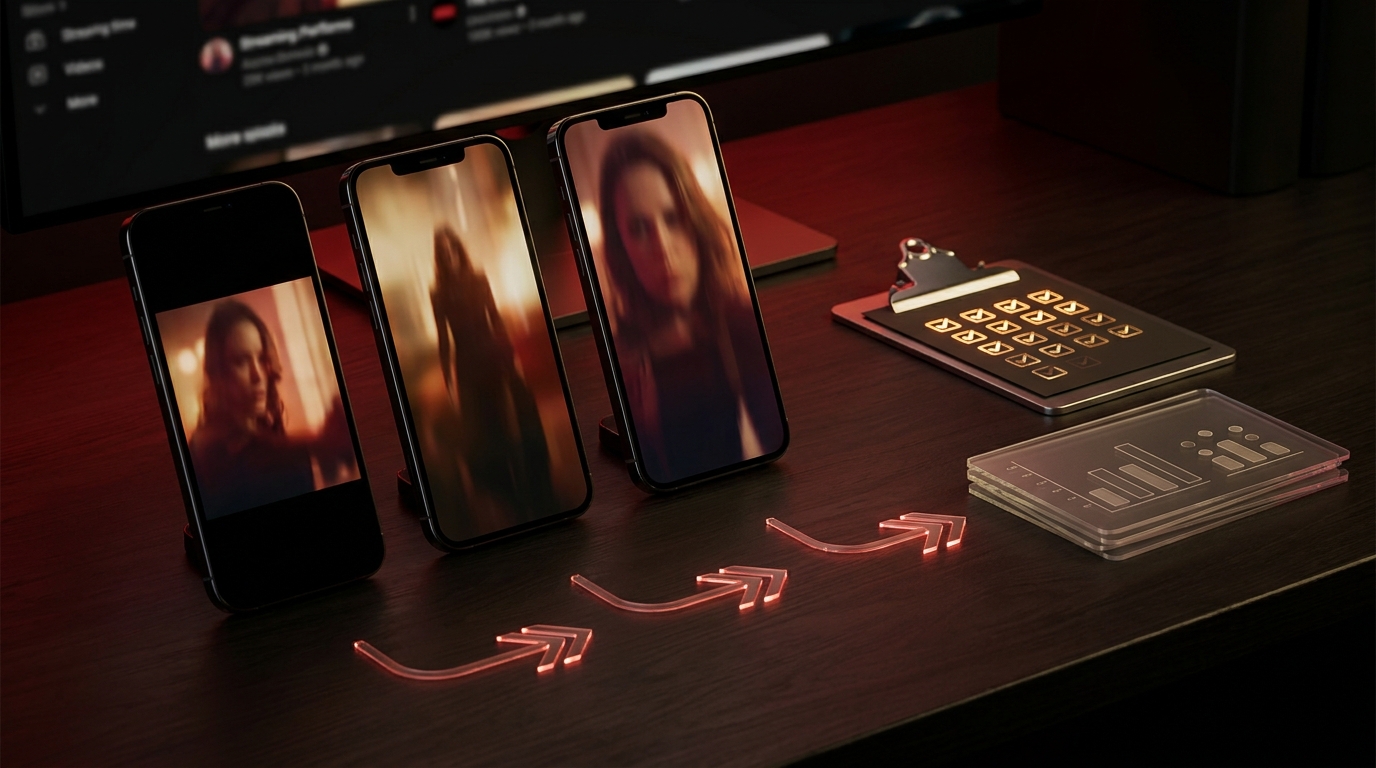
Mobile drama streaming works best when a team treats every episode as part of an operating system, not as another video file to upload.
The viewer experience looks simple: a hook, a vertical episode, a cliffhanger, another tap, and sometimes an unlock. Behind that simple flow, a team has to coordinate story packaging, app routes, free preview rules, localization, media QA, analytics, store claims, and weekly decision-making. If one part drifts, the whole funnel gets harder to diagnose.
This mobile drama streaming guide is for growth, content, product, localization, and analytics teams that need a practical way to get a short-drama title ready for launch or relaunch. It does not repeat Nuvelle's existing mobile drama streaming tools scorecard or mobile drama streaming metrics framework. Instead, it gives the team runbook: who owns what, what must be ready before launch, what to check on a phone, and how to decide what happens next.
Nuvelle is a useful reference point because the current public site positions the product around AI short dramas, mobile-first vertical series, romance/revenge/werewolf/billionaire/hidden-identity worlds, localized routes, free in-app unlock messaging, and app-based viewing. The current App Store listing for Nuvelle Drama describes authorized short-form drama series, full-screen vertical playback for short episodes, watch history, favorites, search, app-language switching, free preview episodes, Credits for individual paid episode unlocks, and VIP subscription access while active. Those are the kinds of surfaces a team has to keep aligned.
The Short Version: Mobile Drama Streaming Needs One Source of Truth
Before a team launches a mobile drama streaming title, it should have one shared launch sheet. The sheet does not need to be complex. It needs to stop five teams from answering the same question five different ways.
| Team lane | Owns | Must hand off |
|---|---|---|
| Story and content | Series promise, early episode ladder, protected beats, unlock moment | Episode route map and approved clip ranges |
| Growth | Hook variants, campaign promises, source tags, destination choice | Creative-cell matrix and traffic plan |
| Product | Watch path, paywall state, deep links, resume, favorites, language settings | App route QA and fallback routes |
| Localization | Title, synopsis, subtitles, dubbing or captions, market adaptation | Localized package and mobile QA notes |
| Analytics | Event names, IDs, dashboards, decision cuts | Launch event dictionary and weekly report view |
| Support and trust | Terms, privacy, billing explanation, store metadata, support path | Payment/support readiness checklist |
The practical rule is simple: every campaign, app route, localized title, unlock prompt, and report should refer to the same story promise and the same episode IDs.
Start With the Viewing Job
A mobile drama streaming team should not begin by asking, "Which clip is most dramatic?" The first question is, "What job does this viewing moment need to do?"
Use these jobs before assigning assets:
| Viewing job | What the episode must do | Best use |
|---|---|---|
| Awareness | Make a cold viewer understand the emotional conflict fast | Ad hook, social clip, SEO landing route, app-store screenshot theme |
| Activation | Prove the series delivers the promised trope | First episode, series page, onboarding recommendation |
| Continuation | Make the next tap feel necessary | Episode ending, next-episode prompt, push reminder |
| Unlock | Create enough demand to justify a subscription, Credits purchase, or ad unlock | First locked episode and paywall route |
| Retention | Give the viewer a reason to come back tomorrow | Daily drop, resume row, favorites, watch history |
| Expansion | Move the viewer from one series to the next | Genre row, Top 10 list, related-title recommendation |
This changes how teams choose assets. A public humiliation scene may be strong for awareness. A quieter confession may be better for activation. A hard reveal may belong at the unlock boundary. A fresh episode from a favorite genre may be a retention asset.
For a deeper stage map, use Nuvelle's guide to short drama episodes by funnel stage. This article focuses on how the team coordinates those jobs once the title is moving toward launch.
Build the Mobile Drama Streaming Launch Sheet
The launch sheet is the core artifact. It should fit on one page, but it should be specific enough that a designer, editor, media buyer, product manager, translator, and analyst can all work from it.
| Field | What to write | Why it matters |
|---|---|---|
| Series title | Final source-language title and localized title status | Prevents title drift across ads, app rows, and reports |
| Story promise | One sentence describing the wound, reversal, relationship pressure, and open loop | Keeps the hook, episode, and route aligned |
| Genre lane | Romance, revenge, hidden identity, werewolf, billionaire, second chance, family, or another clear lane | Supports discovery and recommendation placement |
| Early episode ladder | The job of episodes 1-5 | Makes the first session easier to diagnose |
| Unlock boundary | First locked episode, free preview count, available access paths | Prevents surprise paywall and measurement confusion |
| Route map | Where each traffic source lands | Keeps cold, warm, returning, and localized viewers on the right path |
| Creative cells | Hook variables and what stays fixed | Turns testing into learning |
| Localization scope | Language, market, subtitle/dub/caption status, title and synopsis status | Stops translation from being treated as the only localized layer |
| QA owner | Person responsible for phone playback, route, billing, and language checks | Avoids "everyone saw it" ambiguity |
| Decision rule | Scale, revise, pause, or localize thresholds | Makes the first weekly review concrete |
A launch sheet is especially important for mobile drama streaming tools evaluation. If a vendor, CMS, analytics stack, or workflow cannot preserve these fields, the team will struggle to learn from launch data.
Assign Roles Before the First Clip Goes Live
Short-drama teams move fast, so role clarity has to be lightweight. Use a simple RACI-style split for every mobile drama streaming launch:
| Workstream | Responsible | Accountable | Consulted | Informed |
|---|---|---|---|---|
| Story promise and episode ladder | Content lead | Show owner | Growth, localization | Product, analytics |
| Campaign hooks and source tagging | Growth lead | Acquisition owner | Content, analytics | Product |
| App route and unlock path | Product owner | App lead | Growth, support | Content, analytics |
| Localized package | Localization lead | Market owner | Content, product | Growth, support |
| Measurement setup | Analytics owner | Growth or product lead | Product, growth | Content, support |
| Launch QA | QA owner | Release owner | All workstreams | Leadership |
The point is not ceremony. The point is to make sure no one assumes someone else checked the route from hook to episode, the language version, or the unlock state.
For campaign operations around this workflow, Nuvelle's vertical drama marketing workflow gives the broader launch and handoff context.
Map the Route From Hook to Episode
In mobile drama streaming, a route is not just a URL or deep link. It is the continuation of the promise.
Map routes by source:
| Source | Best route | What to avoid |
|---|---|---|
| Paid social ad | Matching series page or exact episode path | Generic app home with no visible story match |
| Organic search article | Article CTA to relevant browse, series, or app route | A broad download prompt disconnected from the query |
| App-store listing | First-watch path that matches screenshots and description | Store claims that the first session does not support |
| Push notification | Resume or new daily-drop episode | Sending known viewers to the wrong episode |
| Email or community post | Series page with context and clear free-start path | A locked episode before context is rebuilt |
| Localized ad | Localized title, metadata, and route | Source-language page after translated creative |
The App Store listing for Nuvelle Drama makes this concrete: it describes full-screen vertical playback, watch history, favorites, search by drama title, profile language switching, free preview episodes, Credits, and VIP subscription access. A team should make sure the route from any promotion actually supports the user behavior being promised.
This is also where the public Nuvelle homepage matters. It uses genre rails and story-world signals instead of only generic streaming copy, which makes the viewer's next action easier to infer.
Set the Free Preview and Unlock Rule Early
The unlock boundary is where a mobile drama streaming workflow often becomes messy. Content, growth, product, and monetization may each have a different instinct: show more free episodes, lock earlier, push subscription, support individual unlocks, or lean on rewarded access.
Write one rule before launch:
| Boundary choice | Use when | Watch for |
|---|---|---|
| More free preview | The premise needs more trust before commitment | Weak monetization signal if viewers binge but never meet the locked question |
| Earlier lock | The hook and first episode already create strong demand | Trust risk if the viewer feels stopped before the story proves itself |
| Individual paid unlock | Demand is tied to a specific episode question | Payment friction or unclear consumption cost |
| Subscription/VIP access | The catalog and binge habit are part of the value | Plan clarity, renewal understanding, and post-unlock continuation |
| Ad-supported unlock | The viewer is price-sensitive but still wants the next answer | Ad availability, reward clarity, and completion rate |
Nuvelle's current App Store listing explicitly separates free preview episodes, consumable Credits purchased through Apple in-app purchases, and VIP subscription access while active. That separation is useful because the team can measure whether the issue is story demand, offer clarity, payment completion, or post-unlock satisfaction.
For measurement detail after the boundary is live, use the mobile drama streaming metrics playbook.
QA the Experience on a Real Phone
Desktop review is not enough for mobile drama streaming. The product is portrait-first, attention is fragmented, and small UI problems can break a short session.
Run this phone QA before launch:
| Check | Pass condition |
|---|---|
| First screen | The title, genre, and story promise are recognizable in seconds |
| Episode start | Playback begins quickly and the viewer understands where they are |
| Vertical framing | Faces, status cues, subtitles, and key objects fit the phone screen |
| Episode order | The first five episodes appear in the intended sequence |
| Resume behavior | Leaving and returning preserves the viewer's place |
| Favorites or save path | The viewer can mark a title for later if the app supports it |
| Search | The title can be found by exact title and useful variants |
| Unlock state | Free and locked episodes are visually clear before payment pressure |
| Payment path | Credits, subscription, or other access path uses accurate platform language |
| Terms and privacy | Trust links are accessible before account or purchase decisions |
| Language switch | Interface and content language states do not contradict each other |
| Localized subtitle/caption | Lines are readable and do not cover the emotional reaction |
This checklist should be run on the actual devices and OS versions that matter for the audience. The current App Store listing for Nuvelle Drama requires iOS 17.0 or later and describes iPhone full-screen vertical playback, so iPhone route checks should be part of release QA.
Localize the Package, Not Just the Lines
Localization can make or break mobile drama streaming because the format depends on fast emotional precision. The viewer has very little patience for a subtitle that arrives late, a title that sells the wrong trope, or a route that lands in the wrong language.
Localize these layers together:
| Layer | What to verify |
|---|---|
| Title | The localized title signals the same trope and power dynamic |
| Synopsis | The conflict, relationship pressure, and open loop remain clear |
| Subtitle or caption | Text is readable on a phone and does not cover the key reaction |
| Dubbing or voice, when used | Status, regret, threat, desire, and betrayal are still audible |
| Thumbnail | The image matches the localized promise |
| App route | The viewer lands in the correct language and episode context |
| Unlock copy | Payment, subscription, Credits, ads, or free access language is locally clear |
| Measurement tags | Performance can be separated by market, language, series, episode, and variant |
Nuvelle's site currently exposes language routes for English, Chinese, Japanese, German, French, Spanish, and Portuguese. The team implication is simple: a localized launch should have a localized package and localized route QA, not only translated article text or app labels.
For a deeper operating template, use Nuvelle's short drama localization first-episode kit.
Use a Launch Gate, Not a Long Meeting
A practical mobile drama streaming guide needs a launch gate that teams can actually use. Keep it short enough to run in 20 minutes.
| Gate | Question | Required evidence |
|---|---|---|
| Promise gate | Does every source promise the same story? | Final story promise, approved title, approved thumbnail direction |
| Episode gate | Do episodes 1-5 have clear jobs? | Early episode ladder and protected beats |
| Route gate | Does every source land in the right place? | Route map and phone QA pass |
| Unlock gate | Is the free preview and access path clear? | Unlock boundary note and payment/support copy |
| Localization gate | Are target languages ready for actual viewing? | Localized package and mobile subtitle/caption QA |
| Measurement gate | Can the team read the first break? | Event dictionary, IDs, dashboard cut, source tags |
| Trust gate | Are store, terms, privacy, support, and billing claims aligned? | Public-page and app-store checks |
Do not launch if the team cannot explain the route or the unlock state. Those two failures create the worst learning because the campaign may spend budget while the team cannot tell whether the content, app, localization, or payment path caused the break.
The 14-Day Mobile Drama Streaming Runbook
Use this runbook for a new series, a localized relaunch, or a major campaign refresh.
| Day | Work | Output |
|---|---|---|
| 1 | Lock story promise and genre lane | One-sentence promise and launch-sheet owner |
| 2 | Map episodes 1-5 | Episode ladder, protected beats, unlock candidate |
| 3 | Create route map | Source-to-episode routes and fallback destinations |
| 4 | Prepare creative cells | Hook variants with one variable per test |
| 5 | Freeze measurement IDs | Series, episode, variant, route, language, and source tags |
| 6 | Prepare localized package | Title, synopsis, subtitle/caption, route, thumbnail note |
| 7 | Run phone QA | Playback, resume, search, unlock, payment/support checks |
| 8 | Launch controlled traffic | Small-budget or controlled source test |
| 9 | Read first-session behavior | Starts, completion, continuation, route breaks |
| 10 | Inspect unlock behavior | Boundary reach, unlock attempts, payment/ad completion |
| 11 | Review localization cut | Completion and continuation by language and route |
| 12 | Decide first revision | Fix hook, episode, route, unlock, or localization |
| 13 | Relaunch revised cell | One major change with clean tags |
| 14 | Write decision card | Scale, revise, pause, localize, or retire |
The decision card should be blunt:
| Question | Answer |
|---|---|
| What did we promise? | The exact viewer expectation |
| Where did viewers land? | Route and language |
| What did they watch? | Episode IDs and variants |
| Where did the first break happen? | Start, completion, continuation, boundary, unlock, return |
| What are we changing next? | One material change |
| What stays fixed? | Controls for the next test |
This prevents the common failure where a team changes the hook, route, subtitle, thumbnail, and unlock copy at once, then learns very little.
What to Look For in Mobile Drama Streaming Tools
The right mobile drama streaming tools should make this workflow easier, not heavier. Whether the team is using a CMS, analytics platform, app backend, localization system, campaign manager, or internal tracker, the stack should preserve the relationship between story, episode, route, language, and result.
| Tool capability | Practical test |
|---|---|
| Stable episode IDs | Can the team trace a result to the exact series and episode? |
| Variant tracking | Can a hook, thumbnail, caption, or route test be separated cleanly? |
| Route control | Can traffic land on the right series, episode, language, or resume state? |
| Unlock-state visibility | Can free, locked, paid, subscription, Credits, and ad-supported paths be measured separately? |
| Localization versioning | Can target-market packages be compared without overwriting the source package? |
| Phone QA evidence | Can the team attach screenshots, route checks, or pass/fail notes? |
| Weekly decisions | Can reports answer scale, revise, pause, localize, or retire? |
If a tool cannot answer those questions, it may still be useful for publishing content. It is not yet enough for a serious mobile drama streaming operation.
Common Failure Modes
Most mobile drama streaming failures are not mysterious. They usually come from one of these breaks:
| Failure | What it looks like | Fix |
|---|---|---|
| Promise drift | Ad says revenge, route opens with slow backstory | Route to the promise or revise the opening |
| Episode-job confusion | Every early episode tries to explain everything | Give each episode one job |
| Hidden unlock logic | Viewers do not know what is free or paid | Make free preview and access paths visible |
| Localization flattening | Translated lines lose status, threat, or desire | Protect emotional beats, not only literal lines |
| Unclear IDs | Reports cannot separate title, episode, variant, language, and route | Freeze IDs before launch |
| Desktop-only QA | Phone subtitles, framing, or route states fail | Require mobile pass before live traffic |
| Over-editing tests | Five variables change at once | Test one primary variable per cell |
Teams do not need perfect process. They need enough structure to know what broke first.
FAQ
What is mobile drama streaming?
Mobile drama streaming is the app-based viewing of short, portrait-first drama episodes designed for fast phone sessions, cliffhangers, genre-led discovery, and repeat viewing. In short-drama apps, it often includes free preview episodes plus unlock paths such as subscriptions, individual paid unlocks, Credits, ads, or similar access models.
How is mobile drama streaming different from ordinary streaming?
Ordinary streaming usually centers longer episodes, known shows, and broad content libraries. Mobile drama streaming centers compressed emotional hooks, one- or two-minute vertical episodes, quick continuation prompts, and a much shorter path from first watch to unlock decision.
What should a team prepare before launching a mobile drama streaming title?
Prepare a story promise, early episode ladder, route map, free preview and unlock rule, creative-cell plan, localization package, mobile QA checklist, event dictionary, and weekly decision rule.
What metrics matter most after launch?
Start with qualified episode starts, episode completion, episode-to-episode continuation, unlock-boundary reach, unlock attempt, unlock completion, next-series start, and return behavior. Nuvelle's mobile drama streaming metrics article goes deeper on instrumentation.
How should teams choose mobile drama streaming tools?
Choose tools that preserve episode IDs, route IDs, language versions, creative variants, unlock states, and reporting cuts. A tool that publishes clips but loses the relationship between promise, route, episode, and result will make launch learning weaker.
Final Takeaway
A strong mobile drama streaming operation is not built by uploading more episodes. It is built by making the promise, route, episode, unlock, localization, QA, and measurement system agree.
For Nuvelle, that means every AI-crafted vertical drama should have a clear viewing job, a clean route, a fair free-start experience, a localized package when needed, and a decision-ready report. When those pieces are aligned, a team can do more than stream short dramas. It can learn which stories deserve the next round of budget, localization, and daily-drop attention.